
24/7 Customer Support

Free returns

Same-day & Next-day Delivery

Quality Guaranteed

Unlock Your Welcome Offers: FREE Delivery | Up to 80% OFF | Free 30-day JoyPlus trial
Download the APP
A portable tyre inflator can be a useful addition to a car boot, motorcycle storage box or cycling bag. It may help with gradual pressure loss, seasonal checks and roadside top-ups without searching for a petrol station with a working air machine.
However, product listings often focus on headline figures rather than practical performance. A claimed 150 PSI air compressor may not inflate a car tyre quickly, while a cordless tyre inflator can become inconvenient if its battery is flat when you need it. The right choice depends on your vehicle, expected inflation frequency and access to a 12V socket.
By Joybuy Product Recommendation Officer
Maximum pressure indicates the upper pressure the pump can theoretically reach, not how quickly it inflates a typical car tyre. Airflow, motor power, cylinder design and heat management are more relevant to everyday use.
A compact electric tyre pump may be suitable for pressure top-ups but take considerably longer when starting with a very low or empty tyre. Check whether the listing provides an inflation time, airflow figure or vehicle tyre example rather than relying only on “150 PSI”.
A cordless tyre inflator is convenient because it does not need to remain connected to the vehicle. Its limitation is battery capacity. Charging may take several hours and repeated inflation can use much of the available runtime.
A wired 12V tyre inflator can be more practical for several car tyres, provided the vehicle’s engine is running when appropriate and the cable reaches all four wheels. Some compact models include a 3-metre cable, which can reduce the need to reposition the car.
Small portable compressors are generally designed for passenger cars, motorcycles, bicycles and sports balls. They are not automatically suitable for vans, large SUVs, caravans, trailers, trucks or off-road tyres.
Always check the product’s stated compatibility, connector type and operating instructions. A pump designed for emergency top-ups should not be treated as a workshop compressor or a replacement for repairing a puncture.
Choose a digital tyre inflator that displays the units used in the UK. Many models support PSI, bar, kPa and kg/cm², allowing you to match the vehicle handbook or tyre placard.
The recommended pressure is vehicle-specific and may differ between front and rear tyres or between normal and heavily loaded driving. Set the target using the figure supplied by the vehicle manufacturer, not the maximum number printed on the pump.
An automatic shut-off feature can stop inflation at the selected value, but it is still sensible to verify the result with a separate gauge periodically. Pressure readings can vary depending on valve connection, temperature and sensor quality.
Airflow is often shown in litres per minute, such as 17 L/min, 25 L/min or 26 L/min. In general, a higher airflow can reduce inflation time, but the actual result also depends on tyre size, starting pressure and motor output.
For occasional car use, look for a stated example involving a standard passenger-car tyre. For a motorcycle tyre pump or bicycle pump, compact size and nozzle compatibility may matter more than maximum airflow.
For cordless use, check battery capacity, charging connection, estimated runtime and whether the unit can be used while charging. A USB-C port may be convenient in the car, but charging speed still depends on the power source and cable.
For wired models, confirm whether the compressor uses a 12V DC vehicle socket, the cable length and whether the engine should be running during operation. A duty-cycle warning is also important: some pumps need cooling breaks after extended use.
Useful extras include:
The following recommendations are arranged by practical user profile rather than by a single overall ranking.
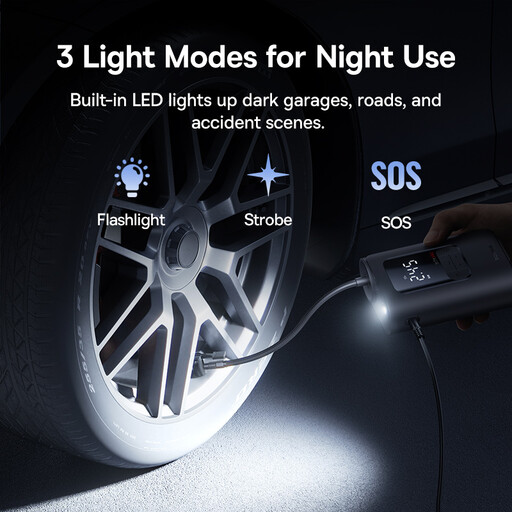
Why This Fits Their Persona: A compact wired option for drivers who want a simple compressor for occasional car, motorcycle or bicycle top-ups without managing a rechargeable battery.
Its 9–15V input and included DC power cable make the power requirement clear, avoiding vague battery-runtime claims.
100W motor power; supplied with an air hose and three air nozzles.

Why This Fits Their Persona: Suitable for drivers who value a compact cordless unit with digital controls, multiple presets and added roadside features.
The listing states a 17 L/min airflow, 4,000mAh battery and an estimated ability to refill up to eight specified passenger-car tyres from 30 to 36 PSI.
150 PSI maximum setting; USB-C input/output, three light modes and five inflation modes.
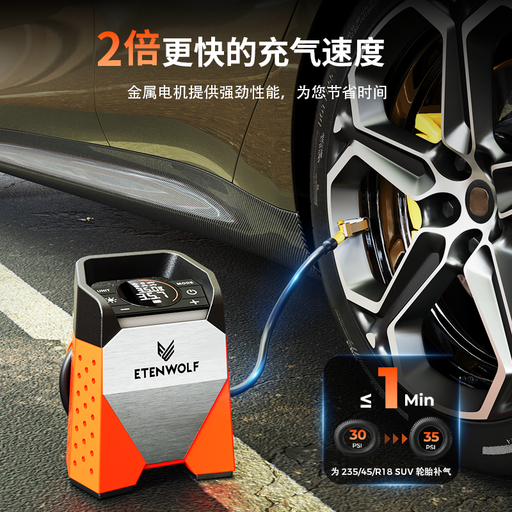
Why This Fits Their Persona: A larger battery-powered format for users who regularly maintain passenger cars, SUVs, bikes and sports equipment.
The specifications identify a 160 PSI maximum, 12V system, 1.25 CFM airflow and 1.47kg weight, giving more context than a PSI figure alone.
Includes Presta, needle and tapered nozzle attachments; automatic shut-off is specified.
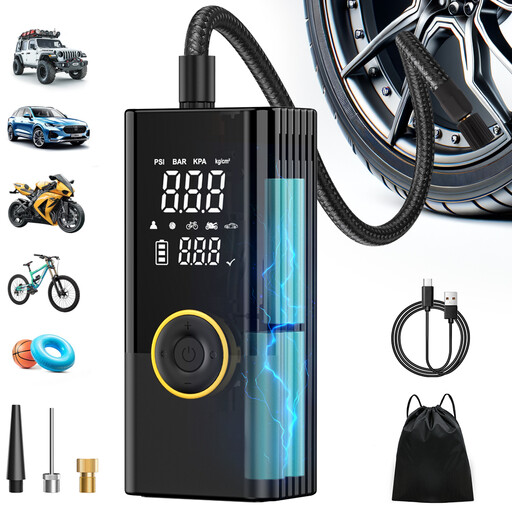
Why This Fits Their Persona: Handy for motorcyclists, cyclists and campers who need a small cordless pump for tyres and sports balls away from a vehicle socket.
Its stated use covers motorcycle tyres, bicycle tyres and balls, rather than implying suitability for large commercial vehicles.
Wireless operation; digital pressure setting and integrated lighting.
A portable pump is intended for inflation, not permanent puncture repair. If pressure falls again soon after inflation, arrange an inspection.
We have compiled a complete, real-time list of products that fully satisfy these strict selection criteria and UK safety regulations.
Yes, for pressure top-ups and some emergency inflation, provided its battery has sufficient charge and the product is rated for your tyre size. For repeated use or several low tyres, a wired 12V model or a higher-capacity cordless compressor may be more practical.
Lifespan depends on storage, heat, frequency of use, battery care and whether the unit is operated within its duty cycle. Keep the compressor dry, avoid leaving a rechargeable battery fully depleted for long periods and follow the manufacturer’s cooling instructions.
A cordless model uses electricity each time its battery is charged. A 12V tyre inflator draws power from the vehicle, so running the engine may use a small amount of fuel. The cost is usually modest for occasional top-ups, but operating time and vehicle efficiency affect the total.