
24/7 Customer Support

Free returns

Same-day & Next-day Delivery

Quality Guaranteed

Unlock Your Welcome Offers: FREE Delivery | Up to 80% OFF | Free 30-day JoyPlus trial
Download the APP
A portable tyre inflator can be useful for routine pressure checks, topping up a slow leak or handling an unexpected low-tyre-pressure warning. However, choosing one based only on a large PSI figure or a low price can lead to disappointment.
The most suitable model depends on your vehicle, how often you inflate, available power sources and whether you also need a bike pump or ball pump. This guide explains the key specifications and highlights practical options for UK drivers, motorcyclists, cyclists and sports enthusiasts.
A listing may promote a 150 PSI tyre inflator or 160 PSI tyre inflator, but maximum pressure alone does not tell you how quickly it will inflate a car tyre. Airflow, measured in litres per minute, motor power and the amount of pressure being added all affect performance.
For example, a pump rated at 160 PSI may be suitable for ordinary car tyres, but its maximum figure does not mean it will inflate every tyre quickly. Check the stated airflow and any specific inflation-time information before buying.
A small cordless tyre inflator is convenient for bicycles, motorbikes and sports balls, but compact devices can have limited battery capacity or operating time. Some mini pumps are specifically unsuitable for car tyres.
Always check the product’s stated compatibility. A bike-focused rechargeable air pump may be an excellent addition to a cycling bag but the wrong choice for a family car.
Portable air compressors often need a cooling pause during extended use. Inflating several car tyres from a low pressure can place more demand on the motor than topping up a single tyre.
Battery-powered models should also be charged before a long journey. A USB-C rechargeable air pump is convenient, but charging speed, battery capacity and whether a 12V cable is included can make a practical difference during an emergency.
For standard UK cars, motorbikes and bicycles, a maximum rating between 120 and 160 PSI is generally more than sufficient for normal inflation tasks. The pressure recommended for your vehicle comes from the manufacturer, usually shown on the driver’s door pillar label, fuel flap or handbook. Do not inflate to the pump’s maximum rating unless the item’s own specifications require it.
Airflow is also important. A model offering 20–35L/min may inflate more quickly than a lower-output mini pump, although real-world results vary by tyre size and pressure.
Battery capacity is shown in mAh. A rechargeable tyre inflator with 6,000mAh or 7,500mAh has more stored capacity than a compact 1,100mAh or 1,600mAh pump, but battery size is not the only consideration. Motor efficiency, operating temperature and tyre size also affect the number of inflations per charge.
For regular car use, consider:
A digital tyre pump with a pressure gauge makes it easier to select and monitor a target pressure. An automatic shut-off tyre inflator stops when the preset value is reached, reducing the need to watch the display continuously. This feature does not replace checking the recommended pressure or confirming that the connector is properly sealed.
Also check the included fittings. Schrader valves are common on cars and many bikes, while Presta valves are used on many road and performance bicycles. Ball needles and tapered nozzles increase versatility.
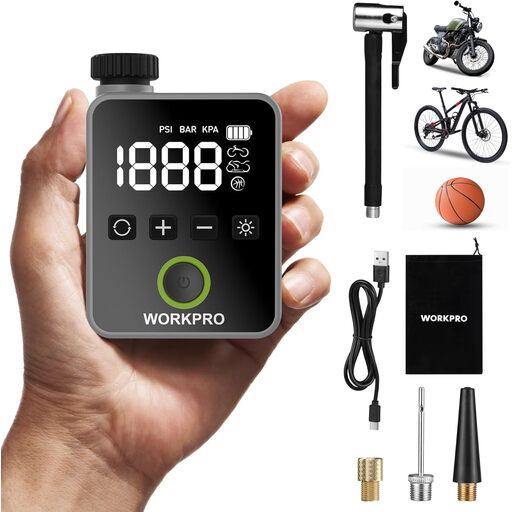
Why This Fits Their Persona: A lightweight option for cyclists, motorcyclists and households that mainly inflate bike tyres and sports balls. At 270g, it is easy to carry in a rucksack or vehicle storage compartment.
Its listing clearly states that it is not suitable for car tyres, helping buyers avoid choosing a small pump for an unsuitable application.
140 PSI maximum pressure, LED display, automatic shut-off, three lighting modes and adaptors for bike valves and balls.
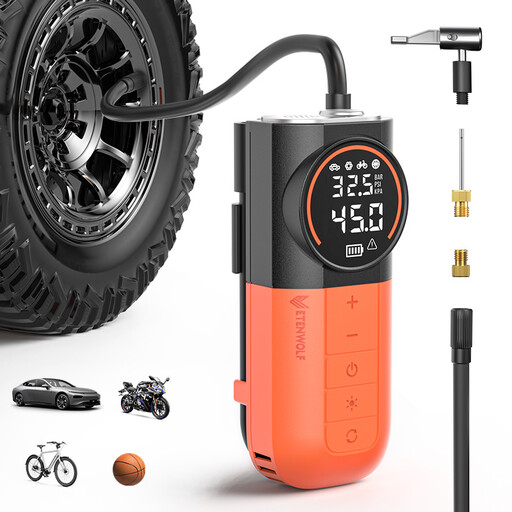
Why This Fits Their Persona: Suitable for drivers wanting a cordless car tyre inflator that also covers motorbikes, bicycles and balls, with a storage bag for keeping accessories together.
The specifications state a 20L/min airflow, 0.65kg weight and the need to pause for heat dissipation, giving a clearer picture than the PSI number alone.
160 PSI rating, digital pressure setting, automatic stop, USB-C charging, LED light and Presta, ball-needle and air-chuck accessories.

Why This Fits Their Persona: A practical match for drivers covering longer distances or managing several vehicles, where higher battery capacity and stronger airflow may be useful.
Its 35L/min airflow and 7,500mAh battery provide more clearly stated capacity than many small emergency pumps, while usage limits still need to be followed.
160 PSI maximum pressure, four preset modes plus manual mode, large LED display, USB power-bank function and automatic shut-off.
We have compiled a complete, real-time list of products that fully satisfy these strict selection criteria and UK safety regulations.
A portable pump is designed for inflation, not for repairing punctures or replacing a professional inspection. If a tyre repeatedly loses pressure, arrange a suitable check rather than repeatedly topping it up.
It can be useful for topping up pressure away from a garage or service station, particularly before long journeys. Choose a model with a suitable car-tyre rating, a readable display, automatic shut-off and enough battery capacity for your vehicle.
Battery lifespan depends on charging cycles, storage conditions, operating temperature and usage frequency. Recharge the unit periodically, avoid leaving it completely flat for long periods and follow the supplied charging instructions. A model with a 12V backup cable can remain useful if the internal battery is low.
Most portable models use relatively little electricity for occasional top-ups. The main practical cost is charging the battery. Corded 12V models draw power from the vehicle, so the engine should generally be running during use to reduce the risk of draining the vehicle battery, following the product instructions.