
24/7 Customer Support

Free returns

Same-day & Next-day Delivery

Quality Guaranteed

Unlock Your Welcome Offers: FREE Delivery | Up to 80% OFF | Free 30-day JoyPlus trial
Download the APP
By Joybuy Product Recommendation Officer
A portable tyre inflator can be useful for correcting gradual pressure loss, preparing for a long journey or dealing with an under-inflated tyre away from home. However, choosing one based only on a large PSI figure or a polished product image can lead to disappointment.
For UK drivers, the practical choice depends on how you will power the device, which vehicles you need to support and whether its pressure controls are clear enough to use safely. The following guide explains the main buying pitfalls and matches several options to different usage profiles.
A label such as 150 PSI or 160 PSI describes the maximum pressure the compressor may reach under specified conditions. It does not necessarily mean that the pump will inflate a car tyre quickly.
Inflation speed is also affected by:
A compact tyre compressor may be suitable for topping up a passenger-car tyre but less practical for repeatedly inflating several large tyres. Check the stated use cases rather than relying on the headline pressure.
A cordless tyre inflator is convenient because it does not need a 12V socket or trailing cable. Its limitation is battery capacity. If it has been stored in the boot for several months without charging, it may not have enough power when you need it.
Before buying, check:
For frequent travel, a wired 12V tyre inflator can offer more predictable access to power, provided your vehicle has a suitable DC outlet and the engine is running during use.
A digital tyre inflator can make pressure setting easier, but the display is only useful if the hose is attached securely and the selected unit is correct. PSI, bar, kPa and kg/cm² are different measurements.
An automatic shut-off function is helpful because it stops inflation at the preset value. Nevertheless, always confirm the recommended cold tyre pressure in the vehicle handbook, door-pillar placard or manufacturer information. Do not use the maximum pressure printed on the tyre sidewall as your normal vehicle setting.
Choose between a battery-powered electric tyre pump, a mains-powered option and a 12V car air pump. Cordless models are easier to move around a vehicle and can be useful for bicycles or motorbikes. Wired models avoid waiting for a battery to recharge.
Cable length matters when inflating all four wheels. A short lead may not reach the rear tyre from the socket, while an extended power cord can reduce the need for repositioning. Ensure the 12V plug, cable and socket are compatible before use.
For ordinary cars, motorbikes and bicycles, a pressure range covering the manufacturer’s recommended setting is more important than an unusually high maximum. A tyre compressor 150 PSI may also include nozzles for balls and inflatables, but do not assume it is designed for lorries, trailers or large off-road tyres.
Duty cycle describes how long a compressor can operate before it needs to cool. If the instructions recommend pauses, follow them. Continuous use beyond the stated limit can increase heat and reduce service life.
Most car and motorcycle tyres use Schrader valves. Many bicycles use Schrader or Presta valves, so a bicycle pump function may require an adaptor. Check which nozzles are included and whether the hose connection is screw-on or clip-on.
A useful control panel should provide:
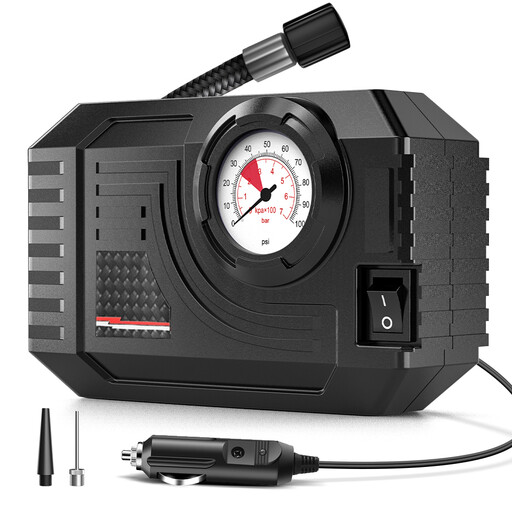
Why This Fits Their Persona: This compact wired model suits occasional top-ups for a car, motorbike or bicycle, particularly when a straightforward 12V connection is preferred.
Its wired design avoids dependence on a small internal battery. Users should run the vehicle engine during operation to reduce the chance of draining the vehicle battery.
Portable format; suitable for car, motorbike and bicycle tyres; no permanent installation required.

Why This Fits Their Persona: A compact cordless option for drivers and cyclists who value preset controls, multiple pressure units and an integrated light for travel or roadside use.
The stated 4,000mAh battery, preset function and auto-off address common cordless convenience concerns. Charge it before storing it for emergencies.
150 PSI maximum pressure; five modes; four pressure units; USB-C input/output and three light modes.
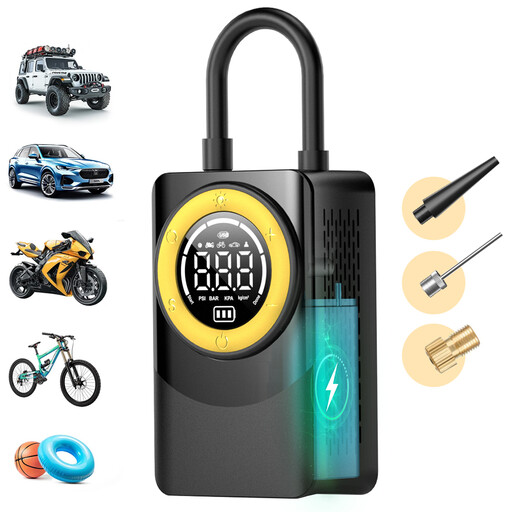
Why This Fits Their Persona: The cordless format is convenient for electric vehicle owners who want a compact emergency tyre inflator without relying on a traditional cigarette-lighter socket.
The digital display shows current pressure and the device is rechargeable. Keep it charged and follow the supplied instructions regarding storage and moisture.
Built-in battery; digital pressure display; described as suitable for electric vehicles, cars, motorbikes and bicycles.
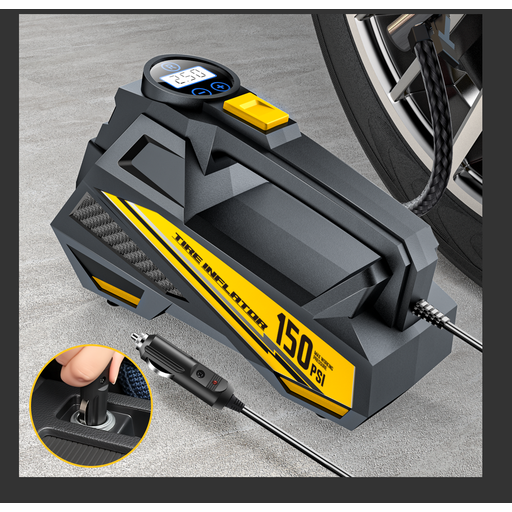
Why This Fits Their Persona: A wired option for motorists who regularly maintain several vehicles or need a broader-use compressor for cars, motorbikes, bikes and balls.
The 12V connection avoids relying solely on an internal battery. Allow cooling pauses where required and verify that the 150 PSI specification suits your intended inflatables.
12V motor; stated 150 PSI output; readable gauge; listed compatibility with cars, motorbikes, bicycles and balls.
We have compiled a complete, real-time list of products that fully satisfy these strict selection criteria and UK safety regulations.
Park on level ground, engage the handbrake and check the tyre for visible damage before inflating. Attach the connector firmly, select the correct pressure unit and set the vehicle’s recommended pressure. Keep hands and clothing away from moving parts and stop if the hose, plug or compressor becomes excessively hot.
A pump is intended to restore pressure, not repair punctures. If a tyre repeatedly loses air, shows sidewall damage or will not hold pressure, seek appropriate assistance rather than continuing to inflate it.
It can be useful for routine pressure adjustments and unexpected under-inflation. It should complement, not replace, a spare wheel or puncture assistance plan where those are available. Check the charge level of cordless models or store a wired model with suitable vehicle access.
Runtime varies by battery capacity, tyre size, starting pressure and operating temperature. Product descriptions may provide an estimated number of tyres or minutes, but these figures are usage-dependent. Recharge the unit periodically and avoid storing it completely flat.
A 12V inflator normally draws power from the vehicle, so its direct electricity cost is limited. The more important considerations are operating time, battery condition and whether the engine should be running during use. Cordless models require mains charging, with cost depending on battery capacity and local electricity rates.