
24/7 Customer Support

Free returns

Same-day & Next-day Delivery

Quality Guaranteed

Unlock Your Welcome Offers: FREE Delivery | Up to 80% OFF | Free 30-day JoyPlus trial
Download the APP
A portable tyre inflator can be useful for topping up car, motorbike and bicycle tyres at home or away from a petrol station. However, product listings often highlight a high PSI figure while leaving out the details that determine whether a pump is genuinely suitable for your needs.
Before buying, look beyond the headline specification. Battery capacity, airflow, valve compatibility and cooling requirements can make a greater difference to everyday usability than maximum pressure alone.
A listing showing 150 PSI air compressor or 160 PSI may appear powerful, but maximum pressure is only the upper limit under specified conditions. It does not necessarily indicate how quickly the pump will inflate a car tyre.
For practical comparisons, also check:
A compact pump designed for bicycle tyres may reach 150 PSI but still be unsuitable for a car. Similarly, a small motorbike tyre pump may struggle with repeated inflation of several vehicle tyres.
A cordless tyre inflator removes the need to find a 12V socket, but its battery must be charged before use. Cold weather, repeated inflation and an ageing battery can reduce the number of tyres completed per charge.
Check the stated battery capacity in mAh, charging connection and claimed usage conditions. A rechargeable tyre pump with USB-C charging is convenient for travel, but it should be topped up regularly if it is kept for roadside emergencies.
Corded models have a different advantage: they can draw power from a vehicle’s 12V socket while the engine is running. They may be less convenient to carry, but they avoid relying on a built-in battery.
Car tyres generally use Schrader valves, while many road bicycles use Presta valves. Electric bikes and some cycling equipment may require a particular adapter. A product can be versatile on paper but inconvenient if the correct nozzle is not included.
Also check hose length, accessory storage, display visibility and whether the pump can be operated in low light. An LED tyre inflator can be helpful during a night-time breakdown, although its light should be treated as an aid rather than a replacement for proper roadside visibility equipment.
Choose a pressure range that covers your intended use, then compare airflow for a clearer view of inflation speed. For cars, follow the pressure shown on the vehicle’s tyre placard or in the handbook rather than the maximum printed on the pump.
For bicycles, pressure requirements vary considerably. A road bike may require a higher pressure than a mountain bike, but the volume of air needed is different. A dedicated bike pump can therefore be more suitable for regular cycling than a general car inflator.
Look for:
An automatic shut-off tyre inflator reduces the need to watch the display continuously, but you should still check that the connector is firmly attached and the target unit is correct.
A digital tyre pressure gauge should clearly show the selected unit, such as PSI, bar or kPa. Check that the pump allows you to change units if your vehicle handbook uses a different measurement.
A suitable portable air compressor should also include the fittings you need. Common accessories include Schrader and Presta adapters, a ball needle and a tapered nozzle for small inflatables.
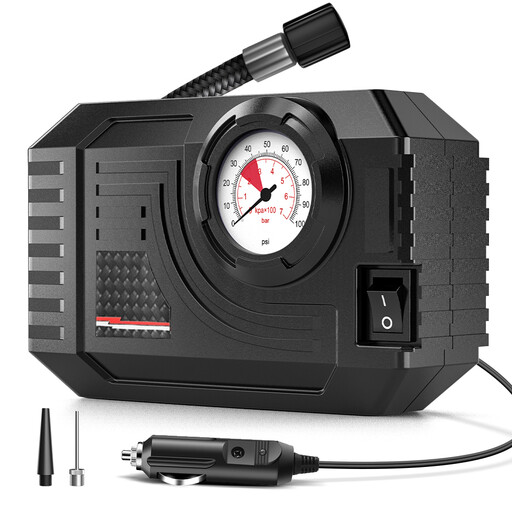
Why This Fits Their Persona: Its wired design suits drivers who want a straightforward car tyre inflator for occasional use without maintaining a rechargeable battery. It can also be used with motorbike and bicycle tyres where the fitting is suitable.
The 12V connection avoids battery capacity concerns. The instructions also identify the need to run the vehicle when using the socket, helping reduce the risk of draining the vehicle battery.
Portable format; suitable for car, motorbike and bicycle inflation; simple wired operation.
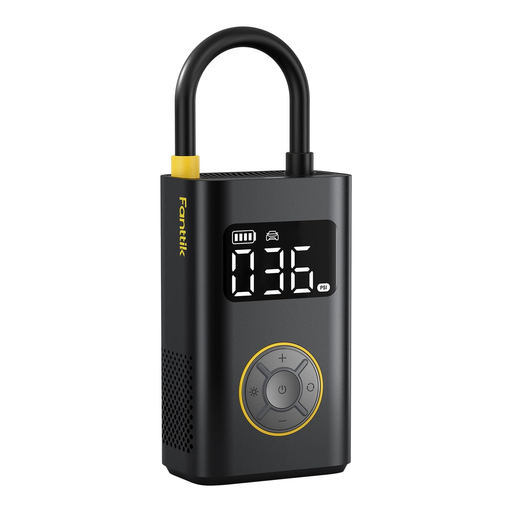
Why This Fits Their Persona: This cordless model is aimed at users who want a compact, organised inflator for cars, motorbikes, bicycles and sports balls during regular travel.
It provides selectable modes, a digital target-pressure display and automatic shut-off, rather than relying only on a maximum PSI claim.
150 PSI maximum pressure; built-in accessory storage; stated battery runtime of up to 23 minutes; automatic shut-off.
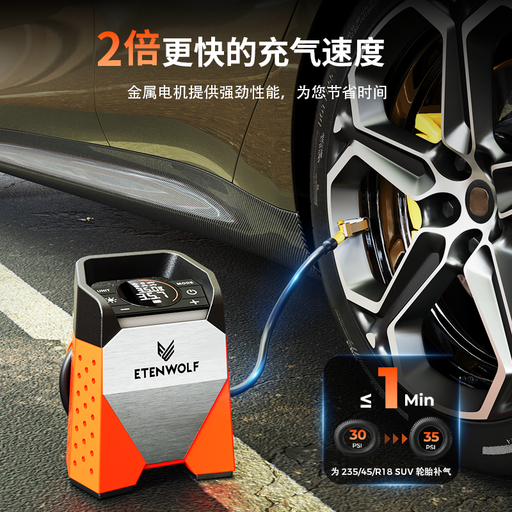
Why This Fits Their Persona: Its larger format is more appropriate for drivers who regularly maintain passenger cars, SUVs, bikes or balls and prefer a model with a stated continuous-use design.
The product information specifies compatibility with passenger cars, SUVs and light trucks, giving a clearer use case than a generic high-PSI listing. It also includes a digital interface and automatic stopping.
160 PSI maximum pressure; 1.25 cubic feet per minute airflow; stated 100% duty cycle; Presta adapter included.
We have compiled a complete, real-time list of products that fully satisfy these strict selection criteria and UK safety regulations.
It can be useful for correcting gradual pressure loss or topping up a tyre away from home. It does not repair punctures, replace a spare-wheel procedure or remove the need to stop safely in a breakdown situation.
Runtime varies by battery size, tyre volume, starting pressure and temperature. Compare the manufacturer’s stated number of tyres or operating time, and recharge the unit after use rather than leaving it empty in a boot or garage.
Some multi-purpose models include Schrader, Presta and needle adapters, but suitability still depends on airflow, pressure range and the manufacturer’s compatibility guidance. A compact motorbike tyre pump may handle several smaller inflatables, while a dedicated cycle pump can be more practical for frequent riders.