
24/7 Customer Support

Free returns

Same-day & Next-day Delivery

Quality Guaranteed

Unlock Your Welcome Offers: FREE Delivery | Up to 80% OFF | Free 30-day JoyPlus trial
Download the APP
That sinking feeling when the tyre pressure warning light illuminates your dashboard is a familiar one for many UK drivers. A quick trip to the petrol station might seem like the answer, but finding a working, available air machine can be a challenge. This is where a portable tyre inflator becomes an essential piece of kit for your car boot.
However, the market is flooded with options, and it is easy to make a poor choice. Many shoppers are caught out by three common pitfalls:
As your Joybuy Product Recommendation Officer, my role is to help you see past the marketing jargon. This guide will break down the essential factors to consider, ensuring you select a reliable tool that offers genuine peace of mind.
To avoid the pitfalls, focus on these core technical specifications. They are the true indicators of a quality electric air pump.
Your first decision is how the device will be powered. There is no single right answer; it depends entirely on your needs.
Product descriptions are often filled with technical jargon. Here is what you actually need to know:
Based on these practical criteria, we have matched several products to different user needs. Instead of a one-size-fits-all approach, this helps you find a model that genuinely suits your lifestyle.
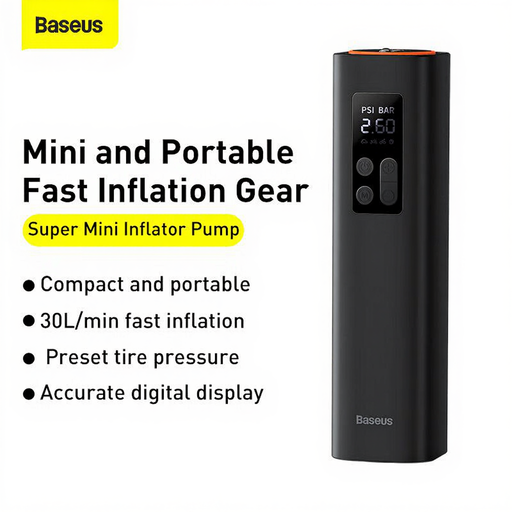
Why This Fits Their Persona: This user needs a simple, reliable tool for routine tyre maintenance and emergencies. The ultra-compact design fits neatly in a glovebox, and the 12V power source means it's always ready to use without worrying about battery levels.
It bypasses the dead-battery pitfall entirely. By drawing power directly from the car's 12V socket, it provides consistent performance whenever you need it, avoiding the unreliability of a poorly maintained cordless model.
Its primary strengths are its extreme portability and plug-and-play simplicity. The generous 3-metre cable provides ample reach for most passenger cars.

Why This Fits Their Persona: Ideal for a family or tech-savvy user who needs a single device for the car, bicycles and sports balls. The cordless design offers ultimate flexibility, and the power bank function is a practical bonus for charging phones on family outings.
With a substantial 7500mAh battery, it directly counters the pitfall of underpowered cordless models. This large capacity provides enough runtime to inflate multiple car tyres or many smaller items on a single charge.
Its versatility is its main strength. Preset inflation modes simplify operation for different items, and the ability to function as a power bank makes it a multi-purpose tool for travel and emergencies.

Why This Fits Their Persona: For cyclists and motorcyclists, size and weight are paramount. This model is extremely lightweight (460g) and compact, making it easy to carry in a backpack or pannier without adding bulk. It's a perfect **bike pump electric** solution.
It tackles the inaccurate gauge pitfall with upgraded pressure sensors. This focus on accuracy is critical for performance bicycle or motorcycle tyres where precise pressure has a significant impact on handling and safety.
The combination of an ultra-portable design and a focus on pressure accuracy makes it a standout choice. The built-in flashlight and power bank feature add valuable emergency utility for riders.
We have compiled a complete, real-time list of products that fully satisfy these strict selection criteria and UK safety regulations.
The lifespan of a portable tyre inflator depends on its build quality and usage. A well-made device from a reputable brand, used for occasional top-ups, can last for many years. For cordless models, the battery is often the limiting factor; look for models with high-quality lithium-ion batteries. For all types, avoid running the motor for longer than the manufacturer's recommended duty cycle (e.g., 10 minutes of use followed by a 10-minute cool-down) to prevent overheating and premature wear.
Yes, many modern cordless tyre inflators are more than capable of inflating car tyres. The key is to choose a model with a sufficiently large battery (e.g., 4000mAh or more) and a motor that can deliver at least 120 PSI. While they may be slightly slower than powerful 12V units for a full inflation from flat, they are perfectly adequate for routine pressure top-ups and most roadside emergencies.
The correct tyre pressure for your vehicle is not on the tyre itself. That number is the maximum pressure the tyre can hold. The manufacturer's recommended pressure can be found in your vehicle's handbook or on a sticker located inside the driver's door frame, inside the fuel filler cap or in the glovebox. Always check the pressure when the tyres are cold (i.e., have not been driven for at least a few hours) for the most accurate reading.