
24/7 Customer Support

Free returns

Same-day & Next-day Delivery

Quality Guaranteed

Unlock Your Welcome Offers: FREE Delivery | Up to 80% OFF | Free 30-day JoyPlus trial
Download the APP
A portable tyre inflator can be useful for routine pressure checks, topping up before a long journey or handling a slow puncture when you are away from a garage. However, product listings often highlight impressive numbers without explaining how the pump performs in real use.
Before buying, look beyond the headline pressure rating. A compact cordless tyre inflator may be convenient but slower on car tyres, while a wired 12V model may provide longer operating time but needs access to your vehicle’s power socket. The right choice depends on your vehicle, typical journeys and whether you need it for bicycles, motorcycles or sports equipment as well.
A 150 PSI tyre inflator is not necessarily faster than a lower-rated model. Maximum pressure indicates the upper operating limit, not how quickly the pump reaches your vehicle’s recommended pressure. Airflow, motor output, battery condition and the starting pressure all affect performance.
A pump that states 25–35 L/min may be more informative for everyday use, but quoted inflation times can vary according to tyre size and pressure. A compact bicycle tyre pump may be suitable for top-ups but take considerably longer on a nearly flat car tyre.
A rechargeable air pump removes the need for a cable, which is useful for motorcycles, bicycles and roadside use. Yet battery capacity and operating time matter. A small 1600mAh unit may suit bicycle tyres and sports balls, while regular car users may prefer a larger battery or a 12V electric tyre pump.
Corded models can offer sustained operation, but check the cable length and socket requirements. Some need the engine running to avoid placing excessive demand on the vehicle battery. Electric vehicle owners should also confirm how the 12V accessory socket operates and whether it remains powered when the vehicle is switched off.
An automatic shut-off air pump can stop when its preset value is reached, helping reduce over-inflation. It does not remove the need to find the correct pressure. Use the vehicle manufacturer’s recommendation, usually shown on the driver’s door pillar, inside the fuel flap or in the handbook. Do not rely on the number printed on the tyre sidewall, as this is generally a maximum specification rather than the recommended road pressure.
Choose a digital tyre inflator that allows you to select the unit used locally, such as PSI or bar. UK vehicle information commonly presents both measurements. A clear screen is useful in low light, while a built-in LED can help when checking a tyre at the roadside.
Pressure accuracy is also relevant. For example, the Porbi Q16 lists pressure detection accuracy of ±0.01 kg/cm². This is a stated specification, but you should still compare readings with a separate gauge if precise pressure management is important.
Battery capacity is shown in mAh, although a larger figure alone does not guarantee quicker inflation. Check:
The Probi Portable Air Pump Q32 has a 1600mAh battery, Type-C charging and a stated bicycle inflation time of approximately 70 seconds from 0 to 2.06 bar. Its three modes cover motorcycles, bicycles and balls, making it more suitable for light, mixed-use inflation than repeated car-tyre inflation.
Most road vehicles use standard Schrader valves, while many bicycles use Presta valves. Check whether the package includes the appropriate adapter. A motorcycle tyre inflator should be compact enough to carry in available storage, but its hose must still attach securely without placing strain on the valve.
For cars and electric vehicles, consider reach. A 3-metre cable can be more practical than a short lead when connecting to all four wheels from a single 12V socket. For large vans, trucks or specialist equipment, confirm the manufacturer’s compatibility information rather than assuming a high PSI label is sufficient.
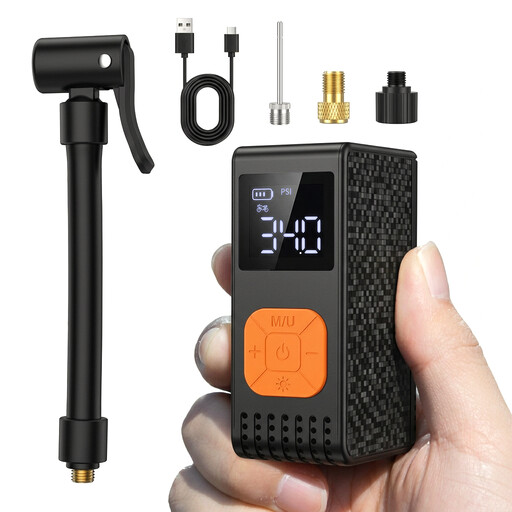
Why This Fits Their Persona: A small option for UK cyclists, motorcycle riders and households that need occasional inflation for bicycles, balls and similar items.
Its listed three inflation modes make the intended use clearer than a generic high-PSI claim. The smaller battery also sets realistic expectations for lighter tasks.
1600mAh battery, Type-C charging, LED lighting and modes for motorcycles, bicycles and balls.
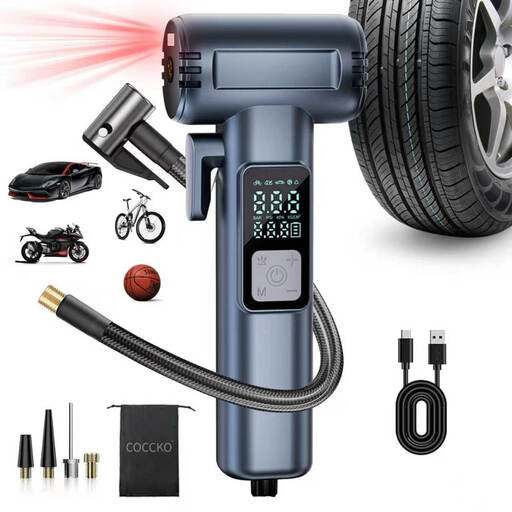
Why This Fits Their Persona: Suitable for drivers wanting cordless operation, a preset pressure display and added visibility during night-time roadside inflation.
The listing provides a stated 4000mAh battery, 35 L/min flow rate and automatic shut-off, rather than focusing only on maximum pressure.
Up to 10.3 bar, LCD pressure display, automatic shut-off, five modes and three LED settings.
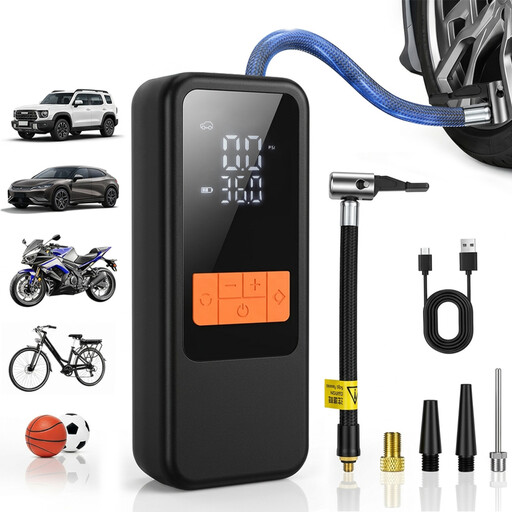
Why This Fits Their Persona: A practical match for drivers who want a cordless car tyre inflator with several preset modes and enough stated runtime for routine vehicle maintenance.
The listing states a 25-minute runtime, approximately 7.5 minutes for an empty tyre and 30 seconds for top-ups, giving clearer use guidance than PSI alone.
4000mAh battery, 150 PSI maximum pressure, 26 L/min flow rate, power-bank output and five inflation modes.
We have compiled a complete, real-time list of products that fully satisfy these strict selection criteria and UK safety regulations.
Some are, but check the stated vehicle compatibility, airflow, battery capacity and inflation time. Small rechargeable models may be more suitable for top-ups, bicycles and motorcycles. For repeated car use, a larger cordless model or a 12V portable air compressor may be more practical.
Running cost depends on battery capacity, charging efficiency and local electricity tariffs. A small pump typically uses less energy per charge than a large compressor, but it may require more time or several charging cycles for multiple car tyres. The purchase specifications rarely provide an exact cost per inflation, so treat runtime and charging time as the more useful comparison points.
Lifespan depends on battery chemistry, charging habits, storage temperature and motor workload. Follow the charging instructions, avoid leaving the device in extreme heat and do not operate it beyond its stated duty cycle. A model listing a battery cycle figure, such as the Q32’s stated minimum of 300 charge and discharge cycles, offers more useful longevity information than a general durability statement.