
24/7 Customer Support

Free returns

Same-day & Next-day Delivery

Quality Guaranteed

Unlock Your Welcome Offers: FREE Delivery | Up to 80% OFF | Free 30-day JoyPlus trial
Download the APP
A portable tyre inflator can be useful for correcting low pressure before a journey, topping up a bicycle tyre or handling a roadside inconvenience. However, choosing one based only on a large PSI figure or a low price can lead to disappointment.
The key is matching the pump to the job. A compact rechargeable tyre inflator may suit a commuter or cyclist, while a larger emergency roadside air compressor may be more appropriate for repeated car-tyre top-ups. The following guide explains the specifications and design details worth checking before you buy.
A listing may advertise 150 PSI tyre inflator or even 160 PSI capability. That figure describes the maximum pressure the device can potentially reach, not how quickly it will inflate a car tyre. Airflow, motor power, battery capacity and the tyre’s starting pressure also affect performance.
For standard UK passenger cars, the recommended pressure is often far below 150 PSI, but you should always check the vehicle handbook or tyre-pressure placard. A high maximum-pressure rating does not automatically make a pump suitable for vans, lorries or large off-road tyres.
Some small air pumps are made for low-pressure items such as swimming rings, yoga balls and air mattresses. For example, the Baseus PocketGo Portable Air Pump has a pressure rating of 3.5 kPa and is specifically unsuitable for car, motorcycle or bicycle tyres. It requires a 5V-1A USB power source and must be switched off manually.
This is an important distinction: check the pressure range and intended use, rather than relying on terms such as “portable air pump” or “electric tyre pump”.
A cordless tyre inflator is convenient, but battery-powered models usually have a limited operating period and may need cooling between tyres. A 4,000mAh battery, for instance, will not perform identically across different tyre sizes or pressure increases.
Before buying, check the stated runtime, charging time and whether the product can also connect to a 12V vehicle socket. Keep the battery charged if the pump is intended for emergencies, and do not leave it in extreme heat for prolonged periods.
For cars, motorcycles and bicycles, look for a pump that clearly lists compatibility with standard tyre valves and offers a practical pressure range. A 150 PSI tyre inflator is generally suitable for common car, motorcycle and bicycle applications when the product specification confirms this.
Airflow, shown in L/min, provides another useful comparison. Higher airflow can reduce inflation time, but quoted figures may vary by test conditions. Treat manufacturer timings as guidance rather than a guarantee for every tyre.
A digital tyre pressure gauge helps you set and monitor the target pressure. Multiple units, such as PSI, BAR and kPa, are useful when switching between vehicle manuals or bicycle equipment.
An automatic shut-off air pump stops when the selected pressure is reached, reducing the need to watch the display continuously. Nevertheless, check the tyre pressure with a separate gauge when accuracy is particularly important, and always set the target according to the vehicle manufacturer’s recommendation.
A rechargeable tyre inflator removes the need to find a 12V socket, which is helpful for motorcycles, bicycles and roadside use. USB-C charging can make recharging more convenient, while a 12V cable provides a useful fallback for car owners.
Also check the hose length, valve connection and included adapters. A Presta adapter may be needed for some bicycle tyres. Nozzles for balls and low-pressure inflatables add versatility, but they do not replace a high-pressure tyre connector.
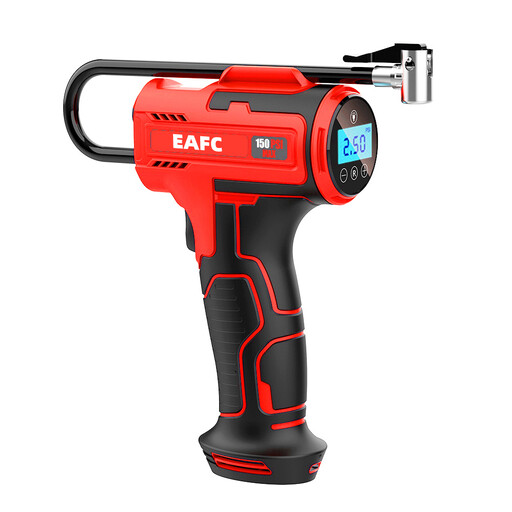
Why This Fits Their Persona: A practical cordless option for UK drivers who want one compact pump for car, motorcycle, bicycle and ball inflation.
Its specification identifies car-tyre compatibility and a built-in battery, rather than presenting it only as a low-pressure inflatable pump.
150 PSI maximum pressure, digital display, automatic stop and built-in LED lighting.
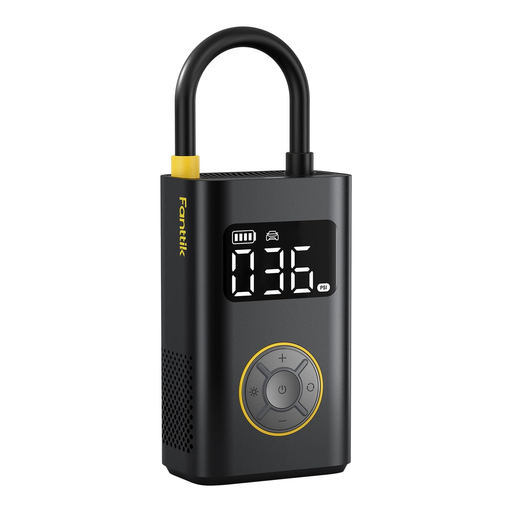
Why This Fits Their Persona: Suitable for motorists who value organised storage, readable controls and one device for several inflation tasks.
The integrated hose and accessory storage help reduce misplaced parts, while preset modes avoid relying solely on the headline PSI figure.
150 PSI range, 4+N modes, automatic shut-off and stated runtime of up to 23 minutes.

Why This Fits Their Persona: A larger cordless model for drivers, SUV owners, motorcyclists and users who may need several top-ups away from a mains supply.
Its 7,500mAh battery and stated 35L/min airflow provide more information than a maximum-pressure claim alone.
160 PSI maximum pressure, 45-minute stated continuous runtime, digital display and LED modes.
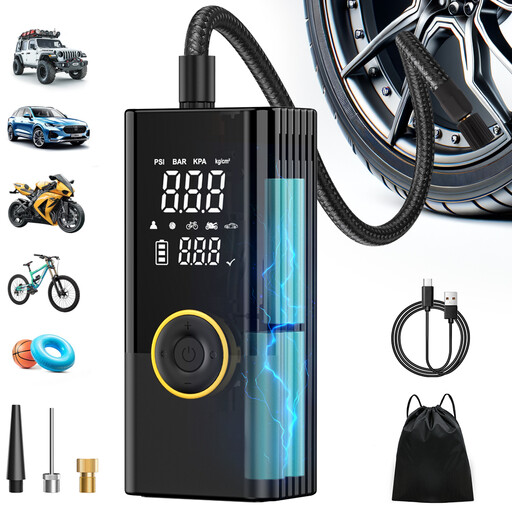
Why This Fits Their Persona: Its compact wireless format is convenient for a backpack, motorcycle storage box or cycling kit.
The product description identifies motorcycle, bicycle and sports-ball use, making its intended application clearer than a generic air-pump label.
22-cylinder design, digital pressure setting, wireless operation and built-in lighting.
We have compiled a complete, real-time list of products that fully satisfy these strict selection criteria and UK safety regulations.
It can be useful for routine pressure top-ups and temporary roadside assistance. It does not replace a spare wheel, sealant kit or professional tyre repair, particularly when a tyre has visible damage or loses pressure repeatedly.
Battery life depends on tyre size, starting pressure, target pressure and operating temperature. Product specifications may state runtime or an approximate number of tyres, but these figures are usage estimates. Charge the unit fully before a long journey and follow its cooling instructions.
A rechargeable model uses a relatively small amount of electricity compared with larger household appliances, but the exact cost depends on battery capacity, charging frequency and the electricity tariff. A wired 12V car tyre pump draws power from the vehicle, so the engine should generally be running when the instructions require it.