
24/7 Customer Support

Free returns

Same-day & Next-day Delivery

Quality Guaranteed

Unlock Your Welcome Offers: FREE Delivery | Up to 80% OFF | Free 30-day JoyPlus trial
Download the APP
By the Joybuy Product Recommendation Officer
An underinflated tyre can be inconvenient on a morning commute, before a long motorway journey or halfway through a cycling route. A portable tyre inflator provides a practical way to top up pressure at home, at a car park or during a roadside delay. However, choosing one based only on a large PSI number can lead to disappointment.
The right model depends on the vehicle or equipment you use, how often you inflate and whether you prefer battery power or a 12V connection. Below are the main traps to avoid, the specifications worth checking and our top recommendations for different UK users.
A rating such as 150 PSI tyre inflator or 160 PSI air compressor describes the maximum operating pressure, not necessarily how quickly the unit fills a car tyre. Airflow, motor output, hose design and heat management also influence performance.
A pump may reach a high pressure in theory but still take a long time with a larger SUV tyre. Look for an airflow figure in L/min, an inflation-time example for a comparable tyre and any stated duty-cycle guidance.
A rechargeable air pump is convenient, but compact cordless models have limited battery capacity and may need cooling pauses. Some are intended mainly for bicycles, motorbikes and sports equipment rather than repeated car-tyre inflation.
Check the product’s stated compatibility before purchasing. For example, the WORKPRO mini inflator is specified as not suitable for car tyres, despite its 140 PSI rating. A small pump can be useful for a bicycle bag but unsuitable as an emergency car accessory.
Cars commonly use Schrader valves, while many road bicycles use Presta valves. An inflator without the correct adapter may require an additional purchase. Also check whether the product includes a USB-C charging cable, 12V lead, extension cable, storage bag, inflation needle and tapered nozzle.
For a corded car tyre pump, a longer lead can make it easier to reach all four wheels. For a cordless tyre inflator, battery charge level and storage conditions matter more than cable length.
Select a pump that comfortably covers your recommended tyre pressure rather than simply choosing the highest number. Your vehicle’s correct pressure is shown on the tyre placard, commonly located inside the driver’s door area or in the owner’s manual. Do not use the maximum PSI figure as a target.
A digital tyre pressure gauge makes readings easier to set and monitor. Models showing PSI, BAR and kPa are useful because UK vehicle information may use different units from bicycle or sports equipment instructions.
Airflow is usually listed in litres per minute. Higher airflow can support quicker top-ups, but real-world speed varies with tyre size and starting pressure. A heavy-duty unit such as the WOLFBOX model lists 45 LPM and uses a double-cylinder design, making it more suitable for larger tyres and repeated use.
Small rechargeable pumps are easier to carry but may require pauses. Follow the supplied instructions and allow the unit to cool if it becomes hot. A stated duty cycle, such as continuous operation guidance, is more useful than a vague “fast inflation” description.
A portable air compressor can be powered by a vehicle’s 12V socket, an internal lithium-ion battery or both. Corded models avoid waiting for a recharge, provided the car battery and socket are available. Battery-powered models are more flexible for bicycles, motorbikes and roadside use away from the vehicle.
For cordless use, compare battery capacity, charging interface and estimated number of inflations. Treat figures such as “up to five tyres” as usage estimates because tyre size, pressure and temperature affect results.
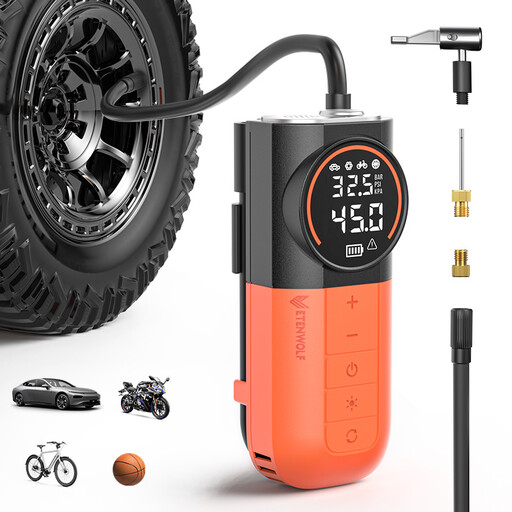
Why This Fits Their Persona: A compact cordless option for commuters, occasional car top-ups, motorbikes, bicycles and sports balls, without carrying a larger mains-style compressor.
Its digital preset function and automatic stop reduce the need to watch the gauge continuously. The instructions also advise regular pauses for heat dissipation.
160 PSI maximum pressure, 20 LPM airflow, built-in LED light and included Presta, needle and USB-C accessories.
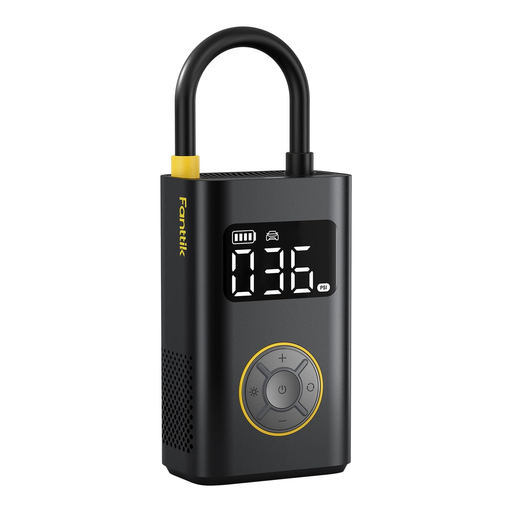
Why This Fits Their Persona: Suitable for drivers and e-bike owners wanting a tidy, self-contained pump with straightforward controls and stored accessories.
The integrated hose and accessory storage help avoid loose parts. Its automatic shut-off tyre pump function stops at the selected pressure.
150 PSI maximum pressure, 4+N modes, integrated hose and a stated 23-minute continuous operating time.
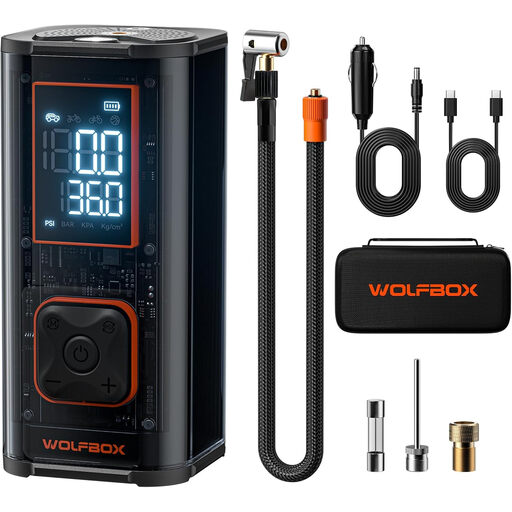
Why This Fits Their Persona: A practical match for households with multiple vehicles, larger car tyres or regular inflation tasks where airflow matters.
Its listed double-cylinder configuration and 45 LPM airflow provide more useful performance information than a maximum PSI figure alone.
150 PSI maximum pressure, 45 LPM airflow, double-cylinder design and a 20-inch hose.
We have compiled a complete, real-time list of products that fully satisfy these strict selection criteria and UK safety regulations.
Usually, yes, provided the model is specifically designed for car tyres and has suitable airflow, hose length and power. Your car’s normal operating pressure will be considerably below 150 PSI. Check the manufacturer’s vehicle compatibility rather than relying on the pressure rating alone.
A rechargeable pump uses electricity for charging, while a 12V model draws power from the vehicle. The running-cost difference is generally small for occasional top-ups. The more important choice is convenience: cordless models work away from the car, whereas 12V pumps can continue operating without waiting for a battery to recharge.
Service life depends on battery ageing, storage, dust, heat and how often the motor is operated continuously. Follow the cooling instructions, avoid forcing connectors and recharge the battery as advised. For frequent heavy use, compare duty-cycle information and consider a higher-airflow model rather than a mini rechargeable pump.