
24/7 Customer Support

Free returns

Same-day & Next-day Delivery

Quality Guaranteed

Unlock Your Welcome Offers: FREE Delivery | Up to 80% OFF | Free 30-day JoyPlus trial
Download the APP
A portable tyre inflator can be a useful addition to a glovebox, boot, motorcycle pannier or cycling bag. It can help with gradual pressure loss, seasonal checks and roadside top-ups without relying on the nearest petrol station.
However, not every compact portable air compressor is suitable for every vehicle. Marketing often focuses on a large PSI figure or a long list of extra functions, while overlooking battery capacity, power supply and realistic inflation performance. The right choice depends on how often you will use it, what you intend to inflate and whether you need a cordless or wired device.
A 150 PSI tyre inflator or 160 PSI model may appear more powerful, but maximum pressure is not the same as airflow or inflation speed. Most UK cars require considerably less than 150 PSI, so also check the airflow rate, motor power and any stated inflation time for a comparable tyre size.
A device with a higher airflow rate may be more practical for repeated car-tyre top-ups. For occasional bicycle or ball inflation, a smaller rechargeable air pump may be sufficient.
A cordless tyre inflator is convenient, but its runtime depends on battery capacity, tyre size, starting pressure and ambient temperature. A compact unit may be suitable for one or two top-ups but less appropriate for inflating several car tyres from a low pressure.
Check whether the product has a USB-C charging connection, how long a full charge takes and whether it also supports a vehicle’s 12V socket. A dual-power device can provide a useful fallback if the battery is depleted.
Car and motorcycle tyres generally use Schrader valves, while many bicycles use Presta valves. A bicycle pump function is only useful if the required adapter is included or readily available. Also check whether the package contains a ball needle, tapered nozzle and suitably long hose.
Extra functions such as an LED light, SOS mode or power bank can be helpful, but they should not replace the core checks: pressure range, power source, duty cycle and compatibility.
Look for a built-in digital tyre pressure gauge with selectable units such as PSI, BAR or kPa. The recommended pressure for your car is normally shown on the driver’s door frame, fuel flap or vehicle handbook. Use that figure rather than the tyre’s maximum permitted pressure printed on the sidewall.
An automatic shut-off tyre pump allows you to set a target pressure before inflation. This reduces the need to monitor the display continuously, although you should still remain nearby and check the valve connection.
Airflow is commonly listed in litres per minute. Higher figures can indicate quicker inflation, but real-world performance varies by tyre size and starting pressure. Also look for instructions about cooling breaks. Portable compressors generate heat, and continuous operation beyond the stated duty cycle may damage the motor or reduce battery life.
For occasional use, a 15–25 minute battery runtime may be adequate. Drivers who want to inflate several car tyres should consider a higher-capacity battery or a 12V tyre inflator powered from the vehicle.
A rechargeable model is convenient for cycling trips, commuting and keeping in a small car. A 12V model avoids battery charging concerns but requires access to the vehicle socket and may need the engine running to avoid excessive battery drain.
Do not assume a compact car tyre pump is suitable for vans, large trucks, trailers or recreational vehicles. Always check the stated compatibility. A high PSI number alone does not confirm that the compressor is suitable for a large-volume tyre.
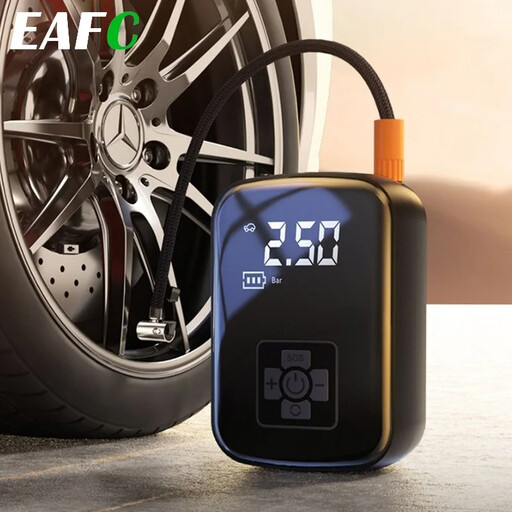
Why This Fits Their Persona: Its compact format and five inflation modes suit new car owners, occasional commuters and households that want one device for car, motorcycle, bicycle and ball inflation.
The specification lists a 3–150 PSI range, automatic stopping and pressure measurement, rather than relying only on a maximum-pressure headline.
25L/min airflow, 3,600mAh battery, built-in light and included USB charging cable.
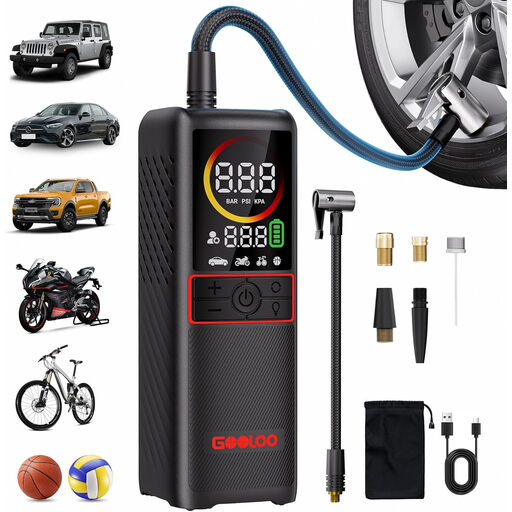
Why This Fits Their Persona: A larger battery and digital controls make it suitable for drivers who want a cordless car tyre pump for regular checks, family travel and mixed vehicle use.
Its listed 7,500mAh battery, preset modes and auto shut-off address concerns about limited cordless runtime and overinflation.
160 PSI maximum pressure, 35L/min airflow, USB-C charging, power-bank function and LED modes.
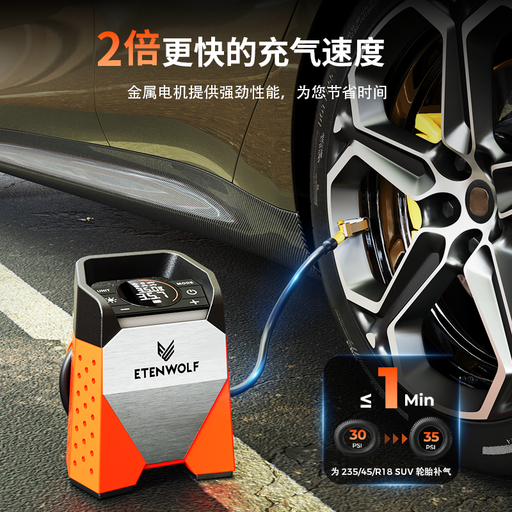
Why This Fits Their Persona: Its wired 12V design and listed continuous-duty specification suit drivers who prioritise repeated inflation and do not mind using a vehicle power socket.
The 12V connection avoids dependence on a small internal battery, while the supplied hose and adapters support several standard valve types.
160 PSI maximum pressure, 1.25 cubic feet per minute airflow and automatic stop function.
It can be useful for correcting gradual pressure loss or making a temporary top-up before reaching a garage. It cannot safely repair a puncture, so inspect the tyre and seek professional assistance if it loses pressure quickly or shows visible damage.
Battery life varies according to capacity, tyre size, pressure difference and operating temperature. Smaller models may be intended for limited top-ups, while higher-capacity units list more inflation cycles or longer continuous operation. Follow the stated duty cycle and recharge the device after use.
Neither power type suits every user. A 12V tyre inflator avoids waiting for battery charging and may be preferable for repeated car use. A cordless model is easier to carry and more convenient for bicycles, motorcycles and outdoor activities. A dual-power emergency car compressor offers both options, provided the vehicle has a compatible 12V socket.