
24/7 Customer Support

Free returns

Same-day & Next-day Delivery

Quality Guaranteed

Unlock Your Welcome Offers: FREE Delivery | Up to 80% OFF | Free 30-day JoyPlus trial
Download the APP
That sinking feeling when the tyre pressure warning light illuminates your dashboard is a familiar one for many UK drivers. It often signals an inconvenient hunt for a petrol station with a working, and often costly, air machine. A reliable portable tyre inflator kept in your boot offers a practical solution, providing peace of mind, enhancing road safety and even improving fuel efficiency by ensuring your tyres are always correctly inflated.
Navigating the market for a car tyre pump can be confusing, with a wide array of features and power options. As your Joybuy Product Recommendation Officer, my role is to help you understand the key considerations, so you can choose a device that genuinely suits your needs, whether for routine maintenance, roadside emergencies or recreational use.
Before looking at specific models, it's helpful to understand the main features that differentiate them. Focusing on these three areas will help you narrow down your search.
The power source is a primary deciding factor. A cordless air compressor is powered by a built-in rechargeable battery. This offers excellent portability, making it ideal for topping up tyres anywhere or for use with bicycles and sports equipment away from the vehicle. A rechargeable air pump is the ultimate grab-and-go tool.
Conversely, a 12V tyre inflator plugs directly into your car's 12V DC socket (the cigarette lighter). This provides a constant and reliable power source, so you never have to worry about a dead battery. This type is often favoured for inflating larger tyres or for those who want guaranteed power in an emergency. Some modern units offer dual-power functionality, giving you the best of both worlds.
Two key metrics determine an inflator's performance: maximum pressure (measured in PSI) and airflow (measured in Litres Per Minute, or L/min). Most car tyres require 30-40 PSI, so ensure the inflator's maximum pressure comfortably exceeds this. A higher airflow rate means faster inflation.
For accuracy, a digital tyre inflator is a must-have feature. A clear screen that displays the current pressure and allows you to pre-set your target pressure is invaluable. The best models include an auto-stop function, which automatically shuts the device off once the target PSI is reached, preventing dangerous over-inflation. This integrated tyre inflator with pressure gauge removes all the guesswork.
Consider the size and weight of the unit. A compact, lightweight model is easier to store in a glove compartment or a motorcycle pannier. Many modern inflators also come packed with useful secondary features. An integrated LED light is incredibly useful for dealing with a flat tyre at night, often with standard, strobe and SOS modes. Some units also function as a power bank, allowing you to charge your phone or other electronic devices from a USB port—a handy feature in any roadside situation.
Based on features, user-friendliness and practicality, here are our recommendations for portable tyre inflators that stand out this year.
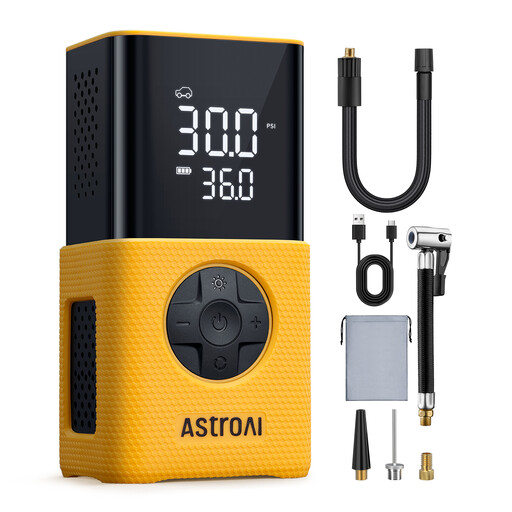
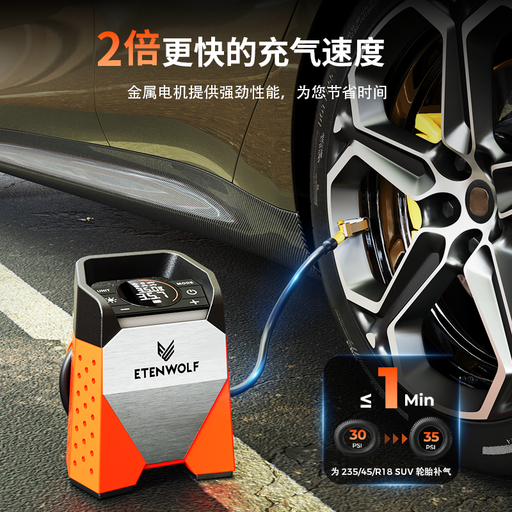
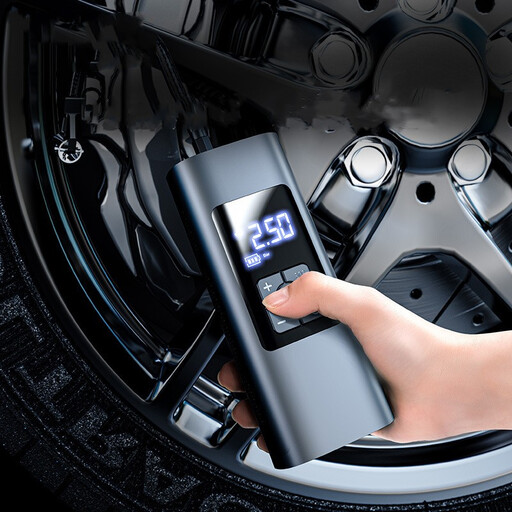
While these models are excellent all-rounders, your specific needs might call for a different tool. Perhaps you are a dedicated cyclist looking for a specialised electric bike pump or other maintenance gear. To discover more tools tailored for two-wheeled adventures, feel free to explore our full range.
Explore our collection of bike accessories to find the perfect tools for your ride.
This depends on the inflator's power (airflow) and the tyre size. For a simple top-up of a few PSI, most models will take only 1-3 minutes. Inflating a car tyre from completely flat can take anywhere from 5 to 10 minutes. Always check the product specifications for an estimated inflation time.
Yes, these devices are designed to be stored in a vehicle. However, it is wise to be mindful of extreme temperatures. During very hot summer days or freezing winter nights, check the manufacturer's guidelines for storage, as extreme temperatures can affect the longevity of internal components, especially lithium-ion batteries.
A quality digital tyre inflator with a built-in pressure gauge is generally accurate enough for all routine maintenance and emergency needs. For those who require competition-level precision, it is still good practice to occasionally cross-reference the reading with a separate, high-quality analogue or digital pressure gauge.