
24/7 Customer Support

Free returns

Same-day & Next-day Delivery

Quality Guaranteed

Unlock Your Welcome Offers: FREE Delivery | Up to 80% OFF | Free 30-day JoyPlus trial
Download the APP
A flashing tyre pressure warning light on your dashboard can instantly turn a smooth journey into a stressful one. While a portable tyre inflator seems like a simple fix, the market is flooded with gadgets that often over-promise and under-deliver. Many UK drivers find themselves with a device that fails when it's needed most.
As the Joybuy Product Recommendation Officer, my role is to help you navigate past the marketing jargon. Before you spend your money, let's look at the common pitfalls that catch out unwary buyers.
To choose a reliable tool, you need to look beyond the flashy features and focus on a few core parameters. Understanding these will ensure you get a device that is both practical and safe for your vehicle.
Your first decision is how your inflator will be powered. There is no single right answer; it depends entirely on your needs.
Some modern units offer a hybrid approach, with a rechargeable battery and a backup 12V power cord for total flexibility.
Almost every portable tyre inflator on the market claims a maximum pressure of 150 PSI. While this figure indicates a motor's potential strength, it's not the most practical metric for everyday use, as most car tyres only require 30-40 PSI.
A more important specification is the airflow rate, measured in litres per minute (L/Min). A higher L/Min means the inflator can move more air, filling your tyre faster and reducing the time you spend on the roadside.
Equally important is the accuracy of the gauge. A digital tyre inflator with an automatic shut-off feature is a non-negotiable for safety and convenience. This allows you to preset your vehicle's recommended tyre pressure, and the device will automatically stop once it's reached, preventing dangerous over-inflation.
Many modern inflators come with additional functions that can be genuinely useful in an emergency.
To help you choose, we've matched some reliable options to different types of UK drivers.

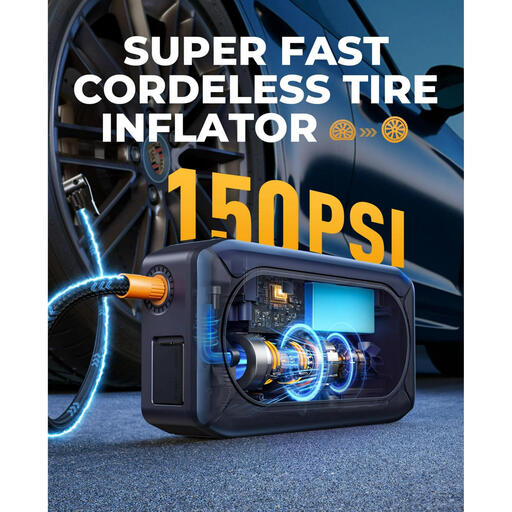
Why This Fits Their Persona: This compact, lightweight unit is perfect for keeping in the glovebox or a backpack. Its cordless design and power bank function provide peace of mind for daily drives, cycling and quick top-ups without any fuss.
It directly addresses the inaccurate gauge issue with advanced pressure sensors. The 4000mAh battery provides a realistic runtime for car tyres, avoiding the pitfall of exaggerated battery claims.
Ultra-Portable: Weighing only 460g, it's easy to store and carry. Multi-Functional: Acts as an inflator, power bank and has a 3-mode LED light.
Why This Fits Their Persona: For those who drive long distances, have larger vehicles (SUVs, vans) or simply want an all-in-one emergency kit, this combination jump starter and inflator is a powerful solution. It covers a flat battery and a flat tyre in one robust unit.
It sidesteps the weak power source trap by integrating a high-capacity battery capable of jump-starting large engines. The digital compressor with auto-shutoff ensures accurate inflation every time.
Powerful Versatility: Jump starts up to 9.0L petrol/8.0L diesel engines and inflates tyres. Safety Focused: Features 10 layers of safety protection, including spark-proof clamps.
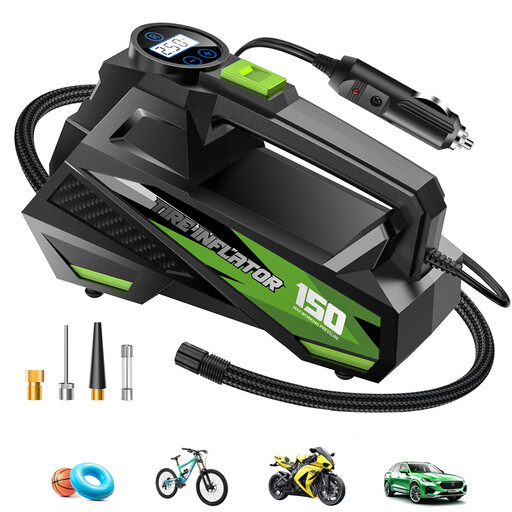
Why This Fits Their Persona: This is for the driver who wants a simple, reliable tool for the boot without paying for features they won't use. Its 12V wired design means it's always ready for an emergency, drawing power directly from the car.
By being a straightforward 12V corded pump, it completely avoids the dead battery pitfall of cheap cordless models. Its simplicity means fewer points of failure, focusing on the core job of inflation.
Ultimate Reliability: No battery to charge or degrade over time. Cost-Effective: Provides the essential function of tyre inflation at an accessible price point.
We have compiled a complete, real-time list of products that fully satisfy these strict selection criteria and UK safety regulations.
The lifespan of a portable inflator depends on its type and build quality. For cordless air compressor models, battery health is key. To prolong its life, avoid storing it in extreme temperatures (like a hot car in summer) and recharge it every 3-6 months, even if unused. For all models, the motor has a "duty cycle," meaning it needs to cool down after a period of continuous use (e.g., 10 minutes on, 10 minutes off) to prevent overheating and damage. A well-maintained device from a reputable brand should provide several years of reliable service.
Most modern digital gauges are reasonably accurate for roadside use, typically within +/- 1-2 PSI. However, they may not be as precise as a dedicated, high-quality analogue or digital pressure gauge. It is good practice to occasionally cross-check the reading with a separate, trusted gauge to ensure your inflator remains calibrated and your tyres are set to the exact pressure specified by your vehicle's manufacturer.
No, you should not leave a 12v air compressor plugged into your car's power socket when not in use. It can slowly drain your car's battery. It is designed for temporary use and should only be plugged in when you are about to inflate your tyres. For best results and to avoid straining your car's battery, it is recommended to have the engine running while operating the compressor.