
24/7 Customer Support

Free returns

Same-day & Next-day Delivery

Quality Guaranteed

Unlock Your Welcome Offers: FREE Delivery | Up to 80% OFF | Free 30-day JoyPlus trial
Download the APP
That familiar, unwelcome glow of the tyre pressure warning light on your dashboard can instantly add stress to any journey. It often signals a frantic search for the nearest petrol station, only to find the air machine is out of order or requires a pocketful of change you don't have. A reliable portable tyre inflator kept in your boot eliminates this hassle, providing peace of mind and a crucial safety tool for any UK driver.
Whether you're a daily commuter, a weekend road-tripper, or a cyclist, maintaining correct tyre pressure is essential for safety, fuel efficiency and tyre longevity. This guide is designed to help you understand the key features to look for and to showcase a few standout options available today, helping you make a practical and informed choice for your car, motorcycle or bicycle.
Navigating the market for a portable air compressor can be confusing. To simplify your decision, focus on these three practical considerations.
The first major choice is how the inflator is powered.
A pump's performance is measured by its airflow, often in Litres Per Minute (LPM), and its maximum pressure, measured in Pounds per Square Inch (PSI). A higher LPM means faster inflation. While most car tyres require a pressure of around 30-35 PSI, a good inflator should offer a much higher maximum (e.g., 120-150 PSI). This ensures it has enough power to handle a wide range of vehicles, from cars and motorcycles to some vans and caravans.
Modern features can make the process significantly easier and safer. A digital tyre inflator with a clear screen allows you to see the current pressure and set your target PSI precisely. The most useful feature is auto-shutoff. Simply set your desired pressure, and the electric tyre pump will automatically stop once it's reached. This prevents dangerous over-inflation and means you don't have to constantly monitor the process.
Here are a few recommendations that balance performance, features and practicality for UK vehicle owners.
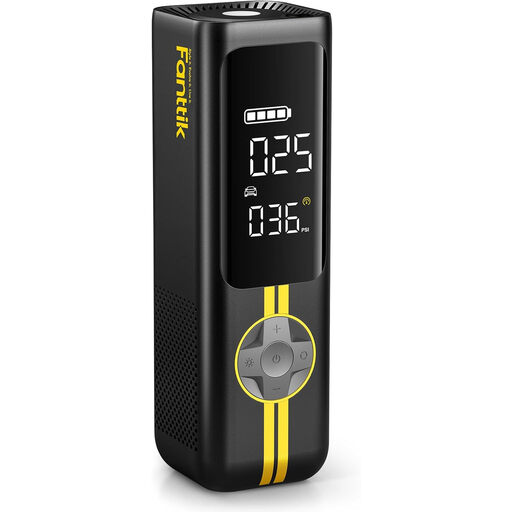
Why It Stands Out: This model is built for speed and convenience. Fanttik highlights its rapid inflation capabilities, making it a great option for those who want to get back on the road quickly. Its cordless design and powerful battery make it exceptionally versatile.
Pros:
Who is it for? Drivers who prioritise speed and the latest technology in a compact, cordless package. It's an excellent all-rounder for cars, motorcycles and bikes.
View Product Details on Joybuy.co.uk
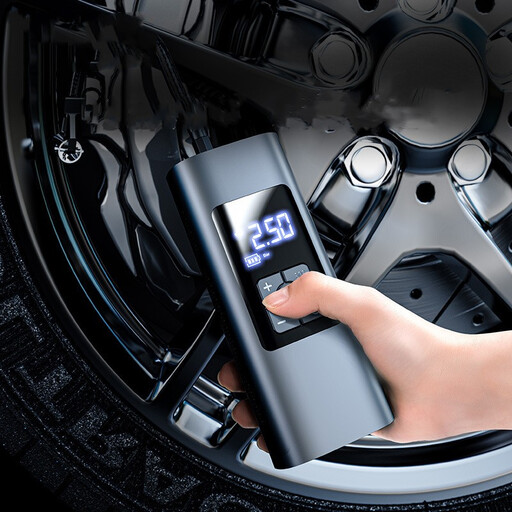
Why It Stands Out: The key feature here is flexibility. With its dual-power system, you can use the 6000mAh battery for cordless convenience or plug it into your car's 12V socket for continuous power, ensuring you're never caught out.
Pros:
Who is it for? The practical user who wants a reliable backup for any situation. The dual-power option makes it a dependable choice for long trips and everyday use.
View Product Details on Joybuy.co.uk
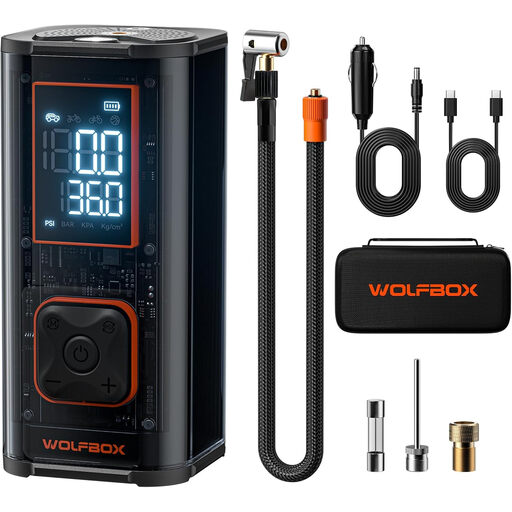
Why It Stands Out: This is a robust, heavy-duty unit designed for more demanding tasks. Its double-cylinder motor provides a high airflow rate (45LPM), making it suitable for larger vehicles that require faster inflation.
Pros:
Who is it for? Owners of larger vehicles like SUVs, vans or pickup trucks, or anyone who needs a powerful and fast car tyre pump for frequent use.
View Product Details on Joybuy.co.uk
The right portable tyre inflator depends on your specific vehicle and needs. If the models above aren't quite what you're looking for, there are many other options to consider.
Explore our full range of tyre pump models to find the perfect fit for your vehicle and budget.
Yes, most models can inflate a tyre from flat, but it will take considerably longer and consume more power than a simple top-up. For cordless models, this will use a significant portion of the battery. For this task, a more powerful unit or a 12V tyre inflator that draws continuous power from the car is often a better choice.
Modern digital inflators are generally quite accurate, typically to within ±1 PSI of the set pressure. The auto-shutoff feature relies on this accuracy to prevent over-inflation. However, it is always good practice to occasionally verify the pressure with a separate, reliable tyre gauge.
Charging time for a rechargeable air pump varies based on its battery capacity and the charger used. Most models will fully charge in 3 to 5 hours using a standard USB-C or similar connection. Always refer to the manufacturer's specifications for precise charging times.