
24/7 Customer Support

Free returns

Same-day & Next-day Delivery

Quality Guaranteed

Unlock Your Welcome Offers: FREE Delivery | Up to 80% OFF | Free 30-day JoyPlus trial
Download the APP
Adding smartphone navigation and hands-free music to an older car does not necessarily require replacing the factory head unit. A portable wireless CarPlay screen can provide Apple Maps, Google Maps, Waze, calls and audio through a separate dashboard-mounted display. However, the right choice depends on more than screen size.
Marketing descriptions often make these devices appear universally compatible and effortless. Before buying, check the following common pitfalls.
Wireless Apple CarPlay and Android Auto require compatible smartphone software. For example, the ESSGOO screens listed here support iOS 12 or later and Android 11 or later, while the OTTOCAST P3 requires at least iOS 10 or Android 11.
A phone may also need Bluetooth and Wi-Fi enabled for wireless pairing. If your handset is older or has restricted software support, a wired connection or newer phone may be necessary.
A plug-and-play car screen usually runs from a 12V cigarette lighter socket and mounts to the windscreen or dashboard. It does not automatically route sound through the car speakers.
Audio may instead use:
FM performance can vary depending on local radio interference. If your car has an AUX input, this is often a practical option for a consistent connection.
A CarPlay AI box is different from a portable CarPlay display. It plugs into a vehicle’s original USB or USB-C data port and uses the existing factory touchscreen. The vehicle must already have factory-wired CarPlay activated.
This means an AI box is generally unsuitable for cars with no CarPlay, aftermarket head units or incompatible factory systems. The OTTOCAST P3 specifically excludes BMW and Tesla models, and its product information states that it is not compatible with aftermarket head units.
A 9-inch CarPlay display is usually easier to position in a smaller car, while a 10.26-inch CarPlay display provides a wider viewing area for maps and split-screen information. Larger screens can be useful in SUVs, lorries, motorhomes and minibuses, but they also occupy more dashboard space.
Resolution affects map clarity and text sharpness. The ESSGOO 9-inch model uses 1024 × 600 resolution, while the ESSGOO 10.26-inch model uses 1600 × 600 resolution. The Carpuride V92 is specified with a 1080p touchscreen.
Brightness adjustment and day/night modes are useful in changing UK light conditions. A screen should be positioned securely and outside the driver’s main view, without obstructing visibility or controls.
Most portable car multimedia players connect through a 12V socket. Some models support 12–24V input, which makes them suitable for many cars, vans, lorries and motorhomes. Always confirm the socket type, cable length and available dashboard space before ordering.
The ESSGOO 9-inch screen includes a 3.5-metre power cable, which can help with installations where the socket is behind the centre console or further away in a larger vehicle.
A car touchscreen with Bluetooth is convenient, but Bluetooth compatibility between the screen and vehicle may differ. Check whether your car supports Bluetooth media playback, not only hands-free calls.
An FM transmitter car screen can work with older vehicles that have no AUX input, although it requires an unused frequency. For the most direct audio route, look for a model with both Bluetooth and AUX. Built-in speakers are useful as a fallback, particularly in commercial vehicles or temporary installations.
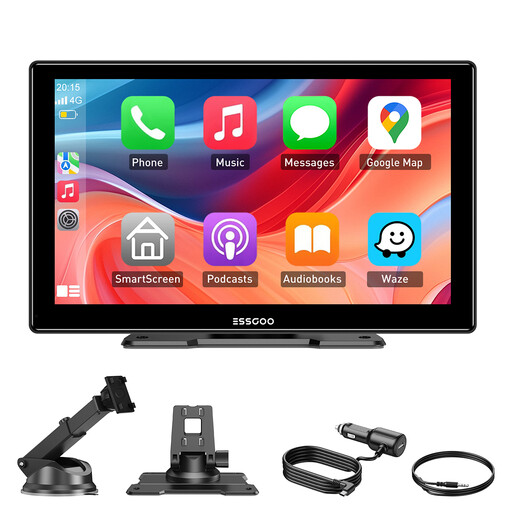
Why This Fits Their Persona: A straightforward option for drivers upgrading an older car without modifying the original stereo. Its 9-inch format suits everyday commuting and smaller dashboard footprints.
It lists supported phone versions, 12–24V power and four audio output methods, making the installation requirements easier to check before purchase.
9-inch HD display, wireless CarPlay and Android Auto, plus Bluetooth 5.3, FM transmitter and AUX output.
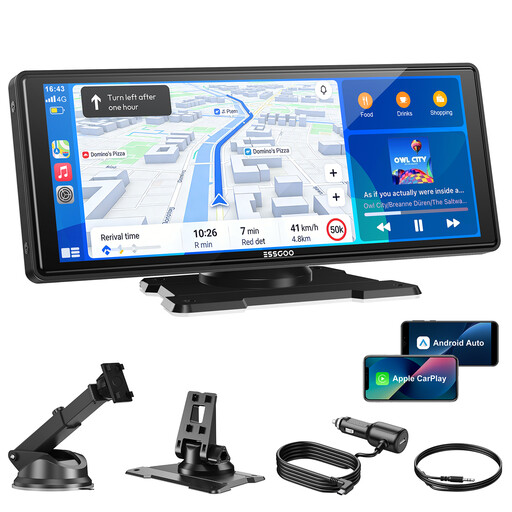
Why This Fits Their Persona: Suitable for drivers who want a wider display for navigation, voice control and daily media use in a car, SUV, MPV or lorry.
The specification clearly identifies resolution, brightness control, day/night mode, power requirements and audio choices rather than relying only on size claims.
10.26-inch 1600 × 600 display, dual-band Wi-Fi, Bluetooth 5.3 and OTA update support.
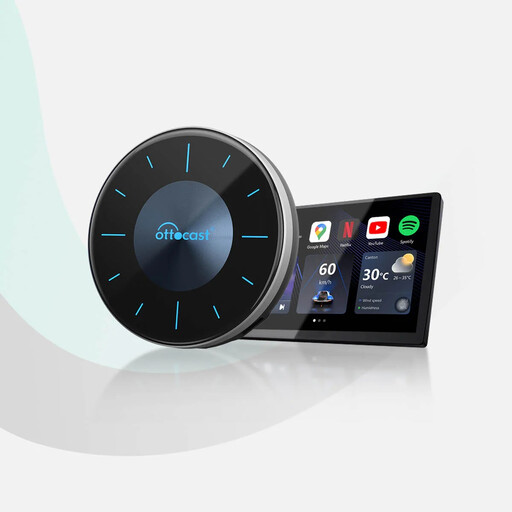
Why This Fits Their Persona: Designed for vehicles with factory-wired CarPlay and users seeking app access, expanded storage or rear-seat entertainment through HDMI.
It states the essential factory-wired CarPlay requirement and excludes BMW, Tesla and aftermarket head units, reducing compatibility uncertainty.
Android 12, 8GB RAM, 128GB storage, 4G SIM support and HDMI output for an external monitor.
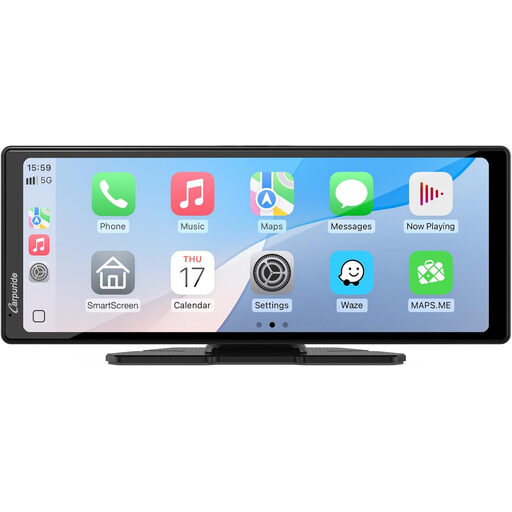
Why This Fits Their Persona: Its large-format display is worth considering for motorhomes, vans and vehicles where map visibility and a dedicated screen are priorities.
The dedicated portable format avoids replacing the existing head unit, while the listed display size helps buyers plan dashboard placement in advance.
10.26-inch 1080p touchscreen with wireless CarPlay, wireless Android Auto, Bluetooth 5.0 and MirrorLink support.
We have compiled a complete, real-time list of products that fully satisfy these strict selection criteria and UK safety regulations.
Before ordering a portable wireless CarPlay screen, confirm:
Use voice control and set navigation before moving off. The screen should not obstruct your view, and video functions should only be used in accordance with UK road-safety requirements.
Most are designed as plug-and-play car screens. Mount the unit, connect it to the 12V socket, pair your phone and select an audio method. A professional installer is generally not required, although cable routing should be neat and secure.
The display itself normally uses your phone’s data connection for live maps, traffic updates, music and online services. An AI box may use a mobile hotspot or its own 4G SIM, depending on the model and app requirements.
Lifespan depends on heat exposure, mounting security, cable condition and frequency of use. Check the stated operating temperature, warranty terms and update support. A screen with brightness controls, a screen saver and OTA firmware updates may be easier to maintain for regular in-car use.