
24/7 Customer Support

Free returns

Same-day & Next-day Delivery

Quality Guaranteed

Unlock Your Welcome Offers: FREE Delivery | Up to 80% OFF | Free 30-day JoyPlus trial
Download the APP
A portable air pump can be useful for much more than a flat car tyre. The right model may help maintain vehicle pressure, inflate bicycle tyres, prepare a paddle board or top up sports equipment. However, product listings often focus on impressive pressure figures while leaving out the details that determine whether an inflator is practical in everyday UK use.
Before buying, watch for three common pitfalls:
Start with the recommended pressure for the item you are inflating. For a car, check the vehicle’s tyre placard or handbook rather than using the maximum figure printed on the pump. Motorcycles and bicycles may require different pressure ranges, while SUP boards typically use low-pressure, high-volume airflow.
A digital tyre inflator lets you set or monitor pressure on a display. This can make repeat inflation more straightforward, but the reading should still be treated as a guide and checked against the manufacturer’s instructions. An air pump with pressure gauge is useful when you want to observe pressure manually.
A stated figure such as 150 PSI or 160 PSI is a maximum operating specification, not a recommendation for every tyre or inflatable. For sports balls and bicycle tyres, a suitable nozzle and controlled inflation are more important than a high headline number.
Electric pumps are often described as fast, but speed depends on the object’s volume, starting pressure and the pump’s airflow. A compact electric air compressor may be convenient for topping up a tyre, whereas a larger SUP air pump is designed to move more air into a board.
Check whether the product is intended for short inflation sessions. Many portable tyre inflators need cooling breaks after extended use. Follow the supplied instructions and avoid running a pump continuously beyond its stated operating guidance. For several car tyres, a corded model with a 12V connection may be more practical than a small rechargeable air pump.
Consider where the pump will be used:
A long cable or hose can make it easier to reach all four car wheels. For bicycles, look for valve compatibility. For balls and toys, check that a needle or tapered nozzle is included. Never force an attachment onto a valve, and keep connectors clean and secure during use.
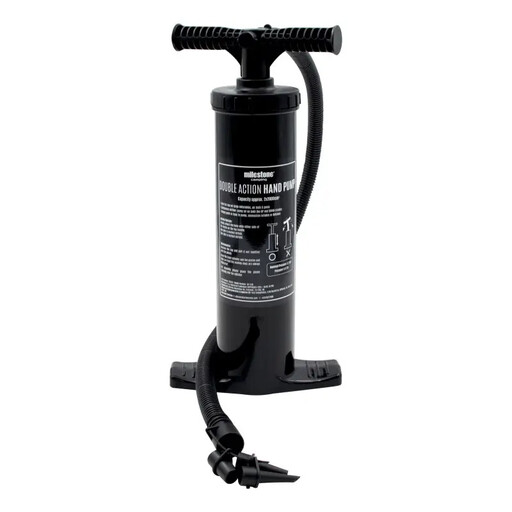
Why This Fits Their Persona: A practical choice for households, campers and occasional users who need a pump for air beds, pool toys and other low-pressure inflatables without relying on a battery or vehicle socket.
It does not depend on a charge level or a maximum PSI headline. The double-action design moves air on both strokes, while three nozzles help address different valve sizes.
Two-litre capacity, large handle, stabilising foot plate, non-kink hose and lightweight construction.
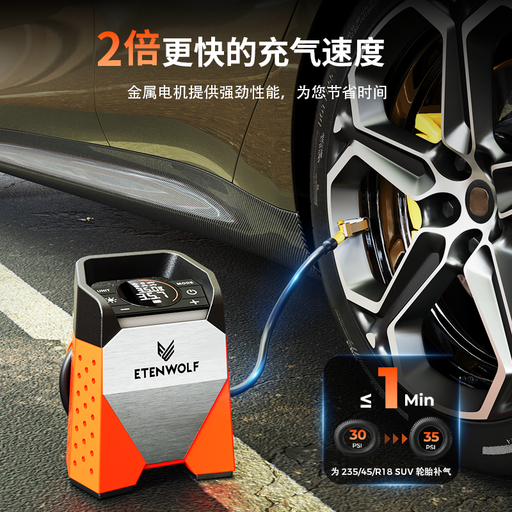
Why This Fits Their Persona: Its battery-powered format suits drivers who want a compact unit for cars, SUVs, bikes and balls, particularly when access to a 12V socket is inconvenient.
The specification identifies the lithium-ion battery, included accessories and automatic stopping at the selected pressure. Users should still charge it before travel and observe the operating instructions.
Listed maximum pressure of 160 PSI, 1.25 CFM airflow, digital controls and included Presta, ball and tapered nozzles.
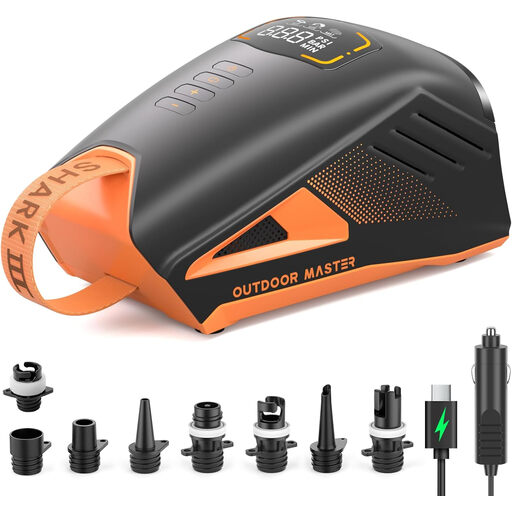
Why This Fits Their Persona: Designed for paddle-board users and outdoor enthusiasts who regularly inflate larger equipment rather than only topping up a vehicle tyre.
Its 20 PSI specification matches the type of pressure required by many SUPs, avoiding the mismatch of using a high-PSI car inflator for a high-volume board.
74Wh battery, Type-C and vehicle DC inputs, digital pressure monitoring, auto-shutoff and inflation/deflation functions.
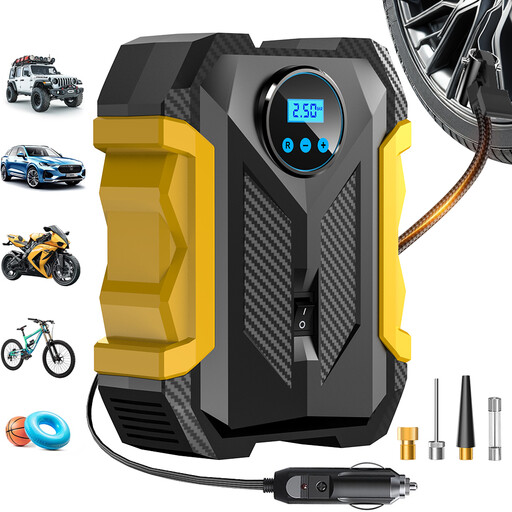
Why This Fits Their Persona: A corded car air pump suits drivers who keep an inflator in the boot for routine checks and roadside top-ups.
The 3-metre cable helps reach vehicle wheels, while the 12V connection avoids depending on a stored battery charge. It should be used as directed with the vehicle running where specified.
150 PSI listed maximum pressure, digital display, LED light and vehicle, motorcycle, bicycle and ball applications.
Use the pressure recommended for your tyre or inflatable, and check pressure when the item is cool where applicable. Park securely before connecting a 12V tyre inflator, apply the handbrake and keep cables away from hot or moving parts. Do not use an electrical pump in wet conditions unless the manufacturer specifically permits it.
For rechargeable models, charge the unit before journeys and store it away from excessive heat and moisture. Allow an electric air compressor to cool between sessions. Inspect the hose, cable, adapter and valve connection regularly; damage or loose fittings can affect performance and safety.
Some are designed for car tyres, including 12V corded inflators and battery-powered models. Check the product’s stated vehicle compatibility, connector type, hose length and operating instructions. A bicycle pump or high-volume inflatable pump may not be suitable for a car tyre.
Their direct running cost is generally limited to electricity used for charging. The practical limitation is battery capacity and charging time. If you regularly inflate several tyres, a corded model may avoid repeated charging; for occasional roadside top-ups, cordless operation can be more convenient.
Lifespan depends on construction, frequency of use, storage and whether the pump is operated within its duty-cycle guidance. Keep it dry, avoid overheating and do not exceed the recommended use period. For emergency readiness, periodically check that the battery charges and that the hose and attachments remain intact.