Induction-ready solo cook
You already have a suitable small saucepan and want adjustable heat, a timer and a hob you can put away after making porridge.


Choose a single-zone induction hob if your small saucepan is induction-compatible and fits the model’s supported base size; adjustable settings give you a way to reduce heat as the porridge warms. A solid-plate hot plate lets you keep a non-induction pan and use a dial, but its plate needs time to cool after cooking. Either way, use a stable, heat-resistant surface and check the socket and cable arrangement.
You already have a suitable small saucepan and want adjustable heat, a timer and a hob you can put away after making porridge.
You want to use a non-induction saucepan and prefer a physical temperature dial to touch controls.
You need a stable place for a portable hob and a cable arrangement that keeps the lead clear of water and hot surfaces. Electrical Safety First highlights these hazards in kitchens.
Choose it when: Your saucepan works with induction and you want adjustable settings for a single-pan breakfast.
Trade-off: The pan must meet the particular hob’s cookware and base-size requirements.
Choose it when: Keeping a non-induction saucepan or using a physical dial matters more to you.
Trade-off: The solid plate remains hot after you switch it off.
For one-person porridge, decide which need comes first, then check the specifications of the particular hob rather than assuming all portable models behave alike.
| Concern | What to check | Who this matters to |
|---|---|---|
| Gentle heat control | Check the lowest stated setting and how you adjust the heat while stirring; maximum wattage alone does not answer this. | If I make porridge regularly, I want to turn the heat down as it warms rather than choose a hob by its maximum output. Around 42% of consumers would put heat control first. |
| Saucepan compatibility | For induction, check the pan’s induction suitability and base diameter against the exact hob’s requirements. | I want to keep using my current saucepan without changing cookware. Keeping an existing pan would be the main concern for around 33% of consumers. |
| Compact, safe setup | Check the hob’s dimensions and placement instructions, and keep the lead clear of water and hot surfaces. Check any extension equipment against the total connected load. | With little worktop space, I need somewhere stable to cook without a trailing lead getting in the way. Around 25% of consumers would prioritise this setup. |
An induction hob needs compatible cookware. Tefal specifies an induction-compatible base measuring 12–25 cm for its IH201840; another model may have different requirements.
Check the marking and base diameter of your saucepan against the exact hob before ordering.
If the pan does not qualify, you will need a compatible saucepan or a different type of hob.
A high maximum rating does not tell you how low the hob can be set while porridge cooks. Cookology states a 120–2100 W adjustment range for the CIPH28SZ, while Tefal states 450–2100 W across nine levels for the IH201840; these specifications do not establish cooking results.
Compare each model’s lower settings, controls and timer rather than treating its maximum rating as a measure of gentle-heat control.
Electrical Safety First warns that connected appliances must not exceed an extension lead’s or cable reel’s maximum current rating. A trailing lead also adds a hazard around a hot hob and water.
Use a suitable wall socket where possible. If an extension device is necessary, check its rating against the combined load, do not daisy-chain devices and fully unwind a cable reel.
The Office for Product Safety and Standards reported a serious fire risk with one specific induction cooker whose plug lacked a conforming BS 1362 fuse link. That report does not describe portable hobs generally.
Check the supplied plug, lead and instructions before use, and consult official recall information if you have a safety concern.
The CIPH28SZ is a single-zone induction option for cooks comparing lower stated power settings and compact storage.
The IH201840 suits a cook who wants a stated pan-base range, stepped power controls and a timer.
The 35240 is a conventional single hot plate for cooks who want to keep using a non-induction saucepan.
The GHP32021UK is another conventional single-plate model to compare with induction options.
These induction models are options to consider if you have, or plan to use, a compatible saucepan for one-person porridge. Compare their controls and pan requirements; the solid-plate alternative remains relevant if keeping a non-induction pan is your priority.
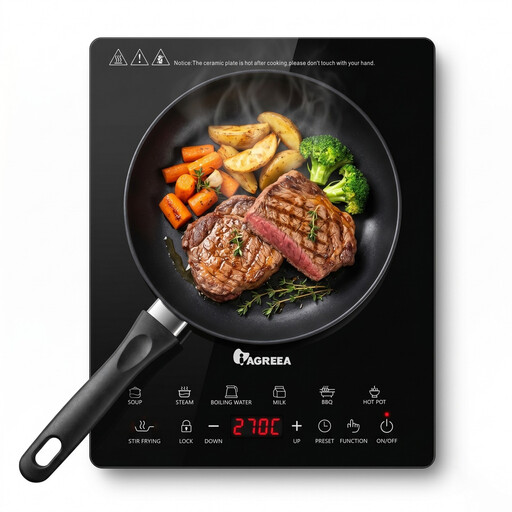 Image unavailable
Consider this model if you want several settings to adjust while cooking one portion of porridge.
The product name specifies 2000 W, eight power levels, 60–270°C temperature control and a three-hour timer. It states a suitable cookware range of 12–26 cm; check that your induction-compatible saucepan fits, as well as the supplied plug and instructions.
 Image unavailable
Consider this model if you have induction-compatible cookware and want a choice of touch-controlled settings.
Its product name specifies 10 power settings, six functions and a safety lock. Check the lowest setting, supported pan-base sizes, dimensions, supplied plug and instructions if those details affect your choice.
It will work only if the saucepan meets that hob’s induction and size requirements. Tefal, for instance, specifies an induction-compatible base of 12–25 cm for the IH201840. Check the base rather than the rim; a conventional hot plate is an alternative if you want to keep a non-induction pan.
Look at the lower controllable settings and how you change them as the mixture warms, not just maximum wattage. Cookology states 120–2100 W for the CIPH28SZ and Tefal states 450–2100 W for the IH201840; neither range alone establishes how your porridge will cook.
Use one only if it is suitable for the combined load of everything connected to it. Electrical Safety First warns against exceeding an extension device’s maximum current rating or daisy-chaining devices; fully unwind a cable reel. A suitable wall socket avoids those additional extension-lead checks.
Stop using the hob and unplug it if you can do so safely. Electrical Safety First identifies hot plugs or sockets, burning smells and damaged cables as danger signs; contact the retailer, manufacturer or a qualified repair professional before using the appliance again.