Students packing light
If you organise notes on a tablet or phone between locations, a keyboard that slips into your bag quickly may matter more than a full-size layout. Logitech’s Keys-To-Go 2, for example, has a built-in cover.


Choose a slim keyboard with a cover if packing light matters most, a compact model with keys described as quiet if you regularly type near other customers, or a foldable keyboard with a fuller layout if longer notes or tablet navigation take priority. Check the exact UK layout and device compatibility before buying; a manufacturer’s quiet-key description is not a comparable noise measurement.
If you organise notes on a tablet or phone between locations, a keyboard that slips into your bag quickly may matter more than a full-size layout. Logitech’s Keys-To-Go 2, for example, has a built-in cover.
If you expect to type beside other cafe customers, key noise and the space a keyboard occupies on the table deserve attention. Logitech and ProtoArc describe quiet-key options, but those descriptions do not establish which model sounds quieter.
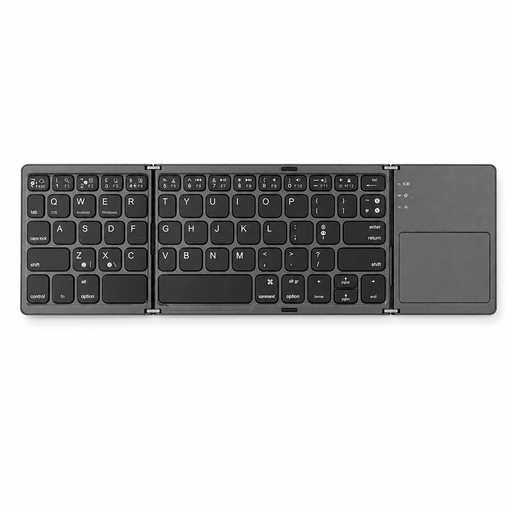
If you reorganise lengthy documents or work across several devices, a fuller layout, device switching or a touchpad may be more useful than the smallest packed size. ProtoArc lists a numeric keypad on its XK01 and a touchpad on its XK01 TP.
Start with how you will carry and use the keyboard, then check its layout and compatibility with the device you take to the cafe.
| Concern | What to check | Who this matters to |
|---|---|---|
| Packability and protection | Compare packed dimensions and weight; check whether a cover is included. | If I carry my study device and notes between locations, I want a keyboard that takes little bag space and has protected keys. Around 42% of consumers put packability and protection first. |
| Typing near other people | Look for a quiet-key description, but do not treat it as a measured noise comparison; consider whether the key feel suits you. | When I type beside other customers, I want to limit disturbance without giving up a layout I can use comfortably. For around 33% of consumers, shared-space typing is the primary concern. |
| Device and note-taking workflow | Confirm operating-system and Bluetooth compatibility, the exact key layout, and whether you need device switching or a touchpad. | If my notes move between a tablet, phone and laptop, I need controls that fit those devices and the way I edit. Device compatibility and workflow come first for around 25% of consumers. |
A different regional layout can put punctuation and currency characters in unfamiliar positions while you type notes.
Check the exact variant rather than relying on the keyboard’s size or brand. Apple identifies a British English Magic Keyboard variant, while ProtoArc identifies UK-layout XK01 variants.
A foldable keyboard can fit in a bag yet take up considerably more room when opened. ProtoArc lists its XK01 TP at 297 g; its expanded width is 386.4 mm.
Compare both the packed dimensions and the opened footprint with the bag and cafe table you expect to use. If minimal carry bulk matters more than a fuller layout, consider a slimmer format.
Logitech describes the Pebble Keys 2 K380s as having quiet low-profile keys, and ProtoArc describes the XK01’s scissor switches as quiet. Those claims do not provide a common measured sound level or settle which key feel you will prefer.
If noise is your main concern, use the descriptions to narrow your choices, then try the keys where possible and check the seller’s return terms before buying.
These brands illustrate different keyboard features relevant to cafe study; check the particular model rather than assuming every keyboard from a brand has the same layout or compatibility.
Portable Bluetooth choices ranging from the covered Keys-To-Go 2 to the compact Pebble Keys 2 K380s.
UK-layout foldable keyboards for a fuller typing layout, with a touchpad available on the XK01 TP variant.
A British English compact Magic Keyboard for buyers using the Apple devices and software specified by Apple.
The Designer Compact Keyboard is a compact option for compatible Windows devices.
These keyboards cover compact multi-device, full-size UK-layout and Bluetooth options for organising notes away from a desk. Compare their stated layouts carefully: several of the models below have a US layout.
 No image available
Consider this 78-key model if you want a compact keyboard for switching between study devices. Its title lists Bluetooth 5.0/4.0 and 2.4 GHz connections, plus support for four devices.
The stated QWERTY US layout may put characters in different positions from a UK keyboard. Check its weight if that will determine whether you carry it regularly.
 No image available
Consider this model if a full-size UK layout matters more to you than carrying the smallest keyboard. Its product title identifies it as a wireless keyboard.
Before choosing it for a cafe, compare its stated 380 × 150 mm footprint and 520 g weight with your table space and bag. Its quiet-key description is a product claim, not a measured comparison.
 No image available
Consider this model if you want a mechanical keyboard with a number-key section for organising notes. Its title lists wired, Bluetooth and 2.4 GHz connection modes.
The stated QWERTY US layout needs checking if you normally type on a UK keyboard. Compare its physical size and weight with what you are willing to carry; sound-dampening claims are not measured cafe-noise results.
 No image available
Consider this 75% layout if you prefer fewer keys than a full-size keyboard while organising notes. The title lists wired, Bluetooth and 2.4 GHz modes, RGB backlighting and PBT keycaps.
Check whether its QWERTY US layout suits your typing. Compare its weight and dimensions before choosing it for your bag, and do not treat its sound-dampening description as a measured noise level.
 No image available
Consider this Bluetooth model if you take notes on a phone, tablet or computer; its title identifies those device categories as compatible.
Check the exact regional key layout, device compatibility and charging expectations before relying on it for a cafe study session. If packing size or quiet typing is decisive, confirm those details for this variant too.
Choose a British English or UK layout if you rely on familiar positions for characters such as £ and @. Check the exact variant title before buying: Apple identifies a British English Magic Keyboard, and ProtoArc identifies UK-layout XK01 variants, but portable keyboards also come in other layouts.
Pair it with the device you plan to use before your study session. Logitech advises putting the keyboard in pairing mode, opening the device’s Bluetooth settings and selecting the keyboard; enter a pairing code if prompted. Check the instructions for your particular model if its pairing controls differ.
A touchpad may be useful if you want cursor control without carrying a separate mouse; it matters less if you are comfortable using the tablet’s touchscreen. ProtoArc lists an integrated touchpad on its foldable XK01 TP, so check that your preferred version includes one rather than assuming all foldable keyboards do.
A rechargeable keyboard needs charging before you leave, whereas a replaceable-battery model requires the correct spare batteries when they run down. Apple lists USB-C charging for its Magic Keyboard; Microsoft says its Designer Compact Keyboard uses four CR2032 coin cells. Check the power arrangement of the exact model you choose.
Take unwanted electrical products and batteries to an appropriate recycling collection point rather than putting them in household rubbish. GOV.UK provides guidance on recycling electrical products and batteries; check local collection arrangements for the item you have.