
24/7 Customer Support

Free returns

Same-day & Next-day Delivery

Quality Guaranteed

Unlock Your Welcome Offers: FREE Delivery | Up to 80% OFF | Free 30-day JoyPlus trial
Download the APP
A portable mini fridge can be useful for chilled drinks, snacks, skincare and toiletries, but compact appliances are not interchangeable. A product that works well on a bedroom desk may be unsuitable for a long car journey, while a small drinks cooler may not provide the organisation needed for cosmetics or food.
Before buying, watch for three common pitfalls:
A thermoelectric mini fridge is compact because it does not use a compressor or refrigerant. It is generally suited to maintaining chilled drinks, snacks, skincare products and toiletries rather than freezing contents.
Check both the cooling range and the conditions used to describe it. For example:
Do not use a warming function for items that require precise food-safety temperatures unless the manufacturer gives suitable instructions. For skincare and cosmetics, follow the storage guidance on each product rather than assuming colder is always preferable.
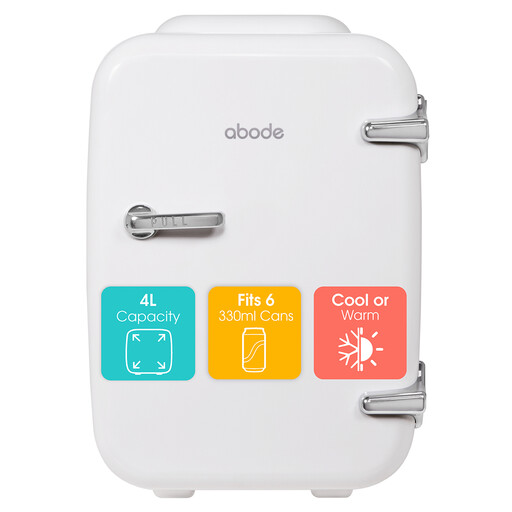
A 4 litre mini fridge is usually suitable for a few cans, snacks, face masks or small toiletries. The stated capacity may be based on 330 ml cans, so compare this with the items you actually plan to store.
A 6 litre mini fridge offers additional height or depth for drinks and bottles. One example can hold up to eight 330 ml cans, or four 550 ml bottles when arranged appropriately. Always check both internal and external dimensions before placing one on a desk, bedside table or caravan shelf.
Look for practical features such as:
An AC/DC mini fridge gives you more flexibility than a mains-only model. A 220–240V AC lead is intended for compatible household or office sockets, while a 12V DC cable can connect to a vehicle socket.
Before buying, confirm:
A car mini fridge should be secured so it cannot slide or tip during travel. Do not place it where it restricts visibility, interferes with airbags or blocks access to vehicle controls.
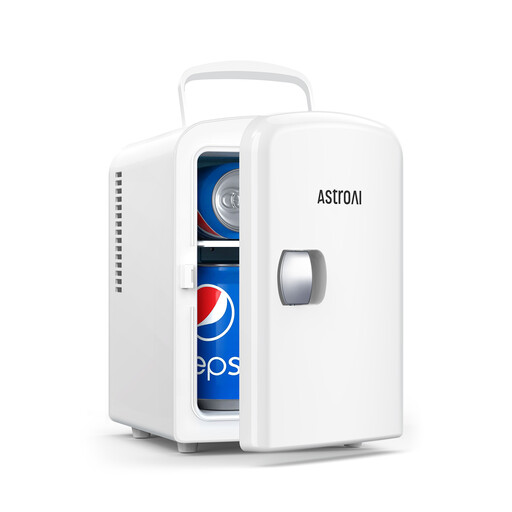
Why This Fits Their Persona: Its compact footprint suits a bedroom, university room or home office where space is limited. The 4-litre capacity is sized for up to six 330 ml cans, snacks or small personal-care items.
The listing states the cooling limit clearly: up to 20°C below ambient, with no freezing function. This helps set realistic expectations for a thermoelectric model.
Includes 220V AC and 12V DC cables; warming reaches up to 66°C. Internal dimensions are approximately 20.5 × 14 × 13.5 cm.
Why This Fits Their Persona: The retro white finish works well in a visible bedroom, home office or university accommodation, while the carry handle makes occasional travel more convenient.
Its specifications distinguish thermoelectric cooling from fixed-temperature refrigeration, stating 16–20°C below ambient rather than implying freezer performance.
Includes a removable wire shelf, inner door pocket, AC mains lead and 12V car adapter. The listed weight is 2 kg.

Why This Fits Their Persona: The extra capacity is practical for regular car trips, camping, caravanning, travel or users storing several drinks and skincare items together.
The product information specifies a cooling chip rather than a compressor, a minimum of 0°C and no freezing capability. It also recommends keeping the door closed and power connected.
Holds up to eight 330 ml cans, or four 550 ml bottles with the shelves adjusted. It includes AC 220–240V and DC 12V power options, plus a water catch tray.
We have compiled a complete, real-time list of products that fully satisfy these strict selection criteria and UK safety regulations.
For a bedroom mini fridge or office mini fridge, prioritise low footprint, door clearance and noise information where available. Leave ventilation space around the appliance and avoid placing it directly against curtains, bedding or other heat-sensitive materials.
For a skincare fridge, measure bottles and jars rather than relying only on litre capacity. Keep products in their original containers and follow the storage instructions supplied by the manufacturer.
For a portable car fridge or mini fridge for travel, consider weight, handle design, cable length and whether the interior remains stable while moving. A thermoelectric drinks cooler is more suitable for short trips and personal quantities than for long-term food storage.
Running cost depends on the appliance’s wattage, how long it operates and your electricity tariff. Use the product’s stated power rating to estimate consumption: watts ÷ 1,000 × hours used equals kilowatt-hours. Thermoelectric models require ongoing power when cooling, so switching to standby or unplugging when not needed can reduce unnecessary use.
Generally, no. These appliances cool below ambient temperature but are not designed to freeze contents. Their performance also varies with room or vehicle temperature. Choose a compressor-based appliance if you need consistent low-temperature or freezing performance.
Only do so when the vehicle’s power system and the product instructions permit it. Check the 12V socket, fuse and battery condition, and remember that some sockets may remain live after the engine is switched off. For safety, secure the unit, maintain ventilation and avoid leaving temperature-sensitive food in it for extended periods without confirming the internal temperature.