People adding milk to an after-exercise snack
Standard skimmed milk is worth considering if you want a dairy drink for a snack, cereal or shake and plan to check its protein and fat values against the rest of what you are having.


Standard skimmed milk is an option when you want a low-fat dairy drink alongside an after-exercise snack. If protein per drink is your main consideration, compare the labelled serving and fat classification of an enriched milk rather than assuming it is also skimmed. A lactose-free option calls for a separate allergen check, while the word “mature” does not identify a particular milk specification.
Standard skimmed milk is worth considering if you want a dairy drink for a snack, cereal or shake and plan to check its protein and fat values against the rest of what you are having.
If the amount of protein in one serving matters to you, compare the exact labels. A protein-enriched milk may be semi-skimmed rather than skimmed.
If lactose-containing dairy causes symptoms, you may be considering a lactose-free option. Cow’s-milk allergy is a different consideration: check the milk allergen declaration rather than treating lactose-free cow’s milk as an allergy-safe substitute.
University College London Hospitals NHS Foundation Trust describes an after-exercise snack as including carbohydrate and protein. For a milk purchase, start with the intended serving, then check whether the product’s fat classification, allergen information and storage instructions fit how you will use it.
| Priority | What to check | Your needs |
|---|---|---|
| Protein per drink | Compare protein for the serving you intend to pour, using the same labelled basis where possible. Check whether an enriched product is skimmed or semi-skimmed. | I want to know how much protein my drink contributes, rather than assuming every carton labelled skimmed or high-protein is the same type of milk. |
| Snack ingredients | Look at the milk’s carbohydrate and fat values per 100ml or per serving. Consider what else is in the snack instead of judging the milk in isolation. | After a longer session, or when my next meal is some time away, I may want carbohydrate-containing food alongside the milk. |
| Lactose and allergens | Check whether the milk is labelled lactose-free and read its milk allergen declaration. Lactose-free cow’s milk and a milk-free product are not interchangeable. | If lactose-containing milk causes symptoms, I need an option I tolerate. If I have a cow’s-milk allergy, I need to check for milk ingredients, not just lactose. |
| Storage and pack size | Read the refrigeration and after-opening instructions on the pack. Check that its size suits the amount you can use within those instructions. | A larger pack only suits me if I can store it as directed and use it in time. |
Skimmed describes a fat classification, not a fixed amount of protein. M&S lists 3.6g protein per 100g for its skimmed milk; Tesco lists 5.5g per 100ml for Arla Protein semi-skimmed milk. Those figures use different measurement bases and should not be treated as a like-for-like serving comparison.
Use the nutrition panels to compare the amount you would actually drink, and check the enriched milk’s fat classification.
The word alone does not tell you a milk’s protein content, fat classification, lactose status or flavour. Retail ranges such as Tesco’s identify options using descriptions including skimmed and filtered.
Decide which characteristic you mean by “mature”, then look for that characteristic on the particular product label.
The NHS describes lactose intolerance in relation to lactose in dairy products. A lactose-free cow’s milk is still a milk product and should not be assumed suitable for someone with a cow’s-milk allergy.
Read the allergen declaration. If symptoms suggest an allergy, seek medical advice rather than substituting lactose-free cow’s milk on your own.
Sainsbury’s and M&S each give refrigeration instructions and a three-day period after opening for the skimmed milk products described in their listings. Instructions for the pack you buy take precedence.
Check its label before choosing a size you may not finish within the stated period.
Milk left beyond the pack’s after-opening instructions may go unused.
These examples illustrate product descriptions and label details to compare; a brand’s inclusion does not make all of its milk products equivalent.
Tesco’s skimmed-milk range lists own-label standard and filtered options alongside branded milk.
Sainsbury’s British Skimmed Milk is an example with serving, allergen and storage information in its product listing.
Cravendale appears as a filtered skimmed-milk option in UK retailer ranges.
M&S provides nutrition and storage information for its own-label skimmed milk.
Waitrose & Partners presents filtered milk as a freshness-focused option within its fresh-milk range.
These two Morrisons UHT skimmed-milk pack variants are options for a standard skimmed-milk drink or shake. Compare their pack sizes with how much milk you expect to use.
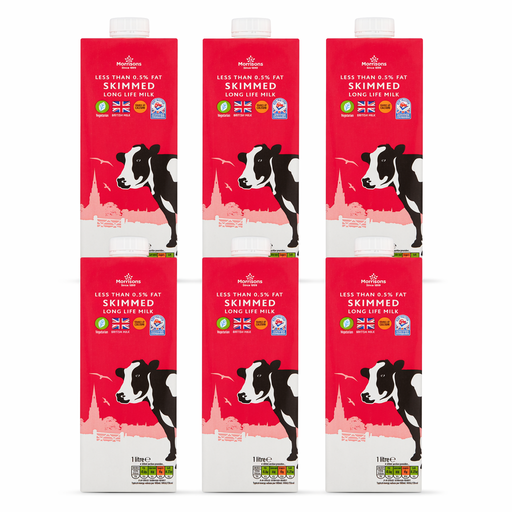 No image available
For a skimmed-milk drink alongside an after-exercise snack, this UHT option comes as six 1 litre packs. Check the nutrition panel and storage instructions for the amount you plan to use.
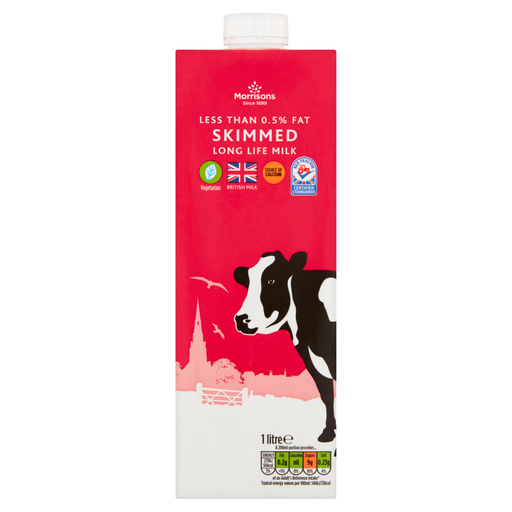 No image available
For a skimmed-milk drink alongside an after-exercise snack, this is the 1 litre UHT variant. Check its nutrition panel, milk allergen declaration and storage instructions before choosing a serving.
Skimmed milk can be part of an after-exercise snack, but do not assume the drink alone covers everything you want from that snack. University College London Hospitals NHS Foundation Trust describes after-exercise snacks as including carbohydrate and protein; consider accompanying food when putting yours together.
Choose by the labelled protein in the serving you would drink and the milk’s fat classification. For example, Tesco lists Arla Protein at 5.5g protein per 100ml, but identifies it as semi-skimmed, so it is not the same type of product as standard skimmed milk.
Do not treat lactose-free cow’s milk as suitable for a cow’s-milk allergy. The NHS distinguishes lactose intolerance from food allergy; check the product’s milk allergen declaration and seek medical advice if symptoms suggest an allergy.
Follow the instructions on the pack you buy. Sainsbury’s says to keep its British Skimmed Milk below 5°C and consume it within three days of opening; M&S gives a range of 0°C to 5°C and a three-day after-opening period for its listed skimmed milk.