Revision snackers comparing calories
You want a savoury snack in a small pack and would rather compare its labelled calories with those of a larger bag before choosing.


For a small revision-break snack, Walkers Oven Baked Sea Salt has the lowest calories and fat per 100 g of the named products compared here: Walkers lists 96 kcal per 22 g pack and 438 kcal per 100 g. If you prefer conventional potato crisps, compare the amount you plan to eat as well as the per 100 g figures; the baked option also needs its ingredients and allergen warnings checked.
You want a savoury snack in a small pack and would rather compare its labelled calories with those of a larger bag before choosing.
You snack during study breaks and want the amount you intend to eat to be clear, whether that means choosing an individual pack or serving some from a larger bag.
You need to read the exact flavour’s ingredients and allergy statement. A potato-based product may still contain other ingredients or carry allergen warnings.
Start with the amount you expect to eat during a break. Then use the per 100 g label to compare products sold in different pack sizes.
| Priority | What to check | Your needs |
|---|---|---|
| Calories and portions | Check calories for the whole pack or intended serving, then compare per 100 g. Walkers lists 96 kcal per 22 g Oven Baked Sea Salt pack and 438 kcal per 100 g; Tyrrells lists 208 kcal per 40 g Lightly Sea Salted pack and 519 kcal per 100 g. | I want to know the calories in the amount I will actually eat, especially if I open a sharing bag while revising. |
| Fat | Compare the same weight of each named product. Walkers lists 13 g fat per 100 g for Oven Baked Sea Salt; Tyrrells lists 29.3 g per 100 g for Lightly Sea Salted. A baked label alone does not describe every nutritional difference. | If fat is part of my comparison, I still want to check calories and the other lines on the label. |
| Salt | Read the exact flavour’s salt figure for the pack or serving. Walkers lists 0.19 g per 22 g Oven Baked Sea Salt pack, while Seabrook lists 0.4 g per 31.8 g Sea Salted bag. | Salt matters to my choice, so I do not want to assume that similarly named sea-salt flavours have the same figures. |
| Ingredients and allergens | Check the current ingredients and allergy statement for each flavour. Walkers warns that Oven Baked Sea Salt may contain milk, wheat, gluten, barley, soya, celery and mustard; Pipers lists milk ingredients in Lye Cross Cheddar & Onion. | I need the particular pack to suit my dietary requirements, rather than relying on the word “potato” or a claim about another flavour. |
Walkers Oven Baked Sea Salt has lower calories and fat per 100 g than the conventional products compared here, but its label also lists salt and possible allergens.
Compare the calories, fat and salt in the amount you plan to eat, and read the ingredients and allergy statement.
Tyrrells labels its 150 g Lightly Sea Salted bag as five 30 g servings. The bag and one labelled serving are different amounts.
If you want a set amount for a revision break, choose an individual pack or put a portion from the larger bag into a bowl.
Walkers Oven Baked Sea Salt carries several “may contain” warnings, while Pipers Lye Cross Cheddar & Onion contains milk ingredients.
Check the ingredients and allergy statement on the exact flavour and pack you receive, particularly when buying for someone with an allergy or a strict dietary requirement.
These figures refer to the named flavours and formats, not every crisp sold by each brand.
Oven Baked Sea Salt comes in a labelled 22 g pack. Walkers lists 96 kcal per pack and 438 kcal per 100 g.
Lightly Sea Salted is a hand-cooked potato crisp listed at 208 kcal per 40 g pack and 519 kcal per 100 g by Tyrrells.
KETTLE lists 516 kcal and 29.5 g fat per 100 g for its Lightly Salted crisps.
Seabrook lists 164 kcal, 9.7 g fat and 0.4 g salt for a 31.8 g Sea Salted bag.
Pipers lists 533 kcal and 31 g fat per 100 g for Lye Cross Cheddar & Onion.
These options include individually packed crisp-style snacks and a larger bag to portion yourself. Compare each flavour’s own label: the figures for Walkers Oven Baked Sea Salt do not describe every pack in a variety multipack or a different flavour.
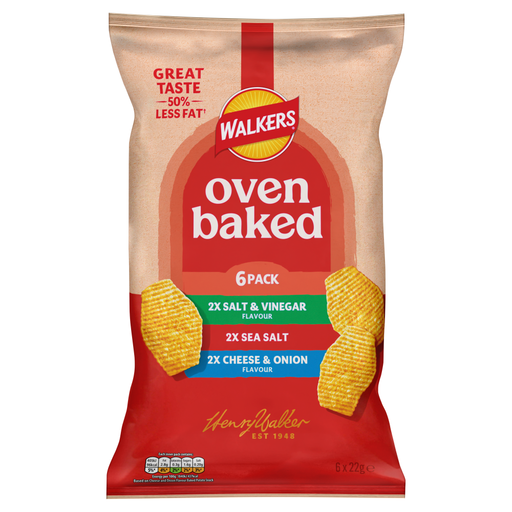 No image available
The individual packs make it easier to choose an amount for a revision break. This is a variety pack, so check the nutrition, ingredients and allergy statement for the flavour you open rather than applying Sea Salt figures to every pack.
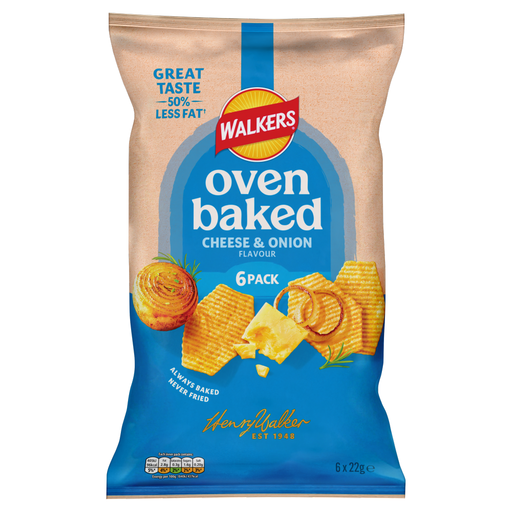 No image available
The 22 g individual packs provide a defined amount for a study break. Check this Cheese & Onion flavour’s own nutrition and allergy label; the Sea Salt figures elsewhere in this article are not figures for this product.
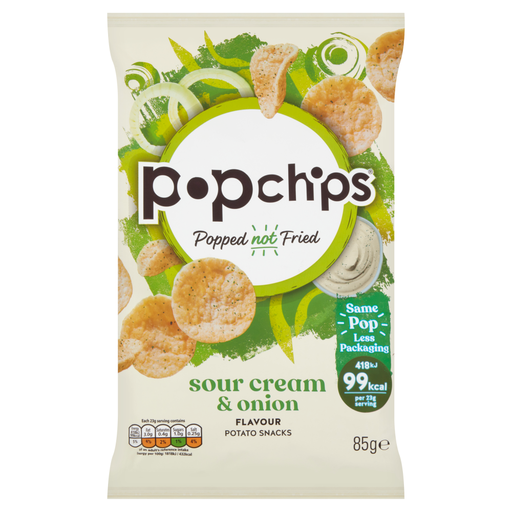 No image available
This larger bag suits someone willing to serve a portion before returning to revision. Read its serving-size, nutrition and allergy information when deciding how much to put out.
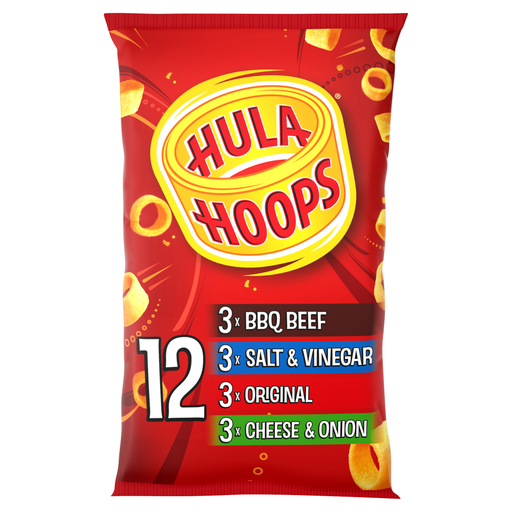 No image available
The individual 24 g packs give you a defined amount for a revision break. Compare the nutrition and allergy details for the particular flavour you choose rather than assuming every pack in the variety has the same label.
No: compare the named products and their labelled amounts. Walkers lists 96 kcal per 22 g pack and 438 kcal per 100 g for Oven Baked Sea Salt, but a baked description does not replace checking calories, salt, ingredients and allergens on another product.
Use the bag or serving figure for the amount you plan to eat, and the per 100 g figure to compare different pack sizes. Tyrrells lists 208 kcal per 40 g Lightly Sea Salted pack and 519 kcal per 100 g; Seabrook lists 164 kcal per 31.8 g Sea Salted bag and 516 kcal per 100 g.
No. Check the current label for the exact product and flavour. Walkers Oven Baked Sea Salt carries several “may contain” allergen warnings, while KETTLE describes its Lightly Salted crisps and Seabrook describes its Sea Salted crisps as gluten-free and suitable for vegans and vegetarians.
No general ban on personal crisp purchases follows from the Food (Promotion and Placement) (England) Regulations 2021: those regulations concern the promotion and placement of specified less-healthy products by qualifying retailers in England. Food supplied by a school is a separate question; the Department for Education’s school-food guidance applies to England, so a school or caterer should check the current requirements for its nation and setting.