Portfolio makers focused on colour
You want glaze hues and tonal relationships to remain reasonably consistent between shoots, so editable files and a repeatable lighting and white-balance process matter more than relying on automatic rendering.


For pottery-glaze portfolio photographs, choose an interchangeable-lens camera with RAW capture and manual exposure controls, then assess the lens and lighting as part of the setup. A 1:1 macro lens is worth considering for small, frame-filling surface details; a 1:2 close-focus lens may suit wider vessel views and less demanding detail shots. Neither magnification nor camera specifications alone will make glaze colour repeatable without a controlled lighting and white-balance workflow.
You want glaze hues and tonal relationships to remain reasonably consistent between shoots, so editable files and a repeatable lighting and white-balance process matter more than relying on automatic rendering.
You photograph texture, small defects, crystalline effects, signatures or test tiles. Lens magnification and room to position lighting around the piece are important alongside the camera body.
You use one camera system for portfolio photographs and studio video, while recognising that a suitable close-focus or macro lens may still be needed for small glaze details.
Start with the smallest glaze detail and the degree of colour consistency your portfolio requires; consider video features once the still-photography setup meets those needs.
| Concern | What to check | Who this matters to |
|---|---|---|
| Repeatable glaze colour | Check RAW capture, manual exposure controls and compatibility with your intended editing and colour-reference workflow. | If I photograph pieces across several sessions, I want to adjust and compare their colour without relying entirely on automatic white balance. Around 33% of consumers put that consistency first. |
| Small surface details | Check the compatible lens’s maximum magnification and its stated focus or working distance; do not judge close-up ability by body resolution alone. | For a small test tile or maker’s mark, I need the detail to occupy enough of the frame to show clearly. This is the primary concern for around 27% of consumers. |
| Glare, form and focus | Look for manual exposure control and plan how you will keep the camera stable and position light around curved, glossy pieces. | When reflected highlights obscure a curved vessel, I need control over lighting and how much of its surface appears in focus. Around 27% of consumers prioritise this. |
| Stills and process video | Confirm the video format you need, the exact lens supplied and whether another close-focus lens is necessary. | If I also film making or glazing, I want one system for that work and my portfolio stills. Video capability comes first for around 13% of consumers. |
RAW files allow editing, but a camera body cannot by itself make a glaze look the same under different lights or on every display and print.
Decide whether you need an attractive portfolio image or a more repeatable colour-reference workflow. For the latter, plan consistent lighting and white balance, and check that a reference target works with your editing software.
Lighting, a reference target and editing add equipment and steps to each shoot.
A camera body’s resolution does not establish how closely its lens can photograph a small patch of glaze.
Check the exact lens’s maximum magnification. Fujifilm and Sony specify 1:1 for the XF30mmF2.8 R LM WR Macro and E 30mm F3.5 Macro respectively; Canon specifies up to 1:2 for its RF 35mm F1.8 Macro.
A separate compatible close-focus or macro lens may be needed for small details.
At high magnification, a short working distance can restrict where lights or reflectors fit around glossy pottery. Sony specifies a minimum working distance of 2.4 cm for its E 30mm F3.5 Macro.
If reflections are central to your work, assess the intended lens and lighting arrangement at the magnification you expect to use, rather than comparing magnification figures alone.
Repositioning lights and reflectors can add setup time for each piece.
Dust may show in evenly lit portfolio photographs, but touching a sensor with unsuitable materials risks damage. Sony warns against commercially available cleaning solutions and cleaning papers for the image sensors covered by its guidance.
Follow the instructions for your exact camera when changing lenses or dealing with dust; if sensor cleaning is needed and you are unsure how to do it, seek an appropriate service provider.
An X-system combination to consider for editable stills and close studies of glaze surfaces.
An RF-system route for portfolio stills and video with a close-focus prime option.
An E-mount route to consider when portfolio stills and process video are both part of the work.
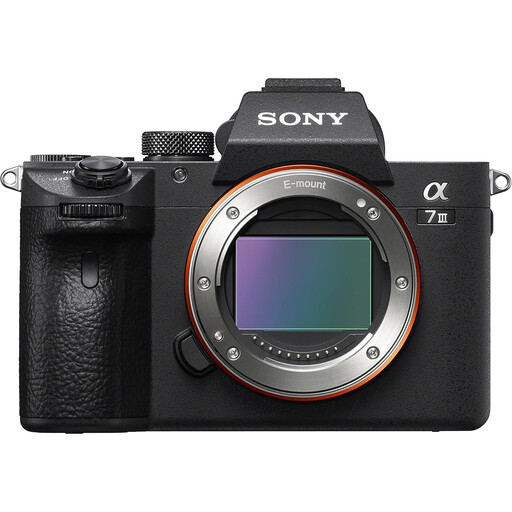
These Sony camera listings offer a choice between a full-frame camera listing and an APS-C stills-and-video kit. Check the exact lens contents and close-focus capability against the glaze details you intend to photograph.
 No image available
Consider this listing for portfolio stills if you are choosing a compatible lens to suit your vessel and detail shots. Confirm the exact box contents before buying: the body-only title conflicts with information describing a supplied lens.
For small glaze details, check the chosen lens’s close-focus or macro specifications separately.
 No image available
This APS-C kit suits makers considering portfolio stills alongside process video. The listing names a 16–50 mm f/3.5–5.6 power zoom, 26-megapixel stills and 4K 60p video.
Check the included zoom’s close-focus specifications before relying on it for tiny glaze details, and confirm the exposure controls you need for tabletop stills.
No. Lighting, white balance, editing and the eventual display or print all affect the result. Adobe documents temperature and tint adjustments in Camera Raw, while Calibrite describes its reference-target workflow as a way to reduce colour differences; neither amounts to a guarantee of a match on every screen or print.
Not for every photograph: wider vessel views and some details may suit a 1:2 close-focus lens. If a very small glaze feature must fill much more of the frame, compare 1:1 options and their working distances. Fujifilm specifies 1:1 for its XF30mmF2.8 R LM WR Macro, Sony specifies 1:1 for its E 30mm F3.5 Macro, and Canon specifies up to 1:2 for its RF 35mm F1.8 Macro.
Follow the cleaning instructions for the exact camera, particularly before touching its image sensor. Sony warns against commercially available cleaning solutions and cleaning papers in its sensor-cleaning guidance; if you are uncertain about sensor cleaning, use an appropriate service provider.
Check an appropriate electrical-equipment collection or take-back route rather than treating an old camera as ordinary household waste. GOV.UK explains that UK waste electrical and electronic equipment rules are intended to reduce equipment sent to landfill or incineration; the available collection arrangements depend on your local authority or retailer.