
24/7 Customer Support

Free returns

Same-day & Next-day Delivery

Quality Guaranteed

Unlock Your Welcome Offers: FREE Delivery | Up to 80% OFF | Free 30-day JoyPlus trial
Download the APP
There is little that disrupts a productive day or a relaxing holiday quite like the dreaded low-battery warning on your phone, tablet or laptop. In an age where staying connected is essential, a reliable power bank is no longer a luxury but a necessity. However, the market is filled with options, making it difficult to distinguish between marketing hype and genuine performance.
This guide is designed to help you understand the key features to look for in a portable charger. We will break down the technical jargon and provide practical advice to help you select a device that fits your lifestyle, whether you are a student dashing between lectures, a professional commuting across the city or a traveller exploring new destinations.
Before diving into our recommendations, let’s cover a few key considerations. Focusing on these three areas will help you narrow down your options and find the perfect match for your devices.
The capacity of a power bank, measured in milliampere-hours (mAh), determines how much charge it can hold. A small, pocket-friendly 5,000mAh unit is perfect for a single full charge on most smartphones, making it an ideal travel power bank for day trips. On the other hand, a 20000mAh power bank offers multiple recharges for your phone and can also power tablets and other larger devices, though it will be heavier and bulkier. If you need to charge a laptop, you will need a high-capacity laptop power bank with a sufficient power output.
A high-capacity power bank is of little use if it takes all day to charge your devices. Look for a fast charging power bank that supports modern standards like Power Delivery (PD) or Quick Charge (QC). The output is measured in Watts (W); a higher wattage means faster charging. A USB C power bank is now the standard, offering versatile and high-speed charging for a wide range of modern electronics, from Android phones and iPhones to the latest laptops.
Beyond core specifications, consider features that add convenience. Some models include built-in cables, so you never have to remember to pack one. A magnetic power bank offers seamless, cable-free charging for compatible iPhones, snapping securely to the back of the device. Others feature digital displays that show the precise remaining battery percentage, taking the guesswork out of recharging.
Here are a few standout options that cater to different needs, from ultra-portability to high-performance charging.
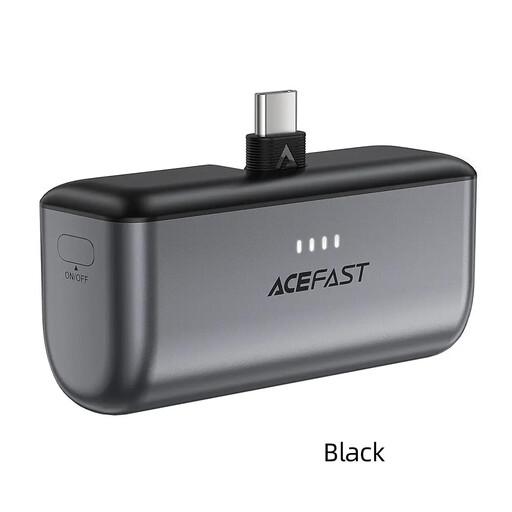
Why It Stands Out: The Acefast M9 is all about convenience and portability. Its unique capsule design includes a foldable, built-in USB-C connector, eliminating the need for a separate cable. It is incredibly compact and lightweight, making it easy to slip into a pocket or small bag for emergency power on the go.
Pros:
Who is it for?: The minimalist who needs a simple, pocket-sized phone battery pack for a quick top-up during their daily commute or a short trip.

Why It Stands Out: This MOVESPEED power bank combines the convenience of magnetic wireless charging with the utility of a built-in stand. Its ultra-slim profile and strong magnetic alignment make it a perfect companion for modern iPhones, allowing you to charge your device while watching videos or taking calls hands-free.
Pros:
Who is it for?: iPhone users who want a sleek, multi-functional charger that offers both wireless convenience and a practical viewing stand for work or entertainment.

Why It Stands Out: For those who need serious power, the REMAX Dinba Series delivers. With a massive 20,000mAh capacity and a powerful 65W USB-C PD output, this is a true laptop power bank. It can charge a MacBook, tablet and phone, often at the same time, making it an indispensable tool for remote workers, students with multiple gadgets or anyone on a long journey.
Pros:
Who is it for?: The power user, digital nomad or frequent traveller who needs a single, reliable solution to keep all their devices—including a laptop—charged and ready.
Our recommendations cover a range of common needs, but your perfect portable charger might have different features. If you are looking for a different capacity, size or even specialised functions, there are many other models to consider.
? Explore our full collection of power banks to find the right fit for your devices and lifestyle.
1. How many times can a 20000mAh power bank charge a phone? This depends on your phone's battery capacity, but a 20,000mAh power bank can typically charge a standard smartphone (with a ~4,000mAh battery) around 3 to 4 times. Keep in mind that all power banks lose some energy during the transfer process, so the usable (or nominal) capacity is always slightly less than the advertised capacity.
2. Can I take a power bank on a plane in the UK? Yes, you can take a power bank on a plane, but it must be in your carry-on luggage, not in checked baggage. UK and international aviation regulations generally restrict batteries to 100 Watt-hours (Wh) without prior airline approval. A 20,000mAh power bank at a standard voltage (3.7V) is around 74Wh, which is well within this limit. However, it is always a good practice to check with your specific airline before you fly.
3. What is the difference between a power bank and a portable charger? There is no functional difference. "Power bank," "portable charger" and "phone battery pack" are all terms used to describe the same device: a portable battery used to charge electronics on the go. The terminology often varies by region or brand, but the core product is the same.