
24/7 Customer Support

Free returns

Same-day & Next-day Delivery

Quality Guaranteed

Unlock Your Welcome Offers: FREE Delivery | Up to 80% OFF | Free 30-day JoyPlus trial
Download the APP
Running out of battery halfway through the day is a modern frustration few of us escape. Whether you're navigating with maps, on a crucial call or simply catching up on your commute, a dead phone is more than an inconvenience. A portable charger, or power bank, is the obvious solution. Yet, the market is flooded with options, many of which promise the world but fail to deliver.
As a Joybuy Product Recommendation Officer, my role is to help you see past the marketing jargon. Many UK consumers find themselves with a power bank that is bulky, slow or barely holds one charge. Let's look at the common pitfalls to avoid before you buy.
To make a smart purchase, focus on these core parameters instead of flashy marketing.
The most important specification is capacity, measured in milliamp-hours (mAh). However, as mentioned, the number to focus on is the rated capacity.
Your power bank's output, measured in watts (W), determines how quickly it can charge your devices.
The physical design and connection types are just as important as the internal battery.
Based on these practical criteria, here are a few options tailored to different needs.

Why This Fits Their Persona: This is for the person who needs a reliable, pocket-sized boost to get through the day. It's small enough to forget it's in your bag or pocket until you need it, making it perfect for the daily commute in London or Manchester.
It directly solves the "cable clutter" trap with its integrated, foldable USB-C connector. There are no extra wires to remember or untangle.
Its main advantage is extreme portability combined with a respectable 22.5W fast charging output for modern USB-C phones.
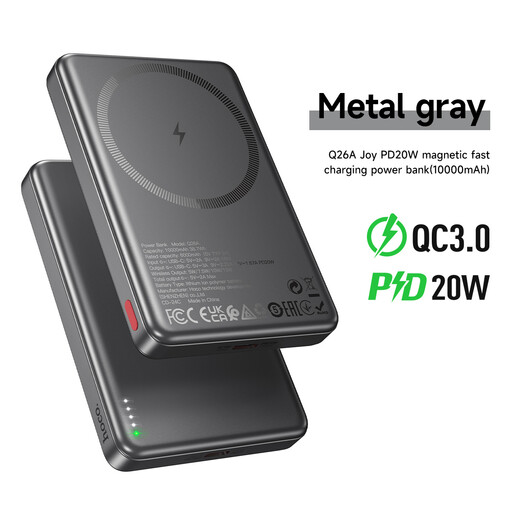
Why This Fits Their Persona: This is for the user who values flexibility. It's a great companion for a long day out, offering a solid 10,000mAh capacity and the choice between fast wired charging for any USB-C device or convenient magnetic wireless charging for a power bank for iPhone.
It clarifies the "fast charging" promise by specifying 20W PD for wired and up to 15W for wireless. The 10,000mAh capacity is a practical, realistic choice for all-day power, avoiding the "inflated capacity" trap.
Its dual-mode charging (wired and wireless) and premium aluminium alloy body offer a combination of function and form that suits most daily scenarios.
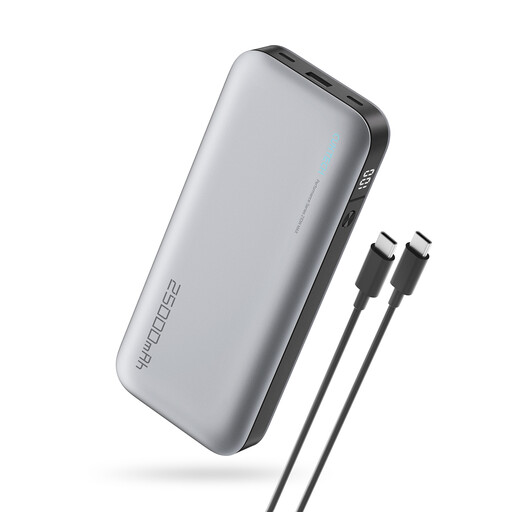
Why This Fits Their Persona: This is a serious tool for professionals, students and travellers who rely on a laptop, tablet and phone. It's built for those who work from coffee shops or are frequently on trains and planes, needing to power a full mobile workstation.
It completely eliminates the "fast charging" ambiguity with a massive 120W total output, clearly positioning it as a true laptop power bank. The large 25,000mAh capacity is genuinely capable of handling multiple devices.
The ability to charge a compatible laptop at high speed is its standout feature. With three ports (2x USB-C, 1x USB-A), it's a versatile hub for all your tech.
We have compiled a complete, real-time list of products that fully satisfy these strict selection criteria and UK safety regulations.
This depends on two factors: your phone's battery size and the power bank's rated capacity. A typical 10,000mAh power bank has a rated capacity of around 5,800-6,500mAh. For an iPhone 15 Pro with a ~3,300mAh battery, you can expect about 1.7 full charges. For a Samsung Galaxy S23 with a 3,900mAh battery, you'd get roughly 1.5 charges. Always check the rated capacity for a more accurate estimate.
Modern, certified power banks (look for UKCA and CE markings) are equipped with overcharge protection circuits that stop the flow of electricity once the battery is full. While this makes it generally safe, it is still considered good practice to unplug chargers once they are full to preserve long-term battery health and for general electrical safety.
Yes, you can. The universal aviation limit is 100 Watt-hours (Wh) per battery, and it must be carried in your hand luggage, not checked in. A 20000mAh battery pack is typically around 74Wh (20,000mAh x 3.7V / 1000 = 74Wh), which is well within the legal limit for air travel in the UK and internationally.