Buying priorities
Start with the flight rules, then choose capacity for your device mix and confirm that the ports, cable and output suit the devices you will charge together. The UK Civil Aviation Authority sets the cabin-baggage baseline, while each airline can apply additional conditions.
| Priority |
What to check |
Your needs |
| Flight rules |
Check the Wh rating against the 100Wh and 160Wh thresholds. Keep the bank in cabin baggage, take no more than two, and review the booked airline’s storage and use rules. |
I need a bank that I can pack and carry under the airline rules for my actual itinerary. |
| Capacity and bulk |
Compare 5,000mAh for light phone backup, 10,000mAh for everyday travel, and 20,000mAh for heavier multi-device use. Check the stated Wh value separately. |
I want enough reserve for my phone, tablet or accessories without carrying more weight and bulk than the journey requires. |
| Ports and output |
Confirm the connector type, cable compatibility, single-port wattage and combined output when several devices are connected. Check the device’s supported charging input too. |
My phone, tablet or laptop needs the right cable and enough power, and I may need to charge more than one device at once. |
| Protection and condition |
Choose a bank with an intact casing and clear battery information. Protect exposed terminals from metal objects with suitable packaging, terminal insulation or a pouch. |
I need to carry the bank safely through the trip and avoid taking a damaged, swollen or overheating battery onto the aircraft. |
Joybuy product options
Joybuy power-bank options for travellers who need a stated Wh capacity, built-in cable convenience and several charging connections for a flight journey.
 No image available
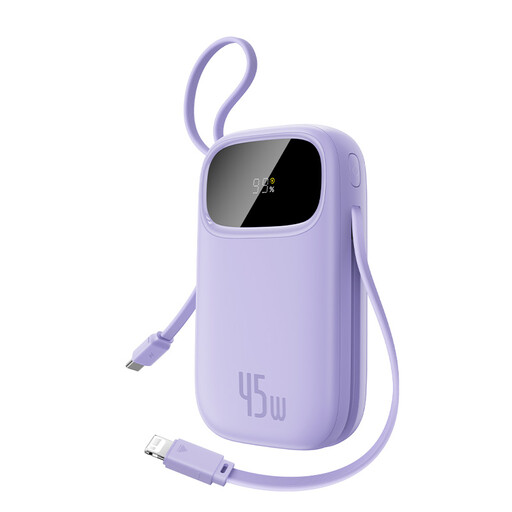
Baseus EnerFill FC31 Qpow 3 10000mAh 45W Power Bank
A multi-device option for phone, tablet or a compatible USB-C laptop when charging one device at a time is sufficient.
Stated 10,000mAh / 36.5Wh capacity, built-in USB-C and iP cables, USB-C and USB-A ports, and a battery display. The stated 45W USB-C output applies to one device; simultaneous charging reduces total output to 15W. Check how it will be protected from loose metal items in cabin baggage.
Joybuy
 No image available
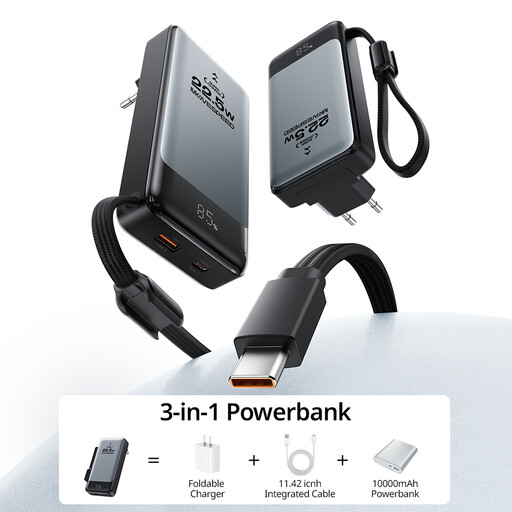
MOVESPEED 3-in-1 10000mAh Power Bank with Type-C Cable
A cable-included option for a phone and several USB-powered accessories during a journey.
Stated 10,000mAh / 38.5Wh capacity, integrated USB-C cable and three outputs. The supplied listing contains differing output information, so confirm the actual single-port and combined-output specifications before buying; its stated 470g weight may also matter for cabin-bag packing.
Joybuy
Frequently asked questions
Can I put a power bank in checked luggage on a flight from the United Kingdom?
No. The UK Civil Aviation Authority says power banks must stay with you in the cabin and must not be packed in checked luggage. If a cabin bag is taken for hold loading at the gate, remove the power bank first.
How many power banks can I take on a UK flight?
The UK Civil Aviation Authority baseline is a maximum of two power banks per person. Check the operating airline as it may add conditions; Ryanair also limits passengers to two power banks within its allowance for spare lithium batteries.
Is a 20,000mAh power bank automatically allowed on a plane?
No. Airline limits are expressed in watt-hours, so mAh alone does not decide whether a power bank is suitable for a flight. Check the Wh value printed on the bank or stated by the manufacturer; UGREEN UK, for example, lists its researched 20,000mAh Nexode model at 72Wh, but the airline’s own conditions still apply.
Can I charge my phone from a power bank during the flight?
Do not assume that you can. The UK Civil Aviation Authority states that power banks must never be recharged on board, and airlines can set additional rules on use and storage. Check the airline’s current policy before departure.
Do I need a protective pouch for a power bank?
A pouch can help protect the bank from impact and keep it away from loose metal objects. The UK Civil Aviation Authority advises passengers to protect spare batteries from damage, while Ryanair requires spare batteries to be individually protected against short circuits through packaging, terminal insulation, a separate plastic bag or a protective pouch.


