
24/7 Customer Support

Free returns

Same-day & Next-day Delivery

Quality Guaranteed

Unlock Your Welcome Offers: FREE Delivery | Up to 80% OFF | Free 30-day JoyPlus trial
Download the APP
Running out of battery when you are out and about is a modern-day frustration we all know too well. A reliable power bank seems like a simple solution, but the market is flooded with options that often over-promise and under-deliver. Many of us have bought a portable charger only to find it dies quickly, charges at a snail's pace or is too bulky to carry.
As the Joybuy Product Recommendation Officer, my role is to help you navigate these choices. Before you spend your money, let's look at two common pitfalls that lead to buyer's remorse.
To avoid these traps, focus on a few key specifications that determine real-world performance.
Instead of just looking at the advertised mAh, check for the rated capacity if available. For charging speed, look for the wattage (W).
Consider how you will use the power bank. A high-capacity model is great for long trips but might be too heavy for a daily commute.
Here are a few options that align with different needs, chosen because they offer clear specifications and practical designs.

Why This Fits Their Persona: This is for the person who needs a quick, no-fuss power top-up on their way to work or between lectures. Its tiny size fits in a pocket or small bag and the built-in connector means you never have to remember a separate cable.
It avoids the capacity myth by being upfront about its purpose: providing a single emergency charge in a compact form, not multiple charges from a bulky brick. The 22.5W output is a clear, specific measure of its fast-charging capability.
The main advantage is the foldable, integrated USB-C connector. It is incredibly convenient and reduces clutter. Its compact size makes it a true "carry-anywhere" device.
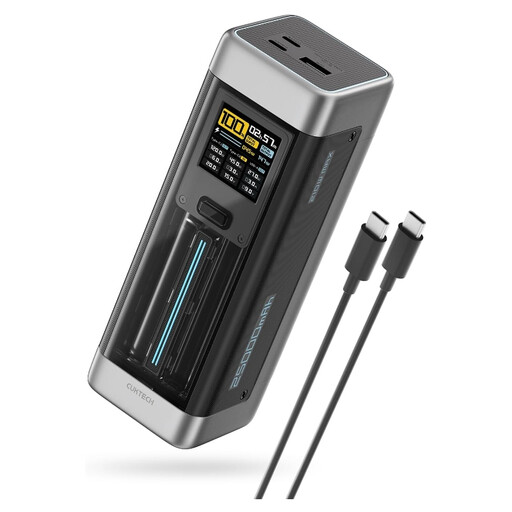
Why This Fits Their Persona: For the professional working from a coffee shop, the frequent traveller or anyone with multiple high-power devices. This is a genuine laptop power bank that can also fast-charge a phone and tablet simultaneously.
It cuts through the vague "fast charge" claims with a specific, verifiable 140W PD3.1 output. This is a technical standard that guarantees its performance with compatible high-draw devices like modern laptops.
Its primary advantage is the massive power output and high capacity, which is airline-compliant (under 100Wh). The smart digital display also provides real-time data on power input and output, giving you full control.
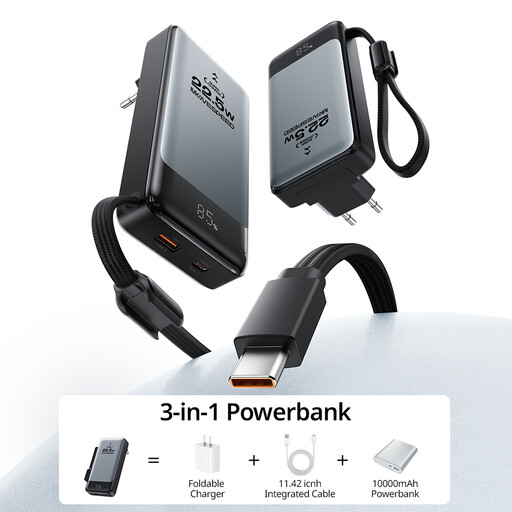
Why This Fits Their Persona: This is for the person who hates carrying multiple chargers and cables. It combines a wall plug, a 10000mAh power bank and a built-in cable into a single, compact unit. It's perfect for weekend trips and decluttering your travel bag.
It solves a practical problem that many cheap power banks ignore: the hassle of carrying extra accessories. By integrating the wall charger and a cable, it offers a complete, self-contained charging system.
The 3-in-1 design is its standout feature. You can use it as a standard wall charger for your devices while it simultaneously recharges its own internal battery, ensuring the power bank is always ready to go.
We have compiled a complete, real-time list of products that fully satisfy these strict selection criteria and UK safety regulations.
This depends on two factors: your phone's battery size and the power bank's rated capacity. As a rule of thumb, a 10,000mAh power bank with a rated capacity of around 6,500mAh can charge a typical smartphone (with a 4,000-5,000mAh battery) about 1 to 1.5 times from empty to full.
Modern, certified power banks are equipped with safety circuits that prevent overcharging. However, for general safety, it is always good practice to charge any electronic device on a hard, non-flammable surface (like a desk or countertop) rather than on a bed or sofa.
Yes, but with restrictions. Power banks must be carried in your hand luggage, not in checked baggage. The capacity is also limited. Most airlines follow the international standard, which allows for power banks up to 100Wh (Watt-hours). A 25,000mAh power bank is approximately 92.5Wh, so it is generally permitted. Always check with your specific airline before you fly.