Phone-first travellers
If your phone holds your boarding pass, messages and maps, a compact bank may be enough. Check its Wh marking and keep it accessible in the cabin.


For a UK flight, start with a power bank whose watt-hour (Wh) rating you can check: a model below 100Wh avoids the UK Civil Aviation Authority’s 100–160Wh airline-approval range, but it is not automatically accepted by every airline. A compact bank may cover phone backup; for a laptop or several devices, check USB-C output and ports as well as capacity. Keep the bank in the cabin, take no more than two under CAA guidance, and check the operating airline’s rules before departure.
If your phone holds your boarding pass, messages and maps, a compact bank may be enough. Check its Wh marking and keep it accessible in the cabin.
When you carry a phone alongside a tablet or other USB devices, check the number of usable ports, the cables you need and how output is shared.
For a USB-C laptop, check its charging requirements against the bank’s output, then consider the bank’s Wh rating and carrying weight. Laptop-capable output alone says nothing about flight eligibility.
Check the battery’s Wh rating and your airline’s handling rules before comparing charging connections and carrying size.
| Priority | What to check | Your needs |
|---|---|---|
| Battery rating | Look for Wh on the label or manufacturer’s documentation. UK Civil Aviation Authority guidance places lithium-ion batteries from 100Wh to 160Wh in an airline-approval range and prohibits those over 160Wh in passenger baggage. UGREEN UK explains that mAh alone cannot establish Wh without battery voltage. | I want to compare the bank’s stated energy rating with the flight rules, rather than rely on its mAh figure. |
| Cabin handling | The UK Civil Aviation Authority says power banks belong in the cabin, not checked baggage, and limits passengers to two. It also says not to recharge a power bank onboard. Check the operating airline’s current storage and onboard-use instructions. | I need to keep my bank with me, including if my cabin bag is taken for hold loading at the gate. |
| Charging output | Compare USB-C output in watts with each device’s supported charging input. For simultaneous charging, check the ports and their shared-output limits; an advertised maximum does not necessarily apply to every connection at once. | A phone top-up is enough for some trips; if I also carry a tablet or laptop, I need connections and output suited to those devices. |
| Cables and fit | Check whether a built-in cable has the right connector and whether separate ports are available. For magnetic charging, confirm compatibility with the phone and case. | I would rather pack fewer cables, but not if the built-in connection leaves one of my devices unusable. |
| Carrying size | Compare the stated weight and dimensions with where you will keep the bank in the cabin. More stored energy or output does not remove airline packing requirements. | If I only need phone backup, I may prefer a smaller item to carry; several devices could justify a larger bank. |
mAh describes charge capacity, while flight battery thresholds use Wh. Without the battery voltage, an mAh figure cannot establish the energy rating.
Use the stated Wh figure where available. If the battery voltage is also stated, UGREEN UK gives the conversion as Wh = mAh × V ÷ 1000; do not substitute the USB output voltage.
A rating below the UK Civil Aviation Authority’s airline-approval range does not waive quantity, cabin-packing or airline-specific handling rules. easyJet, for example, also prohibits using a power bank to charge another device onboard.
Read the operating airline’s restricted-items instructions shortly before departure and keep the bank accessible as directed.
A larger bank can be more to carry without addressing a phone-only need. The device you intend to charge determines whether extra capacity and output are useful.
Start with your devices and expected charging needs, then compare appropriately rated models rather than choosing by the largest mAh figure.
A built-in USB-C cable is less useful if a device needs another connector. Charging output can also vary by port and by the device’s supported input.
Check every device’s connector and charging requirements, and bring a suitable separate cable if the bank’s ports require one.
Anker’s Nano Power Bank A1259 is an example of a compact model with a built-in USB-C cable.
UGREEN’s Nexode 25,000mAh 165W model illustrates a higher-output option with built-in cables.
Belkin lists both integrated-cable compact banks and the UltraCharge Pro Laptop Power Bank 25K.
This magnetic 10,000mAh power bank is an option to consider for phone-focused trips. Check its Wh marking, phone compatibility and airline conditions before flying.
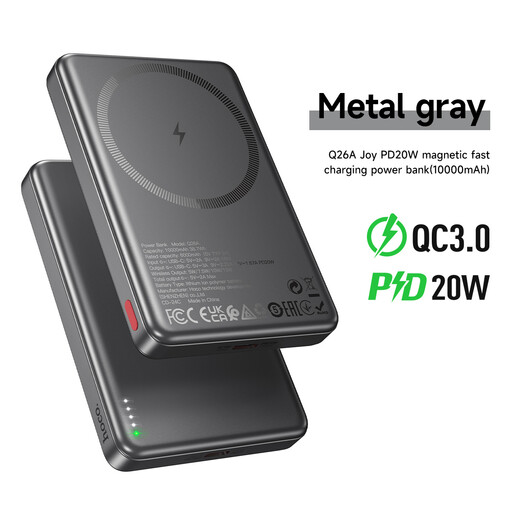 Image unavailable
For phone backup, consider this magnetic model if it suits your phone and case. Confirm the individual bank’s Wh rating and your operating airline’s rules before travel; 10,000mAh alone does not establish flight eligibility.
No. The UK Civil Aviation Authority says power banks must stay in the cabin, not in checked baggage. If your cabin bag is taken for hold loading, remove the bank and keep it with you.
The UK Civil Aviation Authority limits passengers to two power banks per person. Check the operating airline’s current conditions before you travel.
No. UK Civil Aviation Authority guidance says not to recharge power banks onboard. Check your airline’s instructions on using a bank to charge other devices too; easyJet prohibits that onboard use.
No. Flight battery thresholds are expressed in Wh, and mAh cannot establish Wh without the battery voltage. Check the product’s stated Wh rating and the operating airline’s packing and handling rules.
Under UK Civil Aviation Authority guidance, lithium-ion batteries rated from 100Wh to 160Wh require airline approval; those over 160Wh are prohibited in passenger baggage. Confirm the bank’s rating and contact the operating airline about its requirements before departure.