
24/7 Customer Support

Free returns

Same-day & Next-day Delivery

Quality Guaranteed

Unlock Your Welcome Offers: FREE Delivery | Up to 80% OFF | Free 30-day JoyPlus trial
Download the APP
We’ve all been there: you’re navigating with your phone’s map, about to send an important email, or capturing a perfect photo when the dreaded low-battery warning appears. In a world where staying connected is essential, a reliable power bank is no longer a luxury but a daily necessity.
However, choosing the right portable charger can be confusing. With terms like mAh, PD fast charging and various connector types, it’s easy to feel overwhelmed. This guide is designed to cut through the clutter, offering practical advice to help you find a travel battery pack that fits your devices and lifestyle. We will look at key features to consider and highlight some noteworthy options available in the UK.
Before diving into specific products, let’s break down the three most important factors to consider when making your selection.
A power bank's capacity is measured in milliampere-hours (mAh). In simple terms, the higher the mAh, the more charging power it holds.
A large capacity is of little use if it takes all day to charge your device. This is where charging speed, measured in Watts (W), comes in.
Consider how and where you'll be using your power bank. A massive 25,000mAh brick is not practical for an evening out, while a small 5,000mAh unit may not suffice for a business trip. Think about the trade-off between size, weight and power to find the right fit for your bag or pocket.
Based on the criteria above, here are some standout options that cater to different needs, from daily top-ups to powering a mobile office.

Why It Stands Out: This model is all about convenience for Apple users. The integrated Lightning connector means you don't need to carry a separate cable, and its ultra-compact size allows it to slip into any pocket or small bag unnoticed.
Pros:
Who is it for?: iPhone users who prioritise portability and want a simple, cable-free solution for daily use and emergencies.
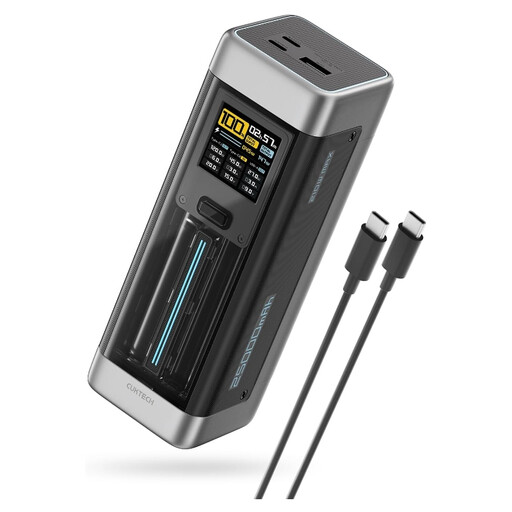
Why It Stands Out: This is a serious power station in a portable form factor. With a massive capacity and an extremely high output of up to 140W, it can charge modern laptops like a MacBook Pro at considerable speed, alongside other devices via its three ports.
Pros:
Who is it for?: Digital nomads, business professionals and students who need to power a laptop, tablet and phone simultaneously while away from a wall socket.

Why It Stands Out: This wireless power bank combines magnetic attachment with a built-in kickstand, making it exceptionally practical. It snaps onto the back of a compatible phone, charges it wirelessly, and allows you to prop the screen up for video calls or watching media.
Pros:
Who is it for?: Users with MagSafe-compatible iPhones who want the convenience of wireless charging and a built-in stand for use at a desk, on a train, or during a flight.

Why It Stands Out: This pocket power bank offers a clever solution for Android and other USB-C device users. The built-in USB-C connector folds away neatly, eliminating cable clutter while delivering a speedy 22.5W charge.
Pros:
Who is it for?: Android, iPad and other USB-C device users seeking a compact, cable-free and fast charging power bank for on-the-go power.
While these recommendations cover a range of common needs, the world of portable power is vast. If you're looking for a different capacity, colour, or feature set, there are many other models to consider.
Explore our full collection of phone charger power bank options to find the perfect match for your devices.
This depends on your phone's battery size and the power bank's efficiency (some energy is lost during transfer). As a general rule, a 10,000mAh power bank can charge a typical smartphone (with a 4,000-5,000mAh battery) around 1.5 to 2 times from empty to full.
Most modern power banks are equipped with safety features, including overcharge protection, which stops the charging process once the battery is full. While it is generally safe, for optimal long-term battery health, it is good practice to unplug any electronic device once it has finished charging.