
24/7 Customer Support

Free returns

Same-day & Next-day Delivery

Quality Guaranteed

Unlock Your Welcome Offers: FREE Delivery | Up to 80% OFF | Free 30-day JoyPlus trial
Download the APP
A dead phone battery at a critical moment is a modern-day frustration we all know too well. Whether you're navigating with GPS, trying to present a digital train ticket or capturing a once-in-a-lifetime photo, losing power is not an option. A reliable power bank is the simple solution, but the market is flooded with options that often over-promise and under-deliver.
As a Joybuy Product Recommendation Officer, my role is to help you see past the marketing clutter. Many shoppers in the UK end up with a portable charger that isn't fit for purpose. Before you buy, be aware of these common pitfalls that lead to wasted money and disappointment.
To choose a portable charger that truly meets your needs, you need to look beyond the headline figures. Here are the three core parameters to check before making a decision.
The number you see on the box, like 10,000mAh or 20,000mAh, is the battery capacity. However, the more important figure is the rated capacity, which is the actual amount of power the bank can output to your devices. Due to voltage conversion, around 30-40% of the energy is lost as heat. A quality 10,000mAh power bank will typically have a rated capacity of around 6,000-6,500mAh. Always look for this figure in the specifications for a realistic idea of performance.
Furthermore, for air travel, the universal standard is Watt-hours (Wh). The limit for carry-on luggage on most airlines is 100Wh. Most power banks are well within this limit, but it's a crucial check for frequent flyers considering a high-capacity laptop power bank.
Charging speed is measured in Watts (W). A standard USB port provides about 5W, which is slow. A modern fast charging power bank should offer much more:
Equally important is the charging protocol. Power Delivery (PD) is the standard used by Apple, Google and most new laptops and Android phones. It's delivered through a USB C power bank port. Quick Charge (QC) is another common standard. For the fastest speeds, ensure the power bank's protocol matches what your device supports.
Consider how you'll use the power bank. Do you need to charge multiple devices at once? Look for models with multiple USB-C and USB-A ports. For ultimate convenience, an iPhone user might prefer a MagSafe power bank that attaches magnetically.
Finally, balance capacity with portability. A high-capacity 20000mAh power bank is excellent for long trips but will be heavier and bulkier than a slim power bank designed to slip into a pocket for a daily commute.
Based on these practical criteria, we've matched a few standout options to different user needs.
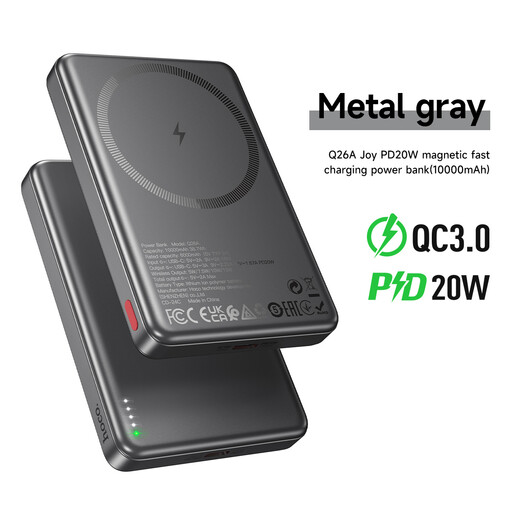
Why This Fits Their Persona: Perfect for the UK commuter or student who needs a reliable top-up during the day. Its slim, lightweight design and magnetic attachment for MagSafe-compatible iPhones offer maximum convenience on the go, eliminating the need for carrying extra cables.
It avoids the vague "fast charge" trap by specifying 20W PD wired charging and up to 15W wireless charging. The premium aluminium alloy body also counters the cheap plastic build pitfall.
Strong magnetic connection for secure wireless charging and the ability to charge two devices at once (one wired, one wireless).
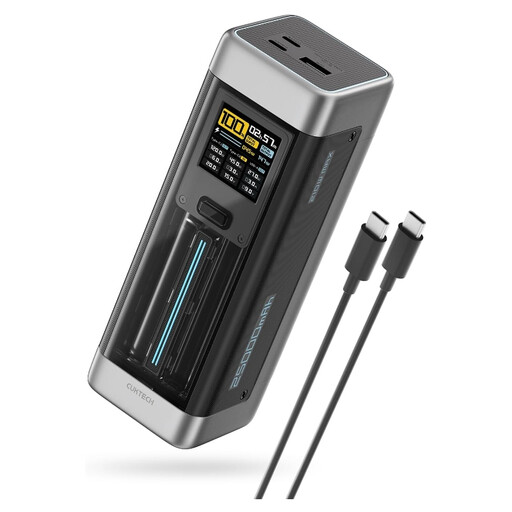
Why This Fits Their Persona: For the professional working from coffee shops, trains or airports. This is a serious laptop power bank capable of powering a MacBook Pro or Dell XPS at high speed, while simultaneously charging a phone and earbuds. Its high capacity supports extended work sessions away from a mains socket.
It specifies the advanced PD3.1 protocol, delivering a verifiable 140W output. This is a clear, technical specification, not a vague marketing claim. The capacity is also just under the 100Wh flight limit, showing it's designed for real-world travel.
Its 140W single-port output is powerful enough for demanding laptops. The smart digital display shows real-time power input/output, giving you full control.

Why This Fits Their Persona: For those who value aesthetics as much as function. This power bank's minimalist design, compact size and unique ambient LED light make it a stylish accessory that fits perfectly in a handbag. It provides reliable power without compromising on looks.
It directly tackles the capacity trap by clearly stating both the 10,000mAh battery capacity and the realistic 5,500mAh rated capacity. It also lists its CE and RoHS safety certifications, avoiding the poor quality pitfall.
Its unique, elegant design with a warm ambient light sets it apart. The inclusion of a travel pouch and high-quality cable adds to its premium feel.
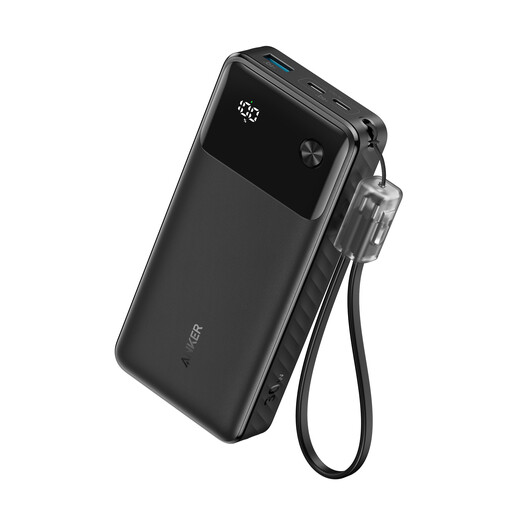
Why This Fits Their Persona: An excellent choice for families, long weekends or anyone who needs a dependable, high-capacity power source. With a large 20,000mAh capacity and three ports, it can keep everyone's devices charged without arguments. The digital display is a simple, user-friendly touch.
It provides specific, real-world charging estimates (e.g., "up to 4.5 charges for iPhone 14"), giving a much clearer performance expectation than a simple mAh figure. The 30W PD output is also clearly defined.
A great balance of high capacity, versatile ports (2x USB-C, 1x USB-A) and a clear digital display for monitoring remaining power.
We have compiled a complete, real-time list of products that fully satisfy these strict selection criteria and UK safety regulations.
This is a common question that highlights the capacity trap. Due to energy loss during power transfer, you can't simply divide the power bank's capacity by your phone's battery capacity. A good rule of thumb is to expect about 60-65% efficiency. So, a 10,000mAh power bank will deliver around 6,000-6,500mAh of usable charge. For a typical smartphone with a 4,000mAh battery, that means you can expect about 1.5 full charges.
Reputable, modern power banks sold in the UK must have safety features like overcharge protection, which stops the charging process once the battery is full. However, for general safety, it is always good practice to charge any electronic device on a hard, non-flammable surface (like a desk, not a bed) and to avoid leaving it charging completely unattended for extended periods.
Yes, you can. Airline regulations are based on Watt-hours (Wh), with the carry-on limit typically being 100Wh. A 20,000mAh power bank is usually around 74Wh (20,000mAh x 3.7V / 1000), which is well under the limit. The critical rule is that power banks must be in your carry-on luggage, not in your checked bags.