Full-day phone users
If you use your phone for navigation, photographs, calls, notes or work while away from a socket, plan for the reserve you need without treating the stated mAh capacity as a fixed number of phone charges.


For a full day of intensive phone use, choose the reserve you need, then check the exact power bank’s USB-C output, recharge input and ports against your devices. A compact pack suits a single-phone top-up, while a larger or multi-port pack makes more sense if you expect repeated charging or need to connect several devices; laptop charging also requires a compatible laptop, cable and single-port output. If you fly, check the marked watt-hour rating and your operating airline’s rules before relying on the pack for travel.
If you use your phone for navigation, photographs, calls, notes or work while away from a socket, plan for the reserve you need without treating the stated mAh capacity as a fixed number of phone charges.
If you need to connect a phone alongside earbuds, a tablet or someone else’s device, check both the number of ports and how output is shared when they are used together.
If your day involves a laptop as well as a phone, confirm that the laptop accepts USB-C charging and that the power bank’s single-port output and your cable meet its requirements. For flights, check the pack’s marked Wh rating too.
Start with the device and duration that drive your need for backup power, then weigh capacity against what you are willing to carry. The concerns below describe consumers according to the need they would put first on a long day away from a socket.
| Concern | What to check | Who this matters to |
|---|---|---|
| Full-day reserve | Check the exact variant’s stated mAh and Wh capacity, then consider how often your phone will need charging. | If my phone handles navigation, photographs and work throughout the day, a brief top-up may leave me short; around 40% of consumers put reserve power first. |
| Everyday portability | Compare the exact model’s dimensions and weight with its capacity. | I want a pack I will comfortably carry on a commute rather than more reserve than I need; roughly 20% of consumers prioritise portability. |
| Several devices | Check port types and the manufacturer’s output figures when multiple ports are active. | When my phone and another device both need power, I need connections that work for them at the same time; about 20% of consumers put multi-device charging first. |
| Compatible USB-C output | Confirm your laptop or tablet’s USB-C charging requirements, the pack’s single-port output and the cable’s capability. | My work device needs USB-C power alongside my phone, so compatibility matters more than a headline total wattage; around 20% of consumers put suitable high-output charging first. |
Capacity does not tell you the pack’s single-port charging output, how power is shared or how its rating fits flight rules. The UK Civil Aviation Authority uses watt-hours, rather than mAh alone, in its passenger guidance.
Check the exact model’s marked Wh rating, USB-C output and recharge input as well as its mAh capacity.
Power can be shared when several devices are connected. Belkin, for example, states a combined 15W output across all ports during simultaneous use for one of its 20,000mAh three-port models; that figure applies to that model, not every multi-port pack.
Read the output figures for the exact port combination you expect to use, particularly if one connected device is a tablet or laptop.
The UK Civil Aviation Authority requires power banks in the cabin, not checked baggage, and says passengers may take two per person and must not recharge them onboard. Airlines can add handling restrictions: easyJet prohibits using a power bank to charge another device onboard, while Ryanair requires it on your person or in an under-seat bag.
Check the operating airline’s current rules before departure and keep the pack in the location it requires.
UK Office for Product Safety and Standards notices identify affected Anker A1681, A1689 and A1647 power banks and a specified Xiaomi 33W 20000mAh integrated-cable model because affected batteries may overheat. A recall of named units does not apply to every product from those brands.
For an older or second-hand pack, compare its exact model and applicable production or serial details with the official recall notice before use.
These brands offer different power-bank configurations; compare specifications for the particular model rather than assuming a feature applies across a range.
Anker’s 20,000mAh-class USB-C range includes models aimed at charging several devices and models with higher stated output.
UGREEN has USB-C power banks aimed at buyers connecting a phone alongside a tablet or compatible laptop.
Belkin’s range spans compact USB-C packs, integrated-cable options and larger multi-port models.
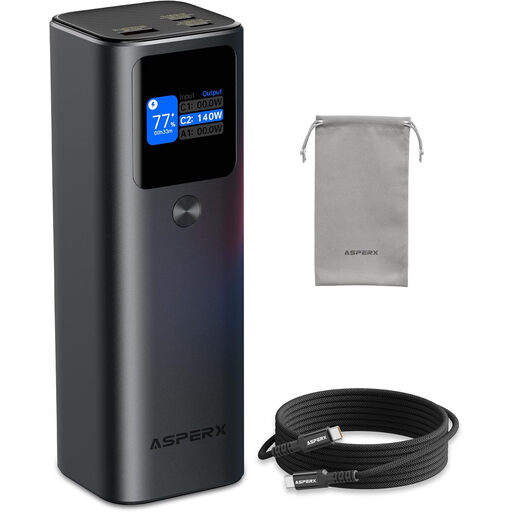
The power bank shown here is a higher-output option to assess if you carry a phone and a compatible USB-C work device. Check its port arrangement and your device’s charging requirements before choosing it for laptop use.
 No image available
Consider this higher-output pack if you need portable power for a phone and want to check compatibility with a USB-C work device.
The listed capacity is 27,600mAh (99.36Wh), and the title advertises 162.5W output. Confirm the exact port layout, single-port output and charging profile required by your device and cable.
For a flight, its stated 99.36Wh rating is below the UK Civil Aviation Authority’s 100Wh airline-approval threshold, but cabin carriage, quantity and onboard-use rules still apply; check your operating airline too.
Yes, subject to the operating airline’s rules, but it must travel in the cabin rather than checked baggage. The UK Civil Aviation Authority says passengers may take two power banks per person and must not recharge them onboard; ratings from 100Wh to 160Wh require airline approval, and those over 160Wh are prohibited in passenger baggage.
Check your operating airline before using it onboard, as permission to carry a power bank does not necessarily mean permission to charge a device with it. The UK Civil Aviation Authority prohibits recharging the power bank onboard, and easyJet also prohibits using it to charge another device.
It can if the laptop supports USB-C charging and the power bank’s single-port output and cable meet that laptop’s requirements. A USB-C connector or a headline total wattage alone does not establish compatibility, so compare the specifications of the exact laptop, pack and cable.
Do not use or fly with a damaged, swollen or overheating power bank. For a possible recall, check its exact model and any affected serial or production range against the applicable Office for Product Safety and Standards notice, then follow that notice’s instructions.