Who needs which kind of power bank?
Start with how long you will be away from a socket and which devices must stay charged. The pack that works for an occasional phone top-up may not meet a tablet’s needs on a long journey.
Daily commuters who travel light
If a power bank must fit in a pocket or small bag, compare its dimensions and weight with the reserve you need for your phone. Which? notes that small packs tend to be easier to carry but typically provide about one charge for an average smartphone; actual results vary by product and device.
Long-day and multi-device travellers
For a phone and tablet, or a day spent far from mains power, consider capacity alongside the number of outputs and their shared rating. Electrical Safety First identifies capacity and output power as separate considerations: stored energy does not, by itself, tell you how quickly connected devices will charge.
Travellers who want fewer loose cables
A built-in cable can remove one packing step if its connector matches your device. Check whether the cable also recharges the bank, whether another port is available and what happens to output when both connections are used. Belkin UK’s specifications illustrate why single-device and shared-output figures need separate attention.
What matters when choosing?
Decide how much charge you need to carry, then check whether the connections and recharge routine work for your devices and journey.
| Concern |
What to check |
Who this matters to |
| Carryability and reserve |
Compare weight and dimensions with the charge you need. Treat mAh as a capacity label, not a promise of full phone charges. |
On a daily commute, I want a pack I will actually carry, even if that means less reserve for a delay. About 25% of consumers would put carryability first. |
| Longer trips and multiple devices |
Compare capacity for your phone and tablet, and check the total output when several ports are active. If flying, check the marked Wh rating against your airline’s rules. |
If I am away from a socket all day or sharing power with a tablet, running short of reserve matters more than pocket size. Roughly 31% of consumers would make longer-trip or multi-device capacity their priority. |
| Compatibility and charging speed |
Match the connector, charging protocol and cable to your device; compare the relevant port’s output with any shared-output rating. |
When I need to charge a particular phone or tablet between stops, the printed wattage is useful only if my device can use it. Around 25% of consumers would prioritise compatible charging speed. |
| Cables and recharging the bank |
Check a built-in cable’s connector and the bank’s input rating; confirm what charger or cable its stated recharge speed requires. |
For frequent trips, I would rather not remember a separate cable, and I need time to replenish the bank before leaving again. About 19% of consumers would put cable and recharge convenience first. |
Brands to consider
These ranges show different ways to meet travel-charging needs. Compare named models rather than treating a brand’s range or a single specification as a guarantee for every product it sells.
Anker
Anker UK lists compact packs, built-in-cable models and higher-output USB-C options.
- Its named 10,000mAh Nano model has a built-in USB-C cable and a stated 30W charging and recharging rating.
- The UK Office for Product Safety and Standards recalled specified Anker A1681, A1689 and A1647 power banks from stated manufacturing periods. Check a pack’s exact model and recall details rather than judging safety by the brand name.
Belkin
Belkin UK lists wired USB-C, integrated-cable, magnetic and higher-output power banks.
- Its 10K integrated-cable model has a USB-C port for connecting a second device, according to Belkin UK.
- Output can change when ports are used together: Belkin UK lists 20W for one port and 15W total for both ports on its BoostCharge Power Bank 10K with Display. Check the specification of the model you choose.
UGREEN
UGREEN UK lists wired USB-C and magnetic power banks, including models with built-in cables.
- UGREEN UK specifies Qi2 15W wireless charging and 30W USB-C charging for its named 10,000mAh Zapix magnetic model.
- Those ratings belong to that model; check your device’s wireless and wired compatibility rather than applying them to the wider range.
Samsung
Samsung UK’s EB-P3400 is a 10,000mAh USB-C battery pack with stated support for compatible Galaxy devices.
- Samsung UK states up to 25W charging for this model when a single device is connected.
- That figure does not establish the charging rate for every phone or tablet; check device compatibility and the conditions for the stated output.
Joybuy power banks for different journeys
These Joybuy models include packs for everyday phone top-ups, built-in-cable charging and a higher-capacity option for longer journeys. Choose by your device connections, carrying needs and the exact model’s ratings rather than capacity alone.
 Image unavailable
Lofree 10,000mAh 22.5W USB-C power bank
Consider this for a commute or day trip when you want a USB-C cable supplied with the pack. The listing states a weight of 220 g and dimensions of 84 × 67 × 30 mm, so check that it suits your bag or pocket. Its stated 22.5W output does not establish the charging speed for your device; confirm compatibility and look for usable-capacity testing if the number of charges matters.
Joybuy
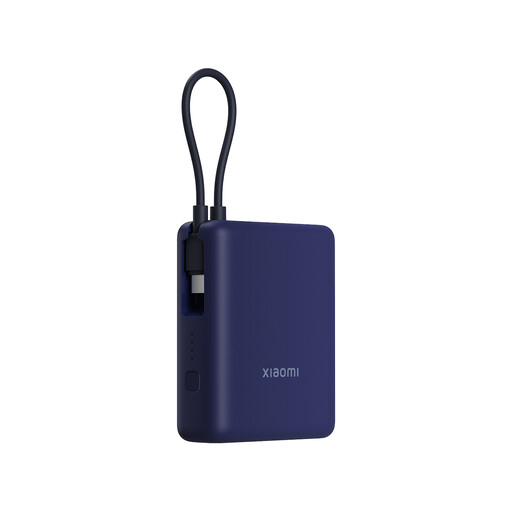 Image unavailable
Xiaomi 33W 10,000mAh integrated-cable power bank, Ice Blue
The integrated cable may suit a commute when you do not want to pack a separate one. The listing states USB-C output, up to 33W output and a net weight of 0.21 kg; check the cable and charging protocol against your device. Identify the exact model and its Wh marking before planning to fly, and check current recalls by model rather than assuming that a notice for another Xiaomi capacity applies to this pack.
Joybuy
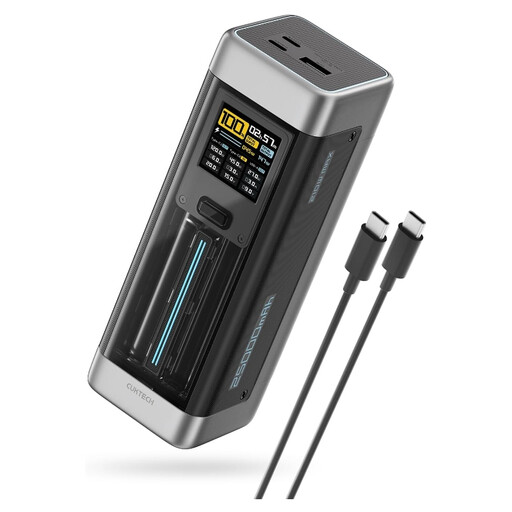 Image unavailable
CUKTECH NO.20 P23 25,000mAh 140W power bank, grey
This higher-capacity, three-port model is worth considering for a longer journey or more than one device. Its title states up to 140W USB-C output, but that figure does not tell you the power available to a particular device or across ports at once. Check the port-by-port ratings, required cable, weight and dimensions; for a flight, confirm the marked Wh rating and your airline’s rules.
Joybuy
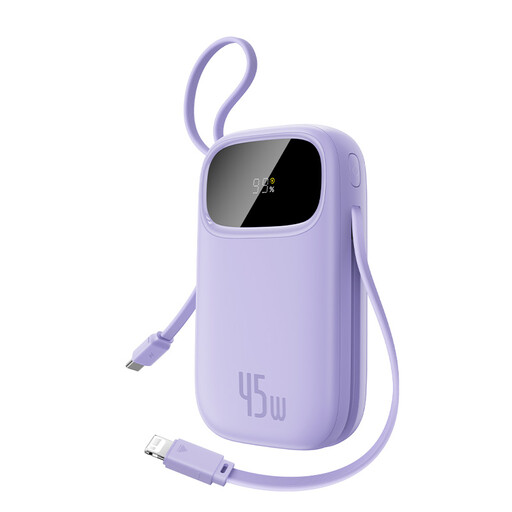 Image unavailable
Baseus EnerFill FC31 Qpow 3 10,000mAh power bank, Nebula Purple
Built-in USB-C and Lightning cables make this a choice to examine if your devices use those connectors and you want fewer loose cables. The listing states up to 45W for single-device use but 5V/3A total when multiple outputs are used. Before buying, ask the seller to clarify how the title’s 10,000mAh capacity relates to the product details’ 5,000mAh at 7.3V; check the Wh marking if flying.
Joybuy
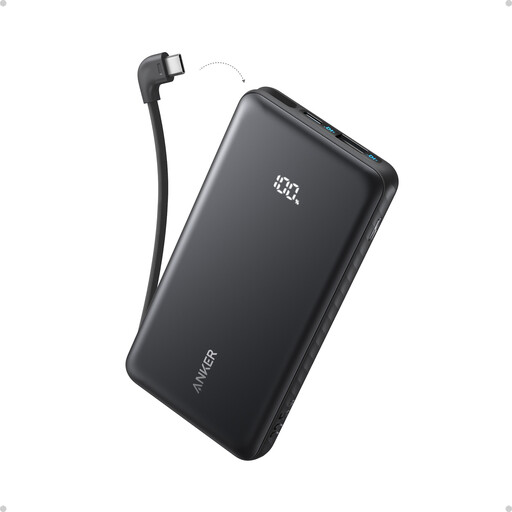 Image unavailable
Anker Zolo 10,000mAh power bank with built-in USB-C cable
The built-in USB-C cable may help on trips when you would otherwise carry a separate cable; the description also identifies a USB-A port. Confirm the exact model’s output before choosing it for faster charging: the title states 22.5W, while the product copy also claims 45W. Check single-port and shared-output ratings, and identify the model and Wh marking if you intend to fly.
Joybuy
Common questions
Does a higher mAh rating mean more full phone charges?
It indicates more stated battery capacity, not a guaranteed number of charges for your phone. Electrical Safety First links capacity to the available reserve, while Which? reports differences in delivered charging between power banks. Compare usable-capacity or device-charge testing where available, allowing for your device’s battery size.
What is the difference between output and input wattage?
Output describes the power a bank can supply to a connected device; input describes how it can be recharged. Check the rating for the port you will use and any total rating for simultaneous charging. Your device, cable and charging protocol must also support the relevant output.
What should I check for power bank safety in the UK?
Identify the exact brand and model, buy from a retailer you can contact, retain the product details and check current GOV.UK product-safety alerts and recalls. The UK Office for Product Safety and Standards has recalled specific power-bank models over overheating and fire risks; a recall for one model should not be assumed to cover every product from its brand.
Can a power bank go in checked luggage?
The International Air Transport Association’s passenger guidance treats power banks as spare batteries restricted to carry-on baggage and calls for protection against short circuits. Check the pack’s Wh marking and your operating airline’s current rules for the particular flight; airline requirements can differ.
Can I use or recharge a power bank during a flight?
Check the operating airline’s current in-flight-use rules before you travel. The International Air Transport Association says airline requirements can differ, so a general carriage rule does not establish whether your airline permits using or recharging the pack in the cabin.


