Phone-only travellers
If your backup charging is mainly for a phone or small USB devices, consider a compact model that fits in the under-seat bag where you will keep it during the flight.


For a British Airways flight, keep your power bank in your smaller under-seat bag, not in checked baggage. For UK departures, the UK Civil Aviation Authority allows two power banks per person and says they must not be recharged onboard. Consider a compact 10,000mAh model for phone-only charging, or a larger USB-C Power Delivery (PD) model if you need to charge a compatible laptop or several devices; in either case, check the unit’s watt-hour (Wh) rating against the rules for your complete itinerary and its output against your devices’ requirements.
If your backup charging is mainly for a phone or small USB devices, consider a compact model that fits in the under-seat bag where you will keep it during the flight.
If you need to charge a laptop, check that it accepts USB-C PD and compare its charging requirement with the bank’s single-port output. Check the bank’s Wh marking separately for carriage.
If several devices may need power, look at the port layout and what each port can deliver when used together. For UK departures, the UK Civil Aviation Authority’s two-power-bank limit and onboard recharging rule still apply.
Start with carriage requirements, then match capacity, USB-C output and ports to the devices you plan to charge.
| Priority | What to check | Your needs |
|---|---|---|
| Cabin carriage | Check the unit’s Wh marking. British Airways requires power banks in hand baggage and advises keeping them in the smaller under-seat item. Check the operating carrier and the rules for every part of your itinerary. | I need to keep the bank with me even if my larger cabin bag is put in the hold. |
| Battery capacity | Compare the stated Wh rating, not mAh alone, with your charging needs and carriage rules. For UK passenger baggage, the UK Civil Aviation Authority says batteries from 100Wh to 160Wh require airline approval; those over 160Wh are prohibited. | For a phone, I may prefer a 10,000mAh class bank to a larger-capacity pack. If I also need laptop power, I need to weigh the extra energy against the space it takes in my cabin bag. |
| USB-C output | Confirm that the device accepts USB-C PD, compare its charging requirement with the bank’s single-port output, and use a cable rated for the intended power. | My laptop needs an output that matches its charging requirements; a bank’s total wattage alone does not tell me what one port can deliver. |
| Ports and cables | Check the connections you need, whether a cable is built in, and the stated output allocation when several ports are active. | If I charge a phone and another device together, I want to know what power remains available to each, rather than relying on the headline output. |
Battery carriage limits are expressed in Wh. The International Air Transport Association says lithium-ion batteries must have their Wh rating marked on the case.
Check the exact model’s Wh rating before buying and make sure you can identify it on the unit before travel.
Single-port output and the total available when several devices are connected can differ. A laptop may receive less power while another device is charging.
Compare your laptop’s USB-C PD requirement with the specified single-port output, then check how the bank allocates power across ports.
British Airways does not permit power banks in checked baggage, so a larger cabin bag being taken for hold loading means you must remove the bank.
Pack it in your smaller under-seat item from the outset, along with any spare device batteries.
The UK Civil Aviation Authority says batteries showing damage, overheating or swelling should not be carried on an aircraft.
Inspect the bank before travelling and do not take it aboard if it shows those signs.
Belkin lists compact, multi-port and laptop-oriented power banks, including a 25K laptop model.
Anker’s cited range includes a phone-focused magnetic 10K model and a 20K model with a built-in USB-C cable.
UGREEN lists a 20,000mAh Nexode model with two USB-C ports and one USB-A port.
This compact, multi-connection option may suit a traveller charging a phone and other small USB devices. Check its simultaneous output before relying on it for several devices or a laptop.
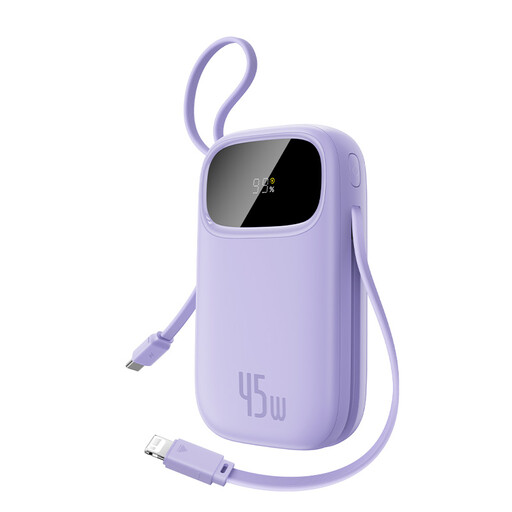 Image unavailable
The built-in USB-C and iP cables offer connections for travel devices without relying solely on separate cables. The listing states 36.5Wh, but check that rating on the unit or its documentation before flying. Its stated 45W output is for single-device use; the supplied simultaneous-output limit is 15W. Confirm your laptop’s charging requirement before relying on this bank for laptop charging.
No. British Airways requires power banks and spare batteries in hand baggage and advises keeping them in the smaller under-seat item. Remove them if a larger cabin bag is taken for the hold.
The UK Civil Aviation Authority says passengers can take two power banks per person. Check the rules for your booked itinerary, including any other operating carrier.
For UK passenger baggage, the UK Civil Aviation Authority says batteries from 100Wh to 160Wh require airline approval, while those over 160Wh are prohibited. Check the exact bank’s Wh rating and the requirements of the operating carrier before travelling.
No on a UK departure: the UK Civil Aviation Authority says power banks must not be recharged onboard. A seat socket does not change that instruction.
Check that the laptop accepts USB-C PD charging, then compare its charging requirement with the bank’s stated single-port USB-C output. If you will connect another device at the same time, check the bank’s shared-output allocation too.