Travellers working on a laptop
If your laptop charges over USB-C, compare its power requirement with the bank’s single-port USB-C Power Delivery (PD) output. Check the cable rating and the output available when another device is connected.


Choose a power bank for the devices you will actually charge: a compact option can cover phone-first travel, while a USB-C-chargeable laptop needs a bank and cable that meet its charging requirements. Before flying, check the unit’s watt-hour (Wh) marking and the rules for your particular journey; British Airways requires power banks in hand baggage, not checked baggage.
If your laptop charges over USB-C, compare its power requirement with the bank’s single-port USB-C Power Delivery (PD) output. Check the cable rating and the output available when another device is connected.
If you mainly need backup power for a phone or tablet, check the connections your devices use and whether the bank’s capacity suits the time you expect to spend away from a socket. Check its Wh marking and carriage rules before the flight.
For a laptop, phone and other devices used on the same journey, count the connections you need and check the output allocated when ports are used together. The headline total output does not tell you what each device receives.
Start with the devices and connections you need, then check the bank’s Wh marking and the carriage conditions for your flight.
| Priority | What to check | Your needs |
|---|---|---|
| Flight carriage | Find the Wh marking on the exact unit. Check each operating airline’s rules and pack the bank in hand baggage, protected against short circuits when not in use. British Airways and the UK Civil Aviation Authority specify cabin carriage. | I need to know where the bank must go, especially if my larger cabin bag is taken for the hold. British Airways advises keeping power packs in the smaller under-seat item. |
| Stored energy | Compare the stated capacity with the devices and time away from mains power. Use Wh, not mAh alone, when checking flight conditions; capacity does not establish charging compatibility. | A phone backup for a journey is different from keeping a laptop and tablet charged during temporary work away from a socket. |
| Laptop output | Confirm that the laptop accepts USB-C charging. Compare its requirement with the bank’s single-port USB-C PD output and check that the cable supports the required power. | If I plan to charge a laptop, I need the relevant port to supply enough power; a bank’s combined wattage is not its single-port rating. |
| Shared charging | Check port types, the number of devices you can connect and the output allocation with several ports occupied. Check the capability of any built-in cable separately. | Charging my phone alongside a laptop matters only if the remaining output still meets the laptop’s needs. |
mAh describes capacity, but it does not by itself answer a flight-capacity question expressed in Wh.
Check the Wh value on the product and compare it with the conditions for your particular journey before relying on the bank for a flight.
A bank’s stated total output may differ from the power available through one USB-C port, particularly when other ports are in use.
Match the laptop’s charging requirement to the stated single-port USB-C PD output, then check the multi-port allocation and cable rating if you will charge devices together.
British Airways prohibits power banks in checked baggage. It advises carrying power packs in the smaller under-seat item in case a larger cabin bag is placed in the hold.
Keep the bank accessible in your under-seat item and protect it against short circuits when not in use, as the UK Civil Aviation Authority advises.
British Airways’ baggage instructions describe its own requirements, not a single policy for every carrier or route.
Check the conditions of each operating airline, along with relevant airport, transit and destination requirements, before buying or travelling.
These brand examples illustrate why the exact model’s output and Wh marking matter more than the brand name alone.
Anker offers USB-C PD power banks, including the Prime A1340 model aimed at charging several devices.
UGREEN’s Nexode range includes a 25,000mAh model with built-in cables for charging several devices.
Belkin offers phone-oriented power banks and USB-C PD models intended for laptop charging.
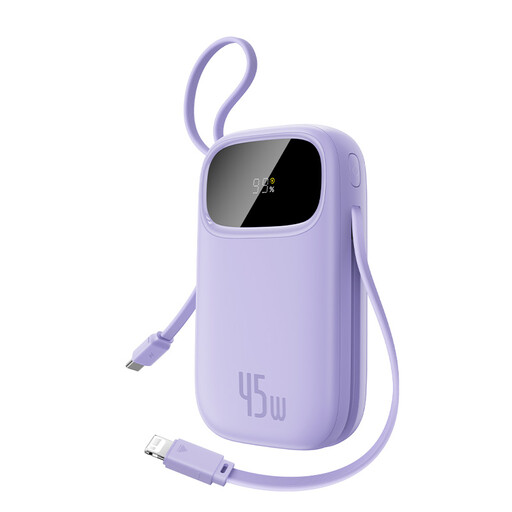
This option has built-in charging cables for phone-first travel. Check its flight carriage conditions separately, and confirm its charging protocol before considering it for a laptop.
 No image available
For phone-first backup charging, this model has built-in USB-C and iP cables and a digital display. Its stated 45W output applies when charging one device; the product information states 15W total when multiple outputs are used. Before flying, confirm the Wh marking on the unit and your journey’s rules. If you intend to charge a laptop, first confirm its USB-C requirements and this bank’s supported charging protocol.
No. British Airways says power banks must travel in hand baggage, not checked baggage. It also advises keeping power packs in the smaller under-seat item in case a larger cabin bag goes into the hold.
Check Wh when assessing flight-capacity conditions; mAh alone does not answer that question. Compare the marking on the exact unit with your operating airline’s current rules, then choose capacity and output for the devices you need to charge.
Current UK Civil Aviation Authority passenger guidance says two power banks per person. Check your operating airline’s instructions as well, particularly if your journey involves more than one carrier.
No under current UK Civil Aviation Authority passenger guidance: power banks should not be recharged onboard. Follow any additional instructions from your operating airline about storage or use.
First check that the laptop accepts USB-C charging. Then compare its power requirement with the bank’s single-port USB-C PD rating and use a cable rated for the required power. If you will connect other devices at the same time, check the bank’s shared-output figures too.