Phone-first commuters
If the main task is keeping a phone usable between home and work, compare the bank’s carrying size, connector and stated output before choosing extra capacity or ports.


For phone-focused daily charging, start with a 10,000mAh bank whose connector and output suit your phone; consider a higher-capacity, multi-port bank when you will be away longer or need to charge several devices. Check each device’s charging requirements and the bank’s output when ports are shared. If you are flying, check its Wh marking and your operating airline’s current rules before you travel.
If the main task is keeping a phone usable between home and work, compare the bank’s carrying size, connector and stated output before choosing extra capacity or ports.
Look for a readable Wh marking and check your operating airline’s current conditions. The UK Civil Aviation Authority says power banks belong in cabin baggage, never checked luggage; the International Air Transport Association says the Wh rating should be marked on lithium-ion batteries.
A phone, tablet and other USB devices may need different connectors or charging modes. Check the bank’s port arrangement and shared output, as well as whether you have suitable cables.
Start with the devices and time away from a socket, then compare capacity, connections and carrying practicality. For a flight, make the Wh marking and airline conditions part of that choice.
| Priority | What to check | Your needs |
|---|---|---|
| Capacity and carrying | Compare stated mAh capacity with how long you will be away and how many devices you will charge. Check the actual weight and dimensions if the bank must fit a pocket or everyday bag. | I mainly need a phone top-up on a commute, so carrying a larger bank may not suit my bag. For a longer outing with several devices, I may want more capacity. |
| Output and cables | Match the device maker’s documented connector and charging mode to the bank’s stated per-port output. Check the cable and the available output when several ports are in use. | My phone and other devices need connections that work with the cables I carry. If I charge two at once, I need to know what each port can provide. |
| Safety and recalls | Choose an identifiable model from a reputable retailer, retain its model details and check recall notices. Electrical Safety First advises against charging a power bank overnight or while you are out of the house. | I want to be able to identify my bank if a recall is announced and to avoid using one that is damaged or overheating. |
| Flight carriage | Read the bank’s Wh marking and check the operating airline’s current rules for your itinerary. The UK Civil Aviation Authority says to keep power banks in cabin baggage, not checked luggage. | Before I fly, I need to know whether my particular bank meets the applicable carriage conditions and where to pack it. |
Capacity does not tell you which connectors the bank has or what output it provides. A larger-capacity model may also be less convenient to carry for a phone-only commute.
List the devices and cables you will take, then compare capacity alongside the bank’s output, ports and dimensions.
A bank’s maximum output does not establish the charging mode supported by your particular device and cable. The headline figure may also differ from the output available when ports are shared.
Check your device maker’s charging specifications, the cable’s capability and the bank’s relevant per-port output.
The UK Civil Aviation Authority says power banks must be kept in the cabin and never packed in checked luggage. An airline may have further conditions for your journey.
Check the Wh marking and the operating airline’s current instructions before departure, including what to do if your cabin bag is taken for the hold.
An identifiable model helps you check safety notices. The UK Office for Product Safety and Standards issued a June 2026 recall for specified POM power banks after identifying insecure internal wiring.
Keep the model details, check relevant recall notices and stop using a bank that is damaged, swollen or overheating.
These examples illustrate different configurations; specifications belong to the named models, not every bank from each brand.
Anker UK lists the Nano A1259 as a 10,000mAh power bank with a built-in USB-C cable and 30W charging, a configuration to consider for phone-focused daily carry.
Belkin UK lists the BPB006 with integrated USB-C and Lightning cables for people carrying devices with those connectors.
UGREEN UK lists a Nexode 20,000mAh model with a stated 72Wh rating, two USB-C ports and one USB-A port.
These options include 10,000mAh banks for daily phone charging and higher-capacity models to consider for longer outings or multiple USB devices. Check the particular model’s connections and output against what you plan to charge.
 No image available
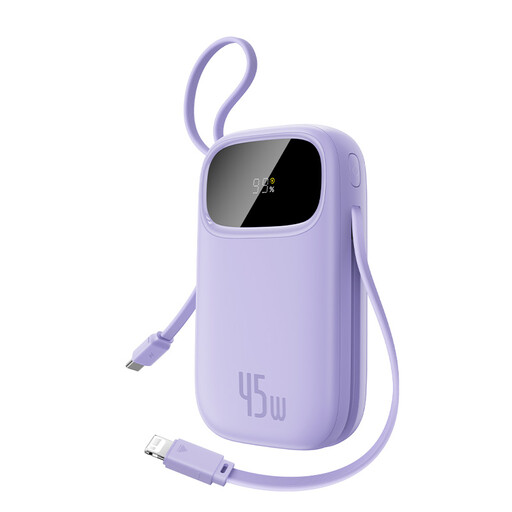
For carrying fewer loose cables while charging USB devices: the listing describes built-in USB-C and Lightning cables, additional USB-C and USB-A ports, and a digital display. It states 36.5Wh and up to 45W with one device, but 15W total when charging devices simultaneously. Check that shared output and the connectors against your devices.
 No image available
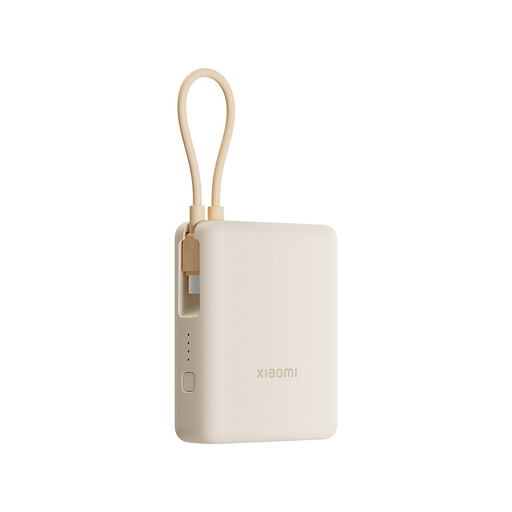
For daily charging with an attached cable, this model also has USB-C and USB-A ports. The listing states up to 33W output and says it can charge up to three devices at once; check the output available when ports are shared. Read the Wh marking before taking it on a flight.
 No image available
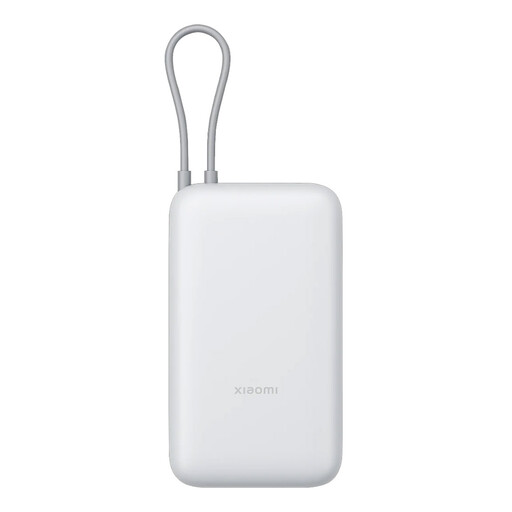
Consider this higher-capacity option for a longer period away from a socket. Its listing describes an integrated USB-C cable for Android USB-C and iPhone 15/16 devices and states a 22.5W maximum; it identifies optimal performance with Xiaomi phones. Confirm your own device’s charging requirements and check the bank’s Wh marking before flying.
 No image available
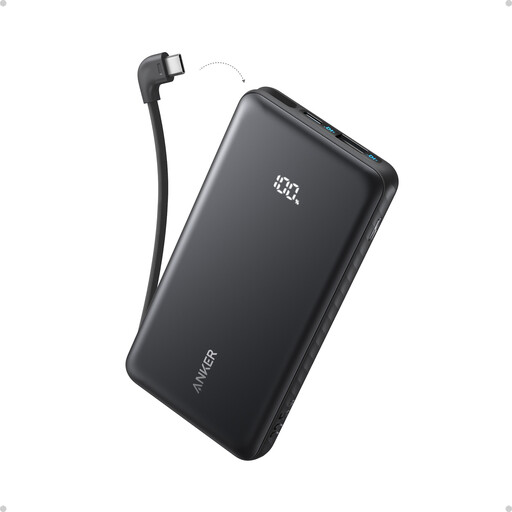
For phone-focused daily carry, this model has a built-in USB-C cable and an additional USB-A port. Its stated maximum output is 22.5W; check your phone’s charging mode and the available output if you plan to use both connections. Check the Wh marking before air travel.
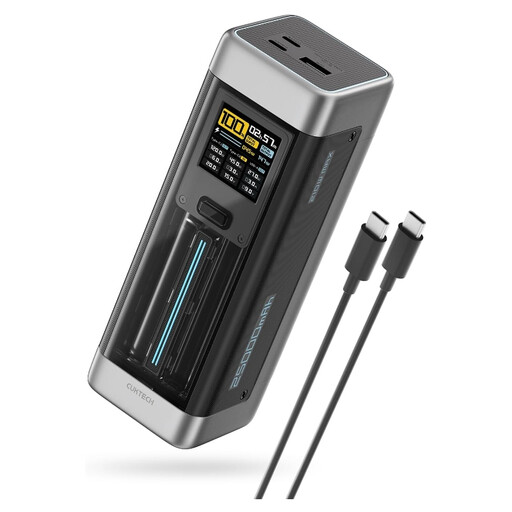 No image available
This three-port option is aimed at longer outings that include a USB-C device with higher documented power requirements. The listing describes two USB-C ports, one USB-A port and up to 140W USB-C output. Confirm the output for the port and charging arrangement you intend to use, your device and cable requirements, and the Wh marking before travel.
No. The UK Civil Aviation Authority says to keep power banks with you in the cabin and never put them in checked luggage. If your cabin bag is to be placed in the hold, tell airline staff about the power bank so you can keep it with you.
Check its marked Wh rating and your operating airline’s current carriage conditions for the journey. The International Air Transport Association says lithium-ion batteries should have their Wh rating marked on the case; capacity in mAh alone is not the marking to rely on for a flight check.
No. A bank’s stated maximum does not establish which charging mode your device and cable can use. Compare the device maker’s connector and charging specifications with the bank’s per-port output, especially if you will charge several devices at once.
Stop using it and do not take it on an aircraft. The UK Civil Aviation Authority warns against carrying batteries showing damage, overheating or swelling; keep the model details so you can also check for relevant safety notices.
Search the UK Office for Product Safety and Standards product-safety alerts and recalls using the exact brand and model. Check the identifying details in any notice rather than assuming that a recall for one model covers every bank from the brand.