Phone-dependent mobile workers
If GPS, calls, notes or sign-ins are part of your workday, consider both how much battery you need before getting home and whether your phone can use the bank’s charging output.


Choose around your phone’s charging method, the battery you use during a long day and the power bank’s output for the ports you will actually use. A large mAh figure or a USB-C connector alone cannot tell you how many useful refills you will get or how quickly your phone will charge; if you are flying, check the bank’s Wh marking and the operating airline’s rules as well.
A power bank is worth considering when your phone must remain available after its usual battery charge would run low and you cannot count on reaching a socket.
If GPS, calls, notes or sign-ins are part of your workday, consider both how much battery you need before getting home and whether your phone can use the bank’s charging output.
Long stretches away from a socket make usable capacity important. For flights, the bank’s Wh marking and the operating airline’s carriage rules add another check.
If earbuds, a tablet or another device will charge alongside your phone, look at the available ports and combined output, not just the highest wattage shown for one port.
Start with the phone and the time you spend away from mains power. Then check how the bank will be charged and carried.
| Priority | What to check | Your needs |
|---|---|---|
| Usable capacity | Compare nominal mAh with independently tested device-charge results where available. Think about your phone’s battery use over the time you will be away. | I need the phone to last through navigation, photos and calls, but do not want to treat a capacity label as a promised number of full refills. Which? notes that portable chargers do not always deliver as much power as their claims suggest. |
| Charging compatibility | Check the phone’s supported charging method, the bank’s output on the intended port and the cable. USB Power Delivery allows connected devices to negotiate the power they require, according to the USB Implementers Forum. | A short break is my chance to top up, so the charging arrangement matters more than the connector shape or a headline wattage alone. |
| Shared output | Compare single-port and combined output when charging several devices. Belkin UK states that its cited BoostCharge 20K model offers up to 20W with one port in use but 15W total when all ports are used. | My phone may need to charge alongside earbuds or a tablet, so I need to know what happens when those ports are used together. |
| Bank recharge | Check the bank’s stated input and the charger and cable needed to supply it. Treat quoted recharge times as conditional on that setup. | For consecutive long days, I need enough time and a suitable socket setup to refill the bank itself. |
| Flight carriage | Check the Wh marking on the exact bank and the operating airline’s current conditions. UK Civil Aviation Authority guidance says to keep power banks in the cabin, take no more than two per person and not recharge them on board; GOV.UK also advises checking airline restrictions. | If I am flying, I need a bank I can identify and carry under the rules for my journey, rather than relying on its mAh label alone. |
Nominal battery capacity is not the energy ultimately delivered to your phone. Which? uses real devices in its power-bank testing because advertised capacity does not always reflect what a charger supplies in use.
Use your phone’s typical battery consumption to judge how much help you need, and compare tested device-charge results for comparable equipment where available.
Power can be shared between connected devices. For example, Belkin UK specifies up to 20W with one port in use, but 15W total with all ports used, for its cited BoostCharge 20K model.
Read the single-port and combined-output figures, then check that your phone and cable support the charging method you plan to use.
An mAh figure on its own does not give the bank’s Wh rating. Airline conditions also affect how a bank may be carried and used.
Before buying or packing, check the exact bank’s Wh marking and the rules of each operating airline. UK Civil Aviation Authority guidance calls for cabin carriage, limits passengers to two power banks and says not to recharge them on board.
A bank with enough capacity for one day still needs to be refilled before the next. Its stated fast-recharge performance depends on a compatible charging setup.
Check the bank’s input specification against the wall charger and cable you will use, particularly if you have only a short window to recharge it.
Achieving the stated fast-recharge input may require a separate suitable mains charger or cable.
These model-specific specifications illustrate different checks; a brand name alone does not establish delivered capacity or charging speed for your phone.
Anker UK lists the A1383 Power Bank (20K, 87W) with a built-in USB-C cable.
Belkin UK’s BoostCharge Power Bank 20K with Display (BPB028hqBK) provides a clear example of why port-sharing figures matter.
UGREEN UK lists its Nexode 20000mAh 100W Power Bank, SKU 25188, with a stated 72Wh rating.
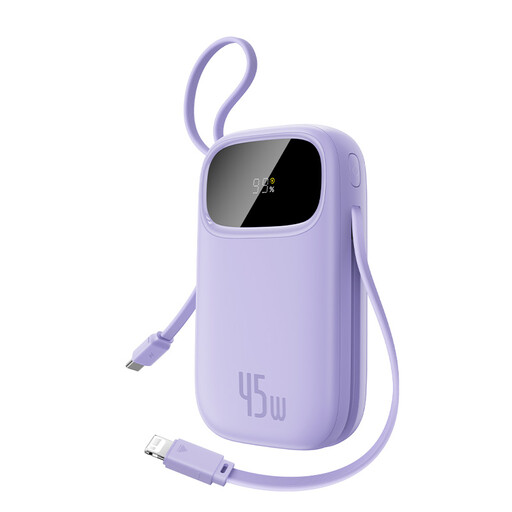
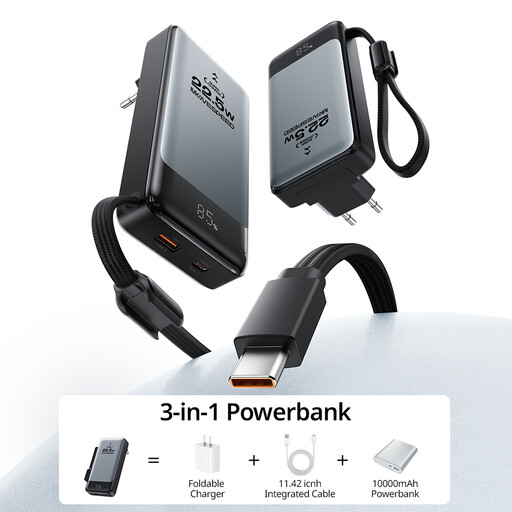
These two portable banks offer integrated cables for charging away from a socket. Compare their stated capacity and charging arrangements against your phone rather than treating either as a guaranteed full-day refill.
 No image available
The built-in USB-C and iP cables may reduce what you need to carry for phone charging on a long day; check which connector and charging method your phone uses. The 45W figure is stated for one device using USB-C, while the supplied product information says total output falls to 15W during simultaneous charging. The 10000mAh label is not a promised number of phone refills.
 No image available
An integrated Type C cable and three stated outputs make this an option to examine if you carry more than one USB device. Its title states 15W, but the supplied output figures differ between charging modes; confirm the output for your intended port and for simultaneous use before relying on a charging speed. Check phone compatibility and do not assume 10000mAh means a fixed number of refills.
UK Civil Aviation Authority guidance says to carry power banks in the cabin, not checked baggage, and limits passengers to two per person; it also says not to recharge them on board. Check the operating airline’s current conditions before travel, as GOV.UK notes that airlines may have different restrictions.
Look for the Wh rating on the exact power bank and check it against your airline’s conditions. The International Air Transport Association explains that watt-hours are calculated as capacity in ampere-hours multiplied by nominal voltage, so mAh alone is not the complete rating.
No. Check your phone’s supported charging method, the bank’s output on the port you will use and the cable. The USB Implementers Forum describes USB Power Delivery as a way for connected equipment to negotiate power, rather than a charging rate guaranteed by the connector shape.
The nominal capacity describes the bank’s cells, not a fixed quantity of energy delivered to a phone. Which? tests portable chargers with real devices because delivered power does not always match what a capacity claim might lead shoppers to expect; compare relevant device-charge test results where available.
Take the power bank out before the bag is placed in the hold. UK Civil Aviation Authority guidance says power banks must stay with you in the cabin; check with airline staff if you are unsure where to keep yours during the flight.