
24/7 Customer Support

Free returns

Same-day & Next-day Delivery

Quality Guaranteed

Unlock Your Welcome Offers: FREE Delivery | Up to 80% OFF | Free 30-day JoyPlus trial
Download the APP
By Joybuy Product Recommendation Officer
A power tower can combine pull-ups, dips, push-ups and leg raises in one home gym strength training equipment setup. However, a low price or long feature list does not automatically mean the station will suit your room, training level or available space.
The most useful buying decision usually comes down to stability, adjustment range and whether the equipment supports the exercises you genuinely plan to perform. The following guide highlights common purchasing pitfalls and compares suitable options for different UK home workout needs.
A stated maximum load is an important reference point, but it is not the only stability indicator. A tower’s base shape, crossbars, rubber feet, frame construction and floor surface all affect how it behaves during movement.
For example, a station may list a high capacity but still be unsuitable for a compact room if its footprint is too large or if it moves on an uneven floor. Always check the assembled dimensions and place the unit on a flat, stable surface.
An adjustable power tower may offer several height positions, but the available range differs between models. A tall user may need a higher pull-up bar, while a beginner may benefit from a lower setting or assisted pull-up support.
Check the actual adjustment range rather than relying only on the word “adjustable”. Also confirm that adjustment pins, bolts and locking points are fully secured before use.
A multifunction power tower with a bench, climbing grips, resistance bands or rotating push-up handles can offer more training choices. Yet extra attachments can increase the footprint and assembly time.
If your routine mainly involves pull-ups and dips, a straightforward pull-up and dip station may be more practical. If you want pressing, core and assisted exercises in one unit, the additional equipment may justify the space.
Look for a steel frame with clear construction information. The supplied options include alloy steel or steel tubing, with listed capacities ranging from 440 lb to 480 lb, and 204 kg for the Sportsroyals models.
These figures are product specifications, not a recommendation to approach the limit during exercise. Do not exceed the manufacturer’s stated maximum. A broad base, reinforced crossbars and non-slip feet can also help reduce movement, although the station must still be assembled correctly and used on a suitable surface.
For UK homes, measure the floor area before ordering. Include space for your body, leg movement and safe access around the equipment. Check doorways, stair access and ceiling clearance, particularly for pull-up exercises.
A pull-up bar should be high enough for your preferred grip and movement while allowing adequate ceiling clearance. Some models provide six height levels, which can help households with multiple users.
The Sportsroyals stations listed here offer adjustment ranges of 178–235 cm and 164.56–221.5 cm respectively. The Pooboo models are also described as height adjustable, but buyers should review the product page for the exact adjustment settings before ordering.
Decide whether you need:
Padding and grips are useful user-perceivable features, but they do not replace careful technique. Stop using the station if any frame, handle or adjustment point becomes loose or damaged.
Most freestanding power towers require assembly. Read the instructions before starting and check that all bolts and connections are tight before the first session. Periodically inspect the frame, adjustment pins, feet, padding and resistance bands.
For UK purchases, review the seller’s safety information, warranty, returns policy and product instructions. Where relevant, check whether the product documentation includes appropriate conformity information such as UKCA or CE marking; do not assume compliance from a product title alone. Keep children and pets away during assembly and exercise, and follow the stated load limit.
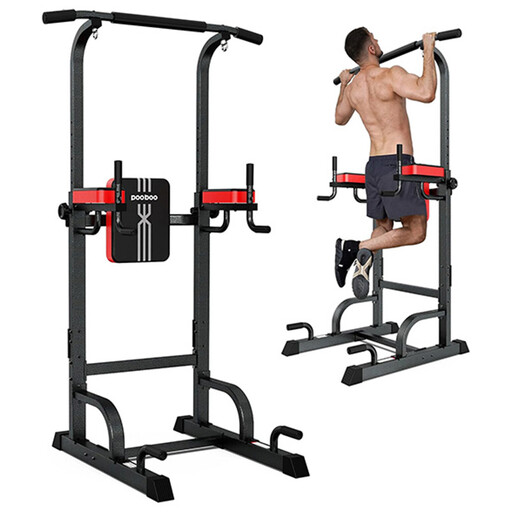
Why This Fits Their Persona: A straightforward choice for beginners building a home routine around pull-ups, dips and core exercises without adding a bench or multiple attachments.
The listing provides a clear 41.73 x 41.73 x 94-inch footprint and a stated 440 lb maximum capacity, making room and load checks easier before purchase.
Alloy steel construction; adjustable height; supports pull-ups, dips and strength training.
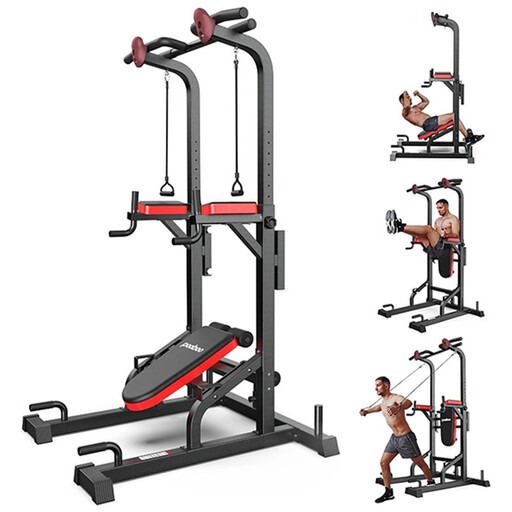
Why This Fits Their Persona: Suitable for users wanting one larger station for bodyweight movements, bench-based exercises and varied home gym strength training.
Its listed features and dimensions make the trade-off clear: the 41 x 30 x 99-inch frame includes a bench and climbing-grip pull-up bar, so it is intended for a larger training area.
Heavy-duty steel frame; bench included; stated 480 lb weight-bearing capacity; non-slip structure.
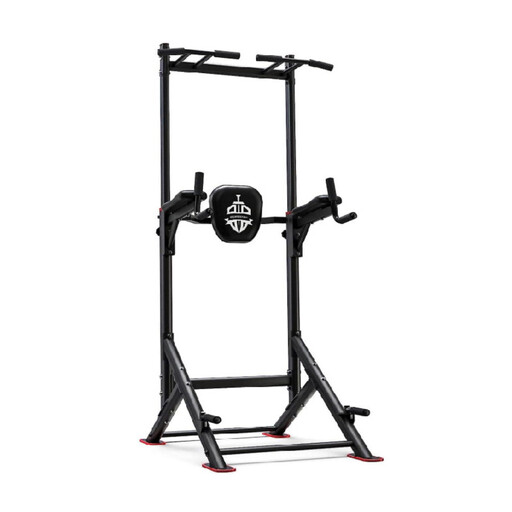
Why This Fits Their Persona: A practical match for intermediate users who prioritise a reinforced base and multiple grip positions for regular bodyweight sessions.
The specification identifies approximately 2 mm steel tubing, a double-triangular base and three cross-bracing points instead of relying only on a high capacity figure.
Six height levels from 178–235 cm; wide and narrow grips; supports pull-ups, dips, push-ups and knee raises.
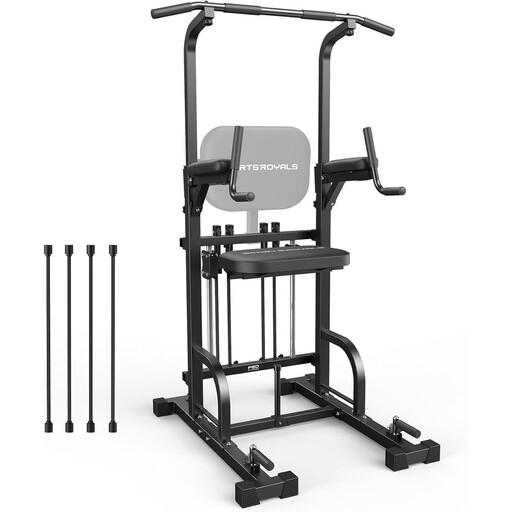
Why This Fits Their Persona: Well suited to users developing pull-up strength who want assisted movement options alongside dips, leg raises and core training.
The listing specifies 10–40 kg resistance bands, six height levels and eight non-slip rubber feet, allowing buyers to assess the assistance and base design in advance.
204 kg stated capacity; foldable support pad; 45-degree rotatable push-up handles; 164.56–221.5 cm height range.
We have compiled a complete, real-time list of products that fully satisfy these strict selection criteria and UK safety regulations.
It can be, provided the assembled footprint and ceiling height are suitable. Measure the base area, allow room for pull-ups and leg raises, and consider whether the frame can pass through your doors and stairways. A compact station without a bench may be easier to accommodate than a multifunction model.
Lifespan depends on assembly quality, frequency of use, user load and maintenance. Tighten bolts periodically, inspect welds and adjustment points, clean the frame with a soft cloth and replace damaged grips, padding or bands where appropriate. Avoid outdoor storage unless the manufacturer specifically permits it, as moisture can affect metal components.
Most freestanding power towers are manually operated and do not require mains electricity or batteries. Their ongoing costs are therefore generally limited to the purchase price, delivery, maintenance and possible replacement parts. Resistance-band models may eventually require new bands, while padded stations may need replacement coverings after extended use.