
24/7 Customer Support

Free returns

Same-day & Next-day Delivery

Quality Guaranteed

Unlock Your Welcome Offers: FREE Delivery | Up to 80% OFF | Free 30-day JoyPlus trial
Download the APP
A power tower can support pull-ups, dips, knee raises and push-ups without requiring several separate machines. However, the wrong model can quickly become an expensive clothes hanger. For UK homes, the main concerns are usually limited floor space, ceiling height, stability on hard flooring and whether the frame suits the intended user.
Before choosing a power tower with pull-up bar or dip station, watch for three common buying traps:
The right choice depends less on the longest feature list and more on the frame, dimensions, adjustment system and exercises you will perform most often.
A free-standing power tower transfers force into the floor during pull-ups, dips and leg raises. Look for a broad base, reinforced supports and non-slip feet rather than relying only on a large capacity figure.
Product listings may show several measurements, such as maximum load capacity and maximum recommended user weight. These are not always identical. Treat the lower applicable figure as the practical limit, and leave a sensible margin for movement during exercise. Never exceed the manufacturer’s stated limit.
Place the station on a flat, stable surface. A rubber exercise mat may help protect flooring and reduce minor movement, but it cannot correct an uneven floor or an incorrectly assembled frame.
An adjustable power tower is useful for households with different users or for assisted pull-up progressions. Check the full height range, not just the number of adjustment levels. Measure from the floor to the ceiling, then allow additional clearance for your head and the movement path above the pull-up bar.
Also measure the tower’s length and width. A large base may improve stability but can make the station difficult to position in a spare bedroom or flat. Leave clear space around the dip handles and front of the tower so that knees and feet do not strike nearby furniture.
A multi-function power tower may include:
Check whether the handles are fixed or adjustable, and look for padded armrests and non-slip grips where relevant. If you are new to pull-ups, an assisted pull-up station or a separate resistance band can reduce the amount of bodyweight being lifted while you build control. A latex resistance band may not suit users with a latex sensitivity, so check the material before purchase.
Assembly is required for the products below. Follow the supplied instructions, tighten all bolts and check connections regularly. Keep children and pets away during use.
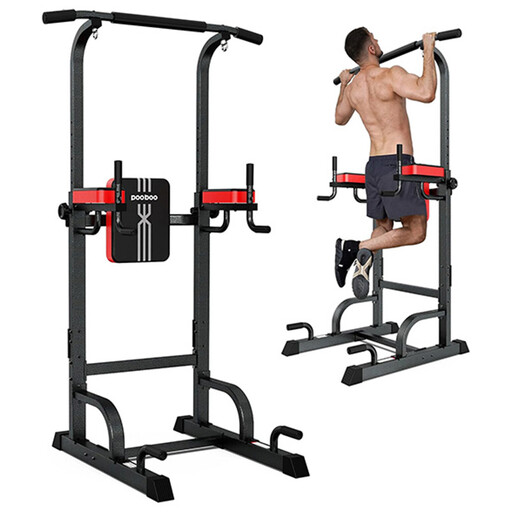
Why This Fits Their Persona: A straightforward choice for someone setting up a first home gym and wanting core bodyweight exercises in one station.
Its listed 41.73 x 41.73-inch footprint and adjustable-height design make the space requirement easier to assess before ordering.
Supports pull-ups and dips, with a listed 440-pound maximum capacity and adjustable height.
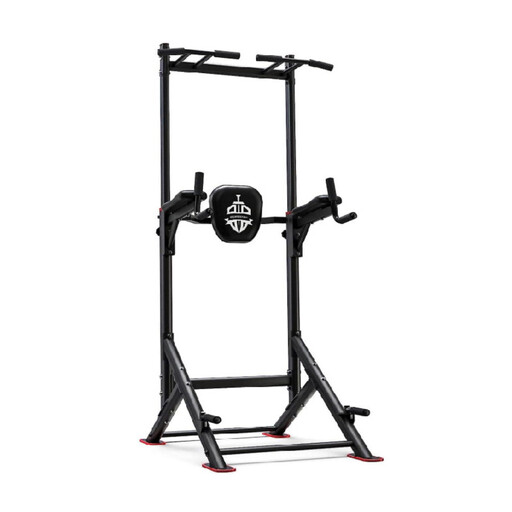
Why This Fits Their Persona: Suits households wanting more grip choices and adjustment positions for varied strength-training routines.
The double-triangular base and three cross-bracing points provide clearly described structural features to compare, rather than relying on vague stability wording.
Offers six height levels from 178 to 235 cm, wide and narrow grip positions and three push-up angles.
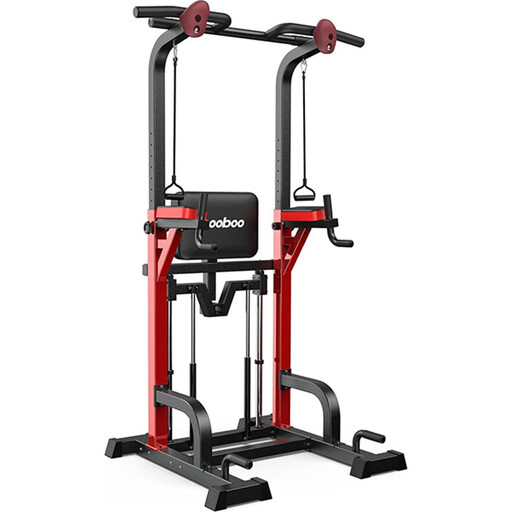
Why This Fits Their Persona: Designed for users who want an assisted pull-up feature alongside regular dips, pull-ups and other home gym movements.
The listing identifies the assisted pad, adjustable height and commercial-steel frame separately, making the main functions easier to verify.
Includes a pull-up bar, dip station and resistance-assisted pad, with a listed 480-pound capacity.
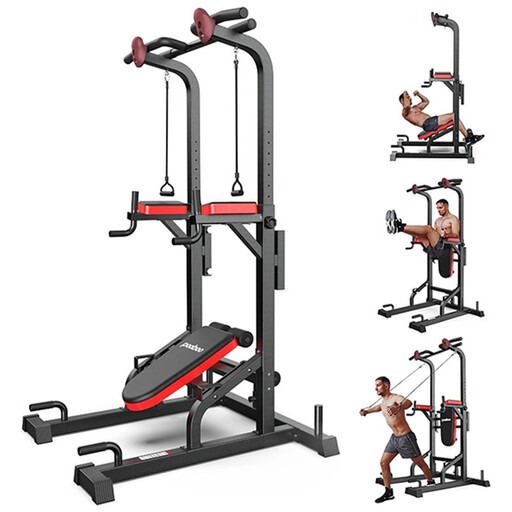
Why This Fits Their Persona: A practical match for users who want a bench-based routine as well as pull-up, dip and bodyweight exercises.
Its stated 41 x 30 x 99-inch assembled dimensions help buyers check whether the bench and tower will fit their available room.
Combines a bench, climbing-grip pull-up bar and dip station, with a listed 480-pound weight-bearing capacity.
We have compiled a complete, real-time list of products that fully satisfy these strict selection criteria and UK safety regulations.
It can be, provided the user selects manageable exercises and follows the assembly and safety instructions. Beginners may start with supported holds, controlled knee raises, push-ups and band-assisted pull-ups. Resistance bands can reduce the initial load, but the band must be secured correctly and checked for wear before use.
Measure the assembled length, width and height listed by the seller, then add clearance around the handles. Ceiling height is particularly important for pull-ups. Avoid placing the tower where the bar could contact a light fitting, beam or low ceiling. A flat floor and enough room to step safely into position are essential.
There is no fixed lifespan. Durability depends on frame construction, frequency of use, user load, assembly quality and maintenance. Wipe the frame with a dry cloth or soft damp cloth as appropriate, store the equipment in a dry area and periodically check bolts, grips, padding and adjustment locks. Replace or stop using any component showing damage.