
24/7 Customer Support

Free returns

Same-day & Next-day Delivery

Quality Guaranteed

Unlock Your Welcome Offers: FREE Delivery | Up to 80% OFF | Free 30-day JoyPlus trial
Download the APP
A power tower for home gym workouts can combine a pull-up bar, dip station, push-up handles and leg-raise supports in one freestanding unit. It is a practical option for UK households that want strength-training equipment without installing a wall-mounted frame.
However, product listings can make similar towers appear interchangeable. The important differences often involve stability, adjustment range, usable space and whether the stated load figure reflects a recommended user weight or a structural capacity. Checking these details before ordering helps prevent an expensive piece of equipment becoming awkward to use.
A listing may show a maximum capacity in pounds while another uses kilograms. Some products also display both a maximum structural capacity and a lower maximum weight recommendation. These figures are not necessarily interchangeable.
Check:
For reference, 204 kg is approximately 450 lb, while 480 lb is approximately 218 kg. Leave a sensible margin rather than selecting a tower based only on a headline number.
A freestanding power tower needs more room than its frame dimensions suggest. You also need clearance for swinging legs, stepping onto the handles and performing pull-ups without touching the ceiling.
Measure:
For example, the Pooboo C772 measures approximately 41 x 30 x 99 inches, while the C966S measures approximately 41.73 x 41.73 x 94 inches. Converting the measurements before purchase makes it easier to plan a spare room, garage or home office gym.
A multifunction power tower may include a bench, climbing-style grips, adjustable handles or an assisted pull-up pad. These features are useful only if they match your training plan and body dimensions.
Look for:
A simple pull-up and dip station may be more suitable than a larger model if you mainly perform bodyweight exercises.
Steel or alloy-steel frames are common for home gym strength training equipment. More important than material wording alone is the design of the base, crossbars and floor feet.
A wide base, reinforced crossbars and non-slip feet can help limit movement during controlled exercise. They do not remove the need for correct assembly or a level floor. Recheck bolts and adjustment points periodically, particularly after the first few sessions.
An adjustable power tower is useful when more than one person will train on it or when you need different settings for pull-ups, dips and push-ups. Compare the number of positions and the actual height range rather than relying on the word “adjustable”.
Some products provide six settings, while others offer 13 levels. A wider range can make the station easier to share, but it may also mean more adjustment points to secure correctly.
An assisted pull-up station can help beginners practise the movement with reduced bodyweight resistance. Some models use a padded support pad, while separate resistance bands provide another way to scale the exercise.
Bands should be selected by resistance level and checked for signs of wear. Latex products may not suit people with a latex sensitivity, so read the material information before buying.
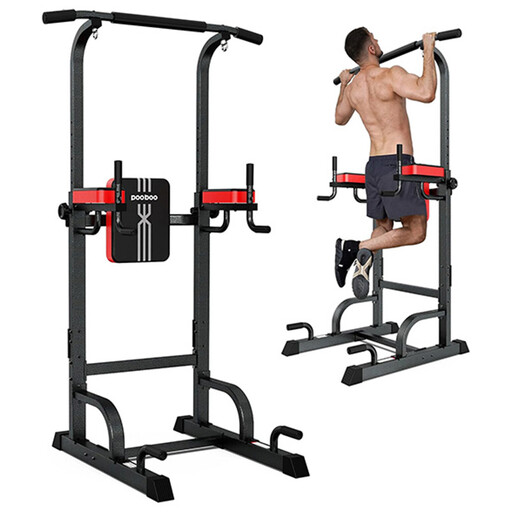
Why This Fits Their Persona: A straightforward choice for starting pull-ups, dips and home strength training without adding a bench or assisted pad.
Its listed 41.73 x 41.73 x 94-inch dimensions and 440-pound maximum capacity make the key planning information visible before purchase.
Adjustable height, alloy-steel construction and dedicated pull-up and dip functions.
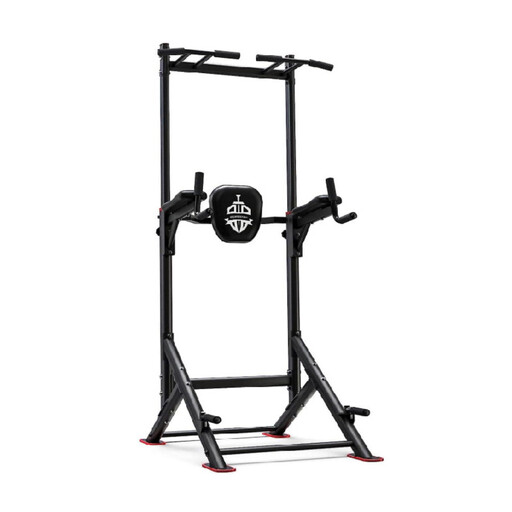
Why This Fits Their Persona: Suitable for households wanting adjustment flexibility and assisted training options in one station.
The listing specifies six height levels, a 10–40 kg resistance-band range and eight non-slip rubber feet.
Assisted pull-up pad, folding backrest function, adjustable armrests and 204 kg stated load capacity.
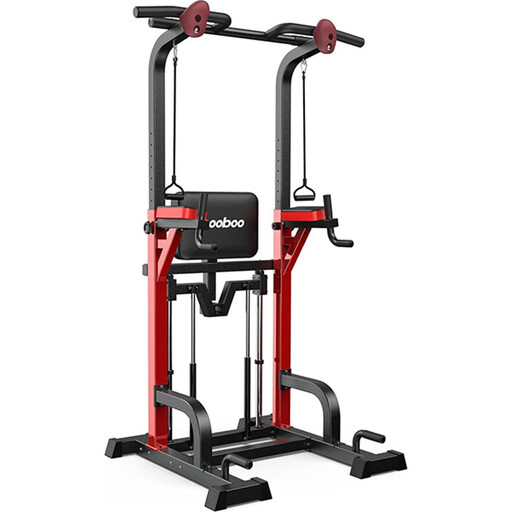
Why This Fits Their Persona: A practical match for users building towards unassisted pull-ups while continuing dips and other bodyweight movements.
The assisted pad is a defined feature rather than an implied benefit, and the listing provides dimensions, assembly details and a 480-pound capacity.
Pull-up bar, dip station, adjustable height and resistance-assisted support in one frame.
We have compiled a complete, real-time list of products that fully satisfy these strict selection criteria and UK safety regulations.
It can be, provided you measure the full footprint and ceiling clearance first. A freestanding tower does not need wall drilling, but it still requires stable flooring and enough surrounding space for leg raises, dips and mounting the pull-up bar.
Lifespan depends on assembly, frequency of use, user load and maintenance. Follow the supplied instructions, tighten bolts periodically, inspect foam and grips, and wipe the frame with a dry cloth. Avoid using a tower if a weld, handle, foot or adjustment mechanism appears damaged.
Not necessarily. Bands are useful for assisted pull-ups, warm-ups and progressive training, particularly for beginners. They are an optional addition rather than a substitute for checking the tower’s frame stability, height range and stated capacity.