
24/7 Customer Support

Free returns

Same-day & Next-day Delivery

Quality Guaranteed

Unlock Your Welcome Offers: FREE Delivery | Up to 80% OFF | Free 30-day JoyPlus trial
Download the APP
Bringing the gym into your home is an appealing thought, but choosing the right equipment can feel like navigating a minefield of marketing claims. A power tower with bench promises a full-body workout in a single footprint, combining a pull-up and dip station with the versatility of a weights bench. However, many find their exciting new purchase gathering dust after a few months, not because their motivation waned, but because the equipment itself was flawed from the start.
As a Joybuy Product Recommendation Officer, my role is to help you see past the glossy photos and identify the key features that make a piece of home gym equipment a worthwhile long-term investment. Before you commit, let's look at the common pitfalls that can turn your fitness goals into frustration.
Many shoppers are swayed by impressive-looking designs and long lists of features, only to be disappointed by the reality. Here are the three most common issues to watch out for:
To avoid these traps, you need to look beyond the marketing and focus on a few non-negotiable technical details. These are the parameters that determine the safety, longevity and usability of your home gym strength training equipment.
The foundation of any good power tower is its frame. Look for descriptions that specify heavy-duty steel construction. While the exact gauge (thickness) isn't always listed, a higher total product weight (over 35kg or 77lbs) is a good indicator of more substantial materials.
Equally important is the base design. A free standing pull up bar needs a wide and stable footprint to counteract the forces of your bodyweight exercises. Look for H-shaped or U-shaped bases with anti-slip foot covers. A base width and depth of over 100cm is a good starting point for ensuring stability during dynamic movements.
To ensure the equipment fits you, not the other way around, height adjustability is crucial. The pull-up bar should have multiple height settings to accommodate users of different heights, allowing for full arm extension without your knees hitting the floor. For the backrest and arm pads on a pull up dip station, look for thick, high-density foam padding that provides support without compressing completely under pressure.
Instead of a single "best" option, the right choice depends on your specific training style and space. Here are our recommendations, matched to different user profiles.
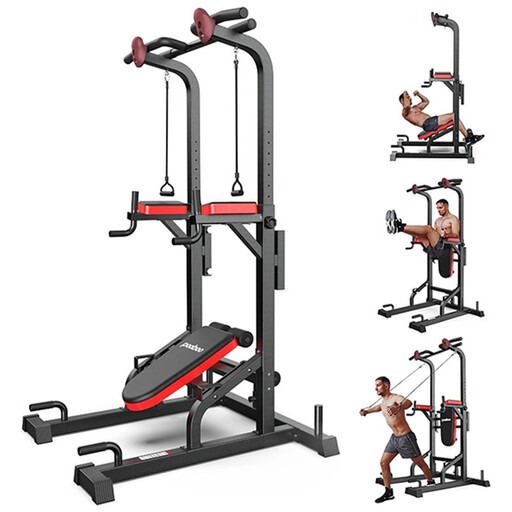
Why This Fits Their Persona: This is for the individual who wants a single, space-efficient solution for both bodyweight exercises (pull-ups, dips and leg raises) and traditional free-weight training (bench press, dumbbell rows). It's the most direct answer to the "all-in-one" home gym need.
Its heavy-duty steel frame and high weight-bearing capacity (480 lbs) directly address the stability pitfall. The integrated bench is a core part of the design, not an afterthought, avoiding the "useless bench" problem.
True multifunctionality. It combines a pull-up station, dip station and a functional bench in one unit, maximising workout variety without needing multiple pieces of equipment.
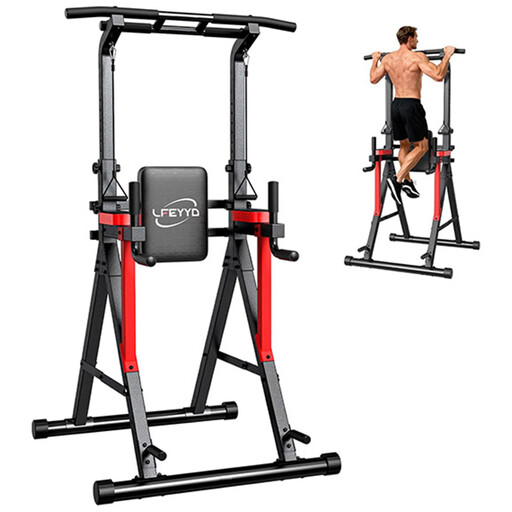
Why This Fits Their Persona: This is for the user focused on calisthenics—pull-ups, dips, muscle-ups and leg raises. They may already own a separate bench or simply don't need one, prioritising stability and adjustability for bodyweight movements above all else.
By focusing solely on being a power tower, its design is optimised for stability. The impressive 13-level height adjustment directly solves the "one-size-fits-all" ergonomic pitfall for a wide range of user heights.
Exceptional adjustability and a sturdy, focused design. The high weight capacity (400 lbs recommended) ensures it remains stable even during advanced or weighted calisthenics.
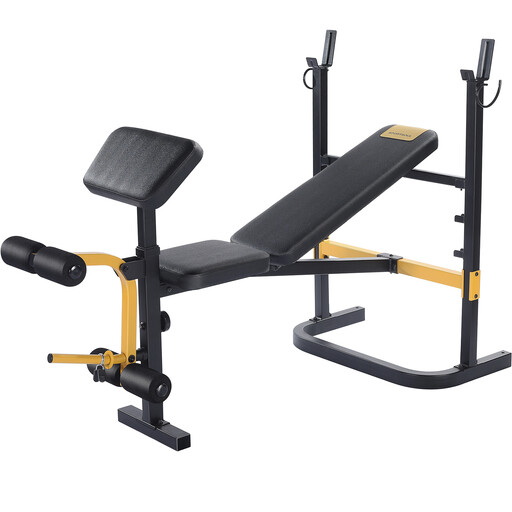
Why This Fits Their Persona: This is an alternative for those who prioritise barbell work (squats, bench press) over bodyweight stations. If your goal is traditional strength training with free weights, this combination of a rack and bench is a more suitable "all-in-one" solution.
It directly counters the "useless bench" pitfall by providing a robust, multi-angle adjustable bench. The integrated squat rack with safety hooks also addresses stability and safety concerns for solo lifters.
Offers a complete platform for barbell and dumbbell workouts, including a leg developer and preacher curl attachment for comprehensive muscle targeting. It's built for lifting heavy.
We have compiled a complete, real-time list of products that fully satisfy these strict selection criteria and UK safety regulations.
When planning your space, think in three dimensions. You'll need a ceiling height of at least 2.4 metres (around 8 feet) to perform pull-ups without hitting your head. The floor footprint is typically around 1.2m x 1m, but you must account for clearance. Plan for at least 1 to 1.5 metres of open space around the unit for safe movement and to fully utilise the bench.
Most models are designed for home assembly and include the necessary tools and instructions. However, due to the size and weight of the components, it is strongly recommended as a two-person job. Set aside 1-2 hours. The most important step is to securely tighten every bolt and nut before the first use and to re-check them periodically as part of routine maintenance.
While possible, it is not the ideal setup. For maximum stability, a hard, level surface like a concrete garage floor, wood or laminate is best. If you must place it on a carpet, it is highly advisable to use a heavy-duty equipment mat underneath. This will create a more stable and non-slip base, prevent the unit from sinking unevenly and protect your carpet from damage.