Weekend continental-breakfast hosts
Plan ahead for several diners with croissants that can be warmed and served together. Multipacks and frozen bake-at-home options are useful formats to compare for cooking time, storage and servings.


Choose the serving format before the premium label: frozen bake-at-home croissants suit a planned breakfast with oven time, while chilled or bakery options suit quicker serving. For a premium-style plain croissant, compare the exact butter content, warming instructions, pack size and allergen statement; retailer labels show meaningful differences, but they do not provide an independent taste ranking.
Plan ahead for several diners with croissants that can be warmed and served together. Multipacks and frozen bake-at-home options are useful formats to compare for cooking time, storage and servings.
Look for a plain croissant intended for a more indulgent breakfast rather than a filled pastry. Check the exact butter percentage and whether it is intended to be served warm, while treating flavour descriptions as retailer or manufacturer claims rather than independent taste testing.
Confirm ingredients and precautionary allergen statements before serving guests. Plain croissants commonly contain wheat, milk and egg, but nut and other trace-allergen warnings can differ between products.
Start with when and how you want to serve breakfast, then compare the current product label for ingredients, preparation and portion information.
| Priority | What to check | Your needs |
|---|---|---|
| Buttery, warm style | Compare the disclosed butter percentage where available. Check whether the pack gives warming or baking instructions. Treat terms such as flaky or golden as product descriptions, not taste-test results. | I want a plain croissant with a buttery laminated-pastry style that can be served warm. Waitrose, M&S, Tesco and Pret listings disclose butter contents from 24% to 33% for the products compared. |
| Breakfast timing | Check whether the product is ready to serve, needs a short oven refresh or requires baking from frozen. Confirm storage instructions before choosing a frozen option. | I need croissants that fit my morning schedule. Chilled examples from Tesco and Waitrose have short stated warming times, while the Pret frozen option is listed as taking 20 minutes from frozen. |
| Allergen information | Read declared allergens and precautionary statements on the current pack. For loose bakery items, ask the retailer about the exact croissant being served. | I am serving guests and need to check for wheat, milk, egg, nuts and other relevant allergens. The Food Standards Agency states that allergen information must be provided for prepacked and non-prepacked food. |
| Saturated-fat comparison | Compare saturates per 100g before comparing per-croissant figures. Check the serving amount as well, because croissant sizes can differ. | I want to compare labels on the same basis rather than assuming that an all-butter or premium range label indicates a lower-saturated-fat option. NHS guidance recommends using per-100g nutrition information for comparison. |
Butter percentage, flour origin and flaky-texture descriptions can help identify the intended style, but they are retailer or manufacturer claims rather than independent taste testing. Preparation method, pack size and allergen suitability can still differ substantially.
Choose the route first: frozen for planned oven-fresh serving, chilled multipacks for a fast warm-up and bakery formats for near-immediate purchase. Then compare the exact label.
The croissants covered here contain wheat, milk and egg, while some also carry nut or broader trace-allergen warnings. Recipes and online product information can change.
For an allergy-sensitive guest, check the physical pack for the exact product and batch, or ask the retailer about loose bakery items. Do not use one retailer's allergen information for another product.
Serving weights and croissant sizes differ, so a per-croissant figure alone can be misleading. NHS guidance classifies more than 5g saturates per 100g as high and recommends comparing nutrition information per 100g.
Use per-100g saturates for product-to-product comparison, then check the per-croissant figure to understand the serving you plan to eat.
The frozen Pret product requires freezer storage and a 20-minute bake from frozen, so it is not an immediate-serve option.
Choose frozen only if you have freezer capacity and enough breakfast lead time; otherwise select a chilled or bakery croissant with a shorter warming instruction.
A supermarket option for a premium-style morning table, with 160g All Butter Croissants that M&S describes as an authentic-recipe, creamy-butter product intended to be warmed.
A chilled four-pack route for shoppers wanting a premium-labelled multipack that can be reheated shortly before breakfast.
A small-pack premium supermarket option for a breakfast serving for two, within Waitrose's No.1 range.
An in-store bakery route for shoppers buying a plain all-butter croissant shortly before breakfast rather than ordering a packaged premium product online.
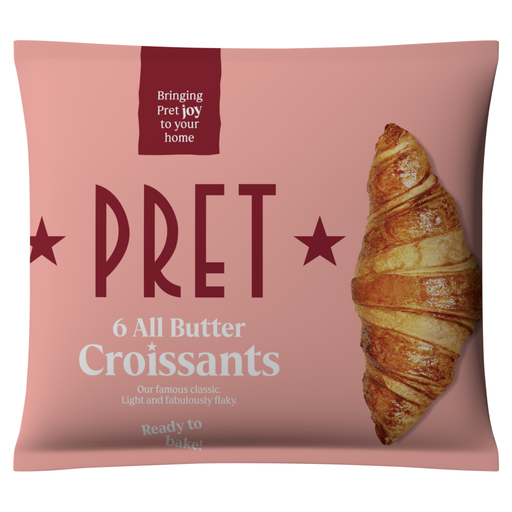
Joybuy product options for a planned continental breakfast with freezer storage and time to bake croissants shortly before serving.
 No image available
Suitable for a planned continental breakfast when warm, oven-baked croissants are preferred and freezer storage is available.
The listing states 24% French-sourced butter, slow fermentation, 27 folds and a 20-minute bake from frozen.
Requires storage at -18°C or below. Contains wheat, milk and egg, and may contain nuts, sesame and soya; check the current pack before serving allergy-sensitive guests.
Start with the serving format and the exact label. The products compared disclose 24% to 33% butter, but this does not independently prove which tastes best; also check warming time, pack size and the current allergen statement.
No. The products covered contain wheat, milk and egg, and precautionary statements differ between packs. Check the current label or ask the retailer about the exact loose bakery item before serving.
It depends on the product state. Tesco Finest states 4 to 5 minutes from chilled, Waitrose No.1 states 2 to 3 minutes from chilled, and the Pret frozen product states 20 minutes from frozen; follow the instructions on the pack you buy.
Not necessarily. NHS guidance recommends comparing labels per 100g, and the listed products range from 13.8g to 17.7g saturates per 100g. Compare the same measure rather than relying on terms such as premium, French-style or all-butter.