Weeknight soup cooks
If you want a shorter route to chicken and barley soup, look for pressure cooking and a sauté or browning function so you can prepare ingredients in the same pot.


Choose a pressure-capable multicooker if a shorter cooking timetable and sautéing ingredients in one pot matter most for chicken and barley soup. Choose a slow-cook-focused model if you would rather plan a gradual cook; whichever route you take, check the pot size, cleaning requirements and the exact model's instructions for cooking barley and handling hot soup.
If you want a shorter route to chicken and barley soup, look for pressure cooking and a sauté or browning function so you can prepare ingredients in the same pot.
If you make several portions at once, consider bowl capacity alongside room to stir, storage space and how you will handle a full, hot inner pot.
If you prefer to prepare soup ahead of a gradual cook, slow-cook controls and straightforward cleaning may matter more to you than pressure cooking.
Decide whether cooking time or a planned slow cook matters more, then choose a capacity you can comfortably fill, store and handle.
| Concern | What to check | Who this matters to |
|---|---|---|
| Cooking time and one-pot preparation | Check the exact model for pressure cooking, sauté or browning, and controls you can use for your recipe. | If I cook soup on a weeknight, I want to sauté ingredients in the pot before the main cook without committing to a long session. Around 40% of consumers put this time-and-preparation need first. |
| Batch capacity | Compare bowl capacity with dimensions and the model's filling limits; allow for handling the inner pot when full. | When I make soup for several meals, I need enough usable room without buying a cooker that is awkward to store or lift. Roughly 30% of consumers prioritise batch capacity. |
| Planned cooking and upkeep | Check slow-cook controls, any delay or keep-warm settings, and which removable parts can be cleaned as instructed. | I would rather set up a gradual cook and have a manageable clean-up than prioritise the shortest cook time. Around 30% of consumers place planned cooking and upkeep first. |
Tefal UK lists pressure cooking for the CY505E40, while its RK302E15 is a slow-cook and grain-oriented model. The category name alone does not tell you which cooking route a model offers.
Check the exact model's named pressure-cook, slow-cook and sauté or browning functions before choosing it for your soup recipe.
A larger bowl can accommodate more soup, but the appliance also needs storage space and a full inner pot needs careful handling.
Compare your usual portion size with the exact model's dimensions, weight and minimum and maximum filling instructions.
A keep-warm setting does not replace thorough cooking of chicken or thorough reheating of stored soup. The Food Standards Agency's catering guidance distinguishes reheating from merely warming food.
Follow the appliance instructions and reheat leftover soup until it is steaming hot throughout before serving.
Instant Pot's Duo Plus manual identifies pearl barley among foods that may foam or spatter and obstruct steam-release components. Follow the instructions for the cooker you actually use.
Check its guidance for grains or soup, observe its filling limits and use its specified pressure-release procedure.
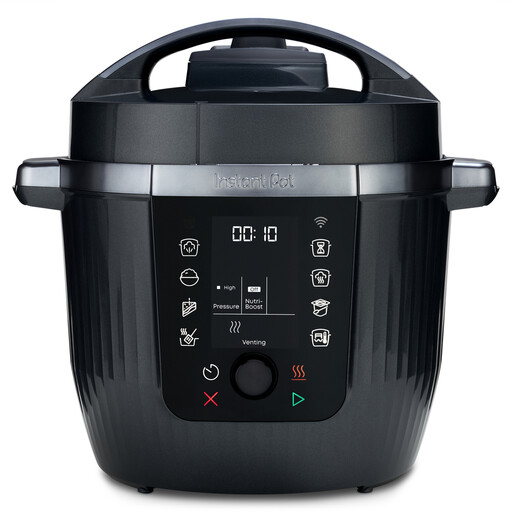
Instant Pot UK offers pressure-capable models relevant to a sauté-then-cook soup recipe, including larger pots for batch cooking.
Tefal UK has models on both sides of this choice: a pressure-capable multicooker and a slow-cook-focused alternative.
Crock-Pot UK offers slow cookers as well as pressure multicookers for cooks weighing a gradual soup cook against a pressure route.
These pressure-capable multicookers are options to consider if you want to sauté ingredients before cooking chicken and barley soup. Check each model's barley, filling and pressure-release instructions before using that route.
 No image available
Consider this model if you want to sauté soup ingredients in the cooker and have both pressure-cook and slow-cook options.
The product name specifies a 5.7L capacity and a ceramic non-stick coating. Check the exact manual's barley, filling and pressure-release guidance, as well as the listing's voltage, plug and warranty details.
 No image available
Consider this model if you want a pressure-cook route with a sauté stage and the option of a slower cook.
The product name specifies a 5.7L capacity. Consult the Pro model's own instructions for pearl barley, filling limits and pressure release; confirm voltage, plug and warranty details before buying.
 No image available
Consider this 6L option if batch-sized soup and a pressure-cook route with a sauté stage are priorities.
The product name specifies 10 programmes. Confirm whether the appliance is labelled MC6SBUK or HMC6SBUK before following model-specific instructions, and check its barley, filling, pressure-release, voltage, plug and warranty details.
Use pearl barley under pressure only when the exact cooker's instructions allow it and you can follow its filling and release guidance. Instant Pot UK publishes a pressure-cooked pearl-barley recipe for a different dish, but that recipe does not establish a cooking time or release method for chicken soup.
Check the exact model's manual for permitted ingredients, filling limits and pressure release. Instant Pot's Duo Plus manual specifically cautions that pearl barley can foam or spatter and potentially obstruct steam-release components; its instructions should not be substituted for another model's manual.
You can use a multicooker programme that thoroughly reheats the soup, following that appliance's instructions rather than relying on keep warm. UK government home-cooking guidance calls for food to be cooked completely, while the Food Standards Agency's catering guidance describes reheating as cooking again, not simply warming.
Confirm the exact listing's voltage and plug before buying, along with its warranty terms. Instant Pot UK states that its UK models are designed for 220–240V outlets and should not be used outside their stated voltage range, even with an adapter or converter.