Colour-display caption makers
Teachers and classroom staff using coloured headings, illustrations or visual coding need colour output and a printer confirmed to accept their chosen paper or card.


For colourful classroom display captions, start with an A4 colour printer, but check that the exact model accepts your intended paper or card before buying. Refillable ink tanks and larger paper trays are worth considering for frequent shared batches; a mono laser is a practical choice only when the captions can be black and white.
Teachers and classroom staff using coloured headings, illustrations or visual coding need colour output and a printer confirmed to accept their chosen paper or card.
Staff who refresh displays repeatedly may value a paper tray that needs less frequent reloading, manageable consumables and a connection that suits a shared workspace.
For black-and-white wording on ordinary A4 paper, print speed may matter more than colour. Two-sided printing can also be useful for other classroom documents, though it may add little to single-sided display captions.
Decide whether the captions need colour and specialist stock before comparing tray capacity, consumables or speed. A quoted maximum paper weight does not, by itself, confirm that a particular card will feed through the printer.
| Concern | Buying checks | Who this matters to |
|---|---|---|
| Colour and caption stock | Check colour capability and the exact model’s supported media type, weight and feed path. | If my display uses coloured labels or card, I need both the intended colours and paper to work in the same printer. Around 42% of consumers put colour and stock compatibility first. |
| Uninterrupted batches | Compare plain-paper input capacity and consumable arrangements; treat rated ink yields as conditional, not a prediction for graphic-heavy captions. | When several staff refresh displays, I want fewer pauses to load paper or change supplies. Roughly 33% of consumers prioritise keeping batches moving. |
| Plain-text output | Confirm that colour is unnecessary, then check mono speed, paper capacity and whether two-sided printing suits the task. | For temporary text signs on ordinary paper, I would accept black-and-white output if it simplifies larger print runs. About 25% of consumers put this plain-text need first. |
Weight does not describe coating, stiffness or the required feed path. Epson advises checking the exact printer’s media guidance and warns that third-party heavyweight paper may have different limits.
Check the model guide against your intended stock and try a small pack before ordering supplies in bulk.
Unsuitable specialist sheets can waste materials and time when feeding needs troubleshooting.
A mono printer cannot reproduce coloured headings, borders or visual coding. Brother identifies its DCP-L2620DW as a mono printer.
List the colour elements your displays actually use before choosing black-and-white output.
Canon specifies automatic duplex on the MAXIFY GX6150 for selected plain-paper media; that does not establish support for specialist caption sheets.
Check the exact model’s duplex media conditions before planning two-sided card printing.
A printer needs a stable location with suitable access to sockets and without trailing leads. School electrical-safety guidance from the London Borough of Hammersmith & Fulham advises checking socket availability before adding equipment.
Plan its position with the school’s equipment inspection and fault-reporting arrangements, and avoid overloaded extensions.
MAXIFY MegaTank models are relevant when a small classroom prints recurring colour-caption batches and shares a printer.
EcoTank models provide a colour-printer route for classrooms considering refillable ink tanks.
Brother’s mono laser models are a reference point for text-led black-and-white signs rather than colour displays.
These printers are choices to consider for classroom display captions. Match the required caption size and stock to the exact model before deciding, particularly if you plan to print on card.
 No image available
Consider this model for recurring colour-caption batches in a shared classroom. Canon UK specifies Wi-Fi, Ethernet, a 100-sheet rear tray and a 250-sheet cassette; check the supported feed route for your caption stock, as its automatic duplex specification covers selected plain papers.
 No image available
Consider this A4 model when scanning or copying would also be useful alongside classroom captions. Its product name specifies Wi-Fi; check the ET-5150’s media types and feed route before choosing caption card.
 No image available
Consider this printer if its supported paper sizes and media suit the display materials you intend to make. Check the exact model guidance for your caption size, stock and feed route before buying supplies.
 No image available
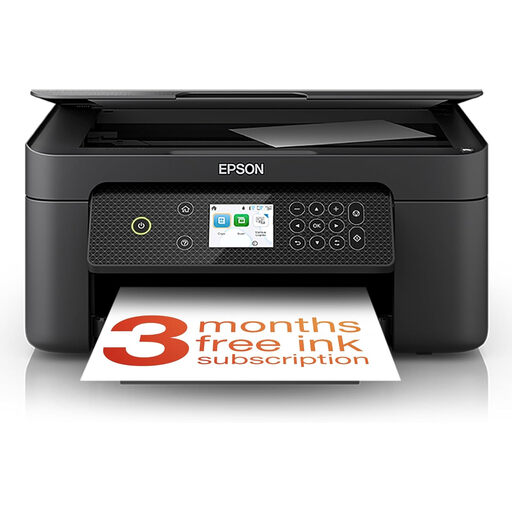
Consider this model for occasional A4 captions where Wi-Fi is useful. Its product name specifies 5760 x 1440 DPI; check the exact model’s supported media and feed route before using card.
No. The stated maximum does not establish support for every card type or feed path. Epson advises checking the exact model guide and notes that third-party media above 90 g/m² may not be supported even where a higher maximum is quoted for specified media.
Choose mono only when the captions are deliberately black-and-white and mainly text. Brother identifies the DCP-L2620DW as a mono printer, so it will not reproduce colour coding, coloured borders or illustrations.
Check the exact model and stock before relying on it. Canon specifies automatic duplex on the MAXIFY GX6150 for selected plain-paper media, which does not establish that it works with card or specialist caption sheets.
Choose a stable position with suitable socket access and no trailing leads. School electrical-safety guidance from the London Borough of Hammersmith & Fulham advises checking that sufficient sockets are available and avoiding overloaded extensions; follow the school’s equipment inspection and fault-reporting arrangements too.