Caretakers of fragile family correspondence
If letters are delicate, unusually shaped or irreplaceable, you may prefer to place and inspect each original individually on a scanner glass rather than prioritise feeder speed.


Choose a multifunction printer with a flatbed scanner if careful, one-at-a-time handling is the priority for fragile or irregular family letters. An automatic document feeder (ADF) is more useful for batches of sound, loose pages, particularly when it can scan both sides automatically, but its capacity does not establish that aged originals are safe to feed. Compare everyday printing needs separately from the scanning workflow.
If letters are delicate, unusually shaped or irreplaceable, you may prefer to place and inspect each original individually on a scanner glass rather than prioritise feeder speed.
If you have many loose, consistently sized letters, especially ones written on both sides, an ADF with automatic two-sided scanning could reduce repeated placement and turning.
If the printer will stay in use after the letters are scanned, printing, copying and connectivity matter alongside how it handles the originals.
Assess the condition of the letters before comparing batch-scanning features. Then decide how much routine home-office work the same machine needs to handle.
| Concern | What to check | Who this matters to |
|---|---|---|
| Careful handling | Confirm the printer has a flatbed, check its usable scan area and read the exact model’s ADF loading guidance. | If my letters are brittle, irregular or irreplaceable, I want to handle each one individually rather than assume a feeder is suitable; around 42% of consumers put careful handling first. |
| Batch scanning | Check ADF capacity and whether it scans both sides of supported page sizes automatically. | With a stack of sound, loose letters written on both sides, I want fewer manual page turns; around 33% of consumers prioritise batch efficiency. |
| Ongoing office use | Compare the print and copy functions, connections, consumable system and desk space needed. | Once the letters are digitised, I still need the machine for ordinary home-office documents; around 25% of consumers put that continuing use first. |
A feeder’s page capacity describes a batch workflow, not the condition of the paper it can safely take. Epson’s scanning guidance directs photos to the scanner glass rather than its ADF; that distinction is a reason to assess other keepsakes individually too, not a rule that every letter is feeder-unsafe.
Sort letters by condition and size. Set aside brittle, torn, curled, attached or irreplaceable originals for individual handling, and use an ADF only for pages that meet the exact model’s loading instructions.
Print functions do not tell you whether the scanner accommodates an unusual sheet or scans both sides of an A4 letter automatically.
Note the collection’s sizes, condition and one-sided or two-sided pages. Compare those requirements with the scanner’s platen area, ADF limits and duplex-scanning specification.
The Library of Congress notes that digital-image choices depend on factors beyond a single scanner setting, including the source material and intended use.
Test-scan representative handwriting, faded areas and margins. Decide how you will name, back up and store the files before scanning the full collection.
A printer prepared for reuse or recycling may still hold settings associated with its previous connection.
Follow the maker’s reset instructions and check for removable memory cards before donating, selling or recycling it. Recycle Your Electricals also recommends removing cartridges.
Canon’s MAXIFY GX4050 illustrates a home-office option that combines a platen with an ADF.
Epson’s WorkForce Pro WF-C4810DTWF illustrates an A4 batch-scanning workflow for sound documents.
Brother’s MFC-J5740DW is relevant when larger-format office work accompanies batches of A4 letters.
These multifunction printers are options to consider when digitising letters alongside routine home-office work. Before choosing one for the collection, confirm its flatbed area, two-sided scanning capability and document-loading limits against the originals you have.
 No image available
Consider this multifunction model if letter scanning will share space with everyday office tasks. If larger originals or two-sided letter batches are part of the project, confirm the maximum scan area and automatic duplex-scanning capability for this exact model before buying.
 No image available
Consider this model if the machine also needs to serve an ongoing home-office printing workflow. For family letters, confirm that its scanning surface fits the originals and check whether any planned two-sided batches can be scanned automatically.
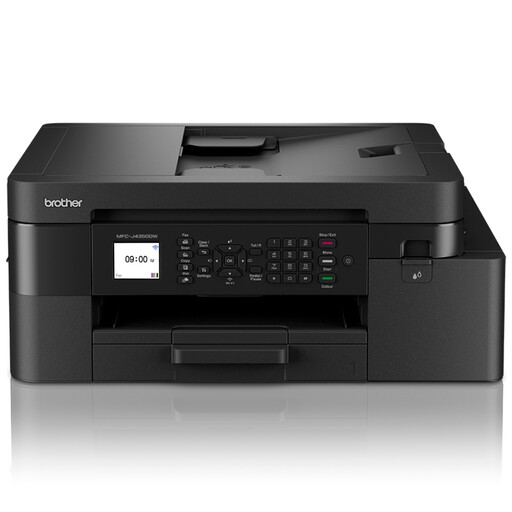 No image available
Consider this all-in-one inkjet printer for a home office that also needs to digitise letters. Check its platen size, ADF paper-condition limits and whether it scans both sides automatically before planning a batch workflow.
Use an ADF only for letters whose condition and size meet the exact printer’s loading instructions; handle delicate or irreplaceable originals individually on a suitable platen. Feeder capacity alone does not establish safe handling, and Epson’s separate instruction to put photos on the scanner glass shows why different originals need different treatment.
Choose a setting by checking whether test scans capture the handwriting, annotations and margins you need; no single resolution number guarantees a useful preservation copy. The Library of Congress notes that digital-image choices also depend on the source material and intended use. Keep clearly named files and a backup as part of the wider plan.
Check whether the scanning software offers a searchable PDF or optical character recognition (OCR) option, then test it on a representative letter before relying on text searches. A readable image does not, by itself, mean the handwriting will be recognised accurately.
Prepare it for reuse or appropriate electrical recycling rather than leaving personal settings on the device. Recycle Your Electricals advises a factory reset and removal of cartridges and memory cards; follow the printer maker’s instructions for the particular model.