Batch-paper archive organisers
If most records are clean, loose sheets, an ADF can reduce repeated page placement. Check its supported media and how the printer will connect to the computers sharing the studio.


For mainly loose A4 records, choose a multifunction printer with both an automatic document feeder (ADF) and a platen: feed supported sheets in batches, but place fragile, bound or irregular originals on the platen. Check for automatic two-sided scanning if double-sided paperwork is common, and consider an A3 device only if oversized records recur often enough to justify the extra space.
If most records are clean, loose sheets, an ADF can reduce repeated page placement. Check its supported media and how the printer will connect to the computers sharing the studio.
Damaged, creased, bound or irreplaceable items call for an item-by-item handling decision. A platen lets you scan an original without pulling it through a feeder.
When several people also print and copy, network access, paper capacity and the work involved in replenishing ink matter alongside scanning features.
For family records in a shared studio, start with the condition and size of the originals. Then decide how often you need batch scanning, two-sided capture and routine printing.
| Concern | What to check | Who this matters to |
|---|---|---|
| Fragile originals | Confirm a platen and its usable scan area; check the feeder’s supported media before inserting any original. | If my records are damaged, bound or irreplaceable, I need to handle them individually rather than send them through rollers. Around 30% of consumers put protecting vulnerable originals first. |
| Loose-paper batches | Check ADF capacity and whether the exact model automatically scans both sides, not merely prints on both sides. | With stacks of ordinary loose sheets, I want to avoid placing and turning every page by hand. Batch capture is the primary need for around 40% of consumers. |
| Shared printing | Check the required Wi-Fi or Ethernet connection, paper capacity and the replacement-ink arrangement. | When several people print and scan on one machine, I need access that suits our computers and a manageable replenishment routine. Around 20% of consumers prioritise this shared workflow. |
| Larger records | Measure recurring originals and confirm the maximum scan size, including whether the platen or ADF handles A3. | If large family charts or certificates appear regularly, I want to capture them without repeatedly splitting the image. Format flexibility comes first for around 10% of consumers. |
A feeder moves paper through rollers; an irreplaceable original may be damaged rather than merely need rescanning. The National Archives cautions that digitisation can risk damage to physical records in its public-records guidance.
Sort the collection first. Feed only loose pages that meet the model’s media requirements, and use a platen or seek specialist handling for vulnerable items.
Automatic two-sided printing does not establish that a printer can capture both sides of a sheet automatically.
Look for an explicit two-sided scanning specification for the exact model before relying on it for double-sided records.
A manufacturer’s stated ink yield describes output under its stated conditions, not every studio’s complete ownership costs.
Compare the appropriate replacement inks, maintenance consumables, expected print mix and warranty terms as well as tray capacity.
A scan may miss an edge, page or detail. Guidance from The National Archives on public records emphasises the importance of complete, legible capture and preserving context; it does not establish a disposal rule for private family papers.
Review the files, organise them consistently, keep a backed-up copy and retain irreplaceable originals unless you have a sound reason and process for disposing of them.
Canon’s MAXIFY MegaTank GX6150 is an A4 print, copy and scan option for a studio that needs both batch feeding and platen scanning.
Epson’s EcoTank ET-5855 is an A4 multifunction option for a shared printing and document workflow.
Brother’s MFC-J6957DW is an A3 all-in-one to consider when larger sheets recur in the collection.
These printers offer different starting points for the same studio task: a larger-format all-in-one, an A4 model with a confirmed platen and ADF, and an inkjet all-in-one for routine loose-paper work. Check the exact scan path before choosing a machine for fragile or double-sided originals.
 No image available
Consider this model if larger originals recur in the studio. Confirm how the exact printer scans A3 sheets, whether it has a platen suitable for your originals, and whether it scans both sides automatically.
 No image available
For mainly loose A4 records with occasional items needing platen handling, the GX6150 combines a flatbed/platen scanner and a 50-sheet ADF. Canon UK also lists Wi-Fi, Ethernet and 350-sheet total paper capacity. Confirm automatic two-sided scanning if you need it: the stated duplex-printing feature does not establish duplex scanning.
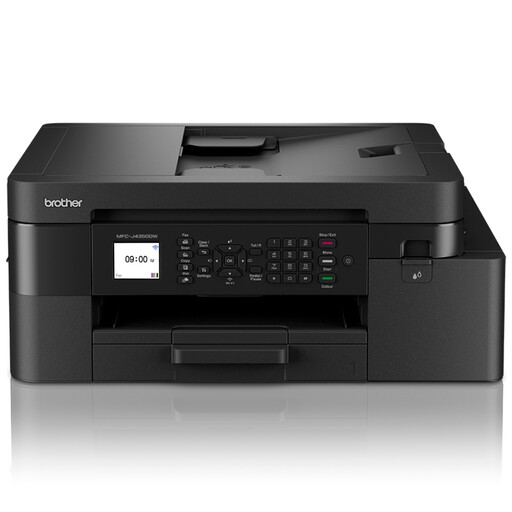 No image available
Consider this model for routine loose-paper work and Wi-Fi-based sharing. Before using it for vulnerable originals or double-sided batches, confirm its platen and automatic two-sided scanning specifications; check for Ethernet if the studio requires a wired connection.
No. Use an ADF for loose originals that meet the exact printer’s supported media conditions, and consider platen scanning for fragile, damaged or bound items. The National Archives cautions that digitisation can damage a physical original in its public-records guidance.
No; printing and scanning are separate specifications. Canon UK lists automatic duplex printing for the MAXIFY GX6150, while Brother UK explicitly lists automatic two-sided scanning for the MFC-J6957DW. Check the wording for the exact model you intend to buy.
Consider A3 when oversized originals recur often enough to justify the space a larger device occupies. Brother UK lists A3 scanning for the MFC-J6957DW, but check whether a candidate model captures your particular originals from the platen, the feeder or both.
A completed scan alone is not a sound reason to discard an irreplaceable original. Check files for missing pages, cropped edges and unreadable details, keep a backed-up copy, and make any disposal decision separately; The National Archives’ public-records guidance does not set a general rule for private family papers.