Black-and-white pattern sharers
Studio members who mainly print A4 written instructions and symbol charts, and want straightforward shared printing without frequent paper reloads.


Choose a mono laser printer if members mainly print black-and-white A4 patterns; choose a colour ink-tank printer if chart colours or scanning marked-up pages matter. Larger trays and an automatic document feeder become more useful when several people print or scan regularly. Consider A3+ only if full-size charts work meaningfully better than A4 sheets.
Studio members who mainly print A4 written instructions and symbol charts, and want straightforward shared printing without frequent paper reloads.
Makers and tutors who need colour distinctions in charts or want to copy and scan marked-up pages.
People organising repeated shared printing and scanning, for whom tray capacity, an automatic document feeder and suitable network connections can reduce manual handling.
Start with whether pattern information depends on colour. Then consider how often members print or scan, and whether any chart genuinely needs a sheet larger than A4.
| Concern | What to check | Who this matters to |
|---|---|---|
| Black-and-white A4 patterns | Check that charts remain legible in greyscale, then compare automatic duplex, tray capacity and permitted connections. | If our patterns use text and symbols rather than essential colour, we want clear A4 copies without repeated paper handling. Around 40% of consumers put that mono-printing need first. |
| Colour and annotations | Check colour printing and scan/copy functions; decide whether occasional flatbed scanning is sufficient. | When chart keys or teaching notes depend on colour, we need those distinctions to survive printing. Colour or marked-page handling is the primary need for around 30% of consumers. |
| Repeated shared use | Compare paper capacity, automatic document feeder capacity and connections allowed on the studio network. | With several members printing or scanning regularly, we want fewer reloads and less page-by-page handling. Roughly 20% of consumers prioritise that shared-workflow need. |
| Oversized charts | Measure the required sheet size and check whether the chosen model supports the necessary A3 or A3+ workflow and feed clearance. | If tiling a chart across A4 sheets makes it awkward to use, we need a full-size print instead. That larger-paper requirement comes first for around 10% of consumers. |
A black-and-white print may lose distinctions carried by colour-coded keys or annotations.
Print a few commonly used pattern PDFs in greyscale and check whether members can still follow every chart.
Manufacturer page yields depend on their stated conditions; the studio’s document mix, colour coverage and settings can differ.
Check replacement bottles and any maintenance consumables for the exact model, using the studio’s typical pages to assess ongoing use.
Duplex support can depend on paper size and type. Canon’s GX6150 specification, for example, sets conditions for A4 or Letter plain paper and specified 64 g/m² paper.
Try a real pattern PDF with the intended paper and binding margin before relying on double-sided handouts.
Unsuitable paper or layouts can mean manually reprinting pages.
Larger-sheet printing adds a specialised paper-handling and workspace requirement. Epson specifies an A3+ rear feed for the ET-15000.
Compare a full-size chart with a tiled A4 version, and measure the space needed to use the larger feed.
Brother has model-specific options for both mono pattern printing and compact colour multifunction use.
Epson’s EcoTank range includes A4 multifunction models and the ET-15000 for a workflow requiring A3+ output.
Canon’s MAXIFY MegaTank GX6150 and GX7050 are relevant where shared A4 colour printing and scan/copy handling matter.
These models cover different pattern-printing needs, from mono A4 pages to colour and larger-sheet workflows. Check the exact model’s functions against the studio’s charts, scanning habits and paper setup.
 No image available
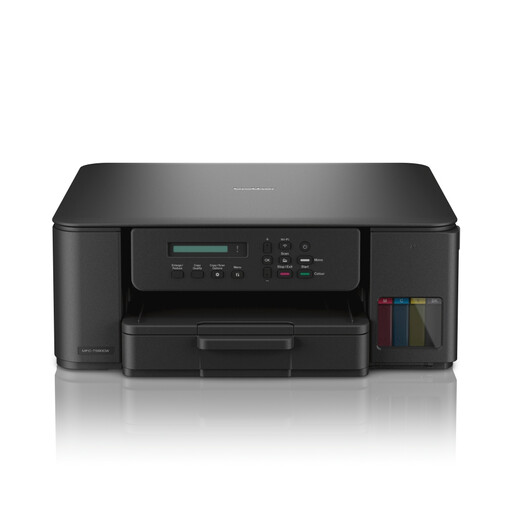
Consider this A4 option if the studio needs colour patterns alongside printing, scanning and copying.
The product name specifies Wi-Fi. Check its paper handling and scanning setup against the number of members sharing it.
 No image available
This colour print, copy and scan option suits a studio that uses coloured charts and occasionally handles annotated pages.
Brother specifies automatic two-sided A4 printing and a 150-sheet input tray. Check whether placing pages individually for scanning fits the studio’s workflow.
 No image available
Consider this mono printer if the studio’s A4 patterns remain clear without colour.
Its product name specifies two-sided printing and a 150-sheet input tray. Confirm scan or copy functions separately if members need them, and check the connection options required by the studio.
 No image available
This mono laser option is relevant when members mainly share black-and-white patterns.
Before choosing it for multi-page handouts or digitising patterns, check its duplex and scanning workflow against the amount of manual page handling the studio can accommodate.
 No image available
Consider this model only if the studio has charts that are difficult to use on A4 sheets.
Confirm the required paper size, compatible paper types, feed path and workspace clearance before relying on it for oversized charts. Check scan and copy functions separately if those are essential.
Choose mono for A4 written patterns and symbol charts that remain clear in greyscale; choose colour when chart keys or annotations depend on it. Test representative pattern pages before committing to a mono printer.
Prioritise an automatic document feeder when members regularly scan or copy multi-page marked-up patterns. Epson specifies a 35-page feeder for the ET-5170, while Canon specifies a 50-sheet feeder for the GX6150; compare those capacities with the studio’s typical batches.
No: check the exact model’s supported paper sizes and types. Canon specifies duplex conditions for the GX6150 that include A4 or Letter plain paper and specified 64 g/m² paper, so test the intended handout stock and layout.
Set up a workflow that keeps personal information secure rather than assuming the printer alone resolves the issue. The UK Information Commissioner’s Office calls for appropriate organisational and technical security measures when organisations process personal data.