Frequent shared-studio printers
Groups printing revision-card sheets repeatedly may need network access, a paper tray that suits their workload and a manageable refill routine.


For repeated revision-card printing by several people, consider a refillable ink-tank printer with suitable shared access. Choose the card stock before the printer: a larger paper tray does not establish card compatibility, and unusually thick stock may require a documented specialist feed.
Groups printing revision-card sheets repeatedly may need network access, a paper tray that suits their workload and a manageable refill routine.
Anyone using craft card or unusually thick stock needs to check the exact printer’s supported material and feed path before choosing a model.
Groups with moderate printing needs may prioritise a printer that fits their shared desk while still offering the connections they need.
For a shared studio, settle the intended card material first, then weigh the printing workload against the space and upkeep the group can accommodate.
Consider it when: Several people regularly print revision-card sheets and a larger ordinary-paper tray would reduce reloading.
Keep in mind: Tray capacity does not establish how much card stock the printer can feed.
Consider it when: Printing is moderate and the shared desk has limited room.
Keep in mind: A smaller tray may need refilling more often, and automatic duplex may not apply to the chosen card.
Consider it when: Thick or craft card is central to the revision-card project and the model documents a suitable feed.
Keep in mind: A specialist feed may handle the stock differently from the main paper tray; check the exact media limits.
| Concern | What to check | Who this matters to |
|---|---|---|
| Card compatibility | Check the stock’s weight or thickness against the exact model’s supported media and feed path; confirm whether duplex applies to that stock. | If my revision cards use heavier material, I need a documented way to feed it rather than relying on a paper-tray figure. Around 45% of consumers put card compatibility first. |
| Shared workflow | Check connections for the group’s devices, ordinary-paper tray capacity and the printer’s dimensions. | When several of us print in the studio, I want access that works for our devices without frequent paper reloads. Shared workflow comes first for around 33% of consumers. |
| Ink and upkeep | Check the ink system, replacement supplies and any maintenance parts needed for the chosen model. | For repeated batches over a term, I want a refill routine the group can manage and a clear plan for upkeep. Around 22% of consumers prioritise ink and maintenance needs. |
Media limits differ by model and feed path. Brother UK specifies 64–220 g/m² for the DCP-T780DW standard tray, while Epson says the ET-8500 straight feed accepts media up to 1.3 mm thick.
Choose the stock first, then check its type, weight or thickness against the intended feed and any duplex restrictions.
An unsuitable feed can mean clearing jams and reprinting cards.
The 350-sheet capacity listed by Canon UK Store for the MAXIFY GX4050 and the 250-sheet tray listed by Epson for the ET-5170 do not establish the capacity of a specialist card feed.
Check the card feed separately from the main tray if the group plans repeated runs on heavier stock.
Refillable tanks still need ink, and Canon UK Store lists a user-replaceable maintenance cartridge for the MAXIFY GX4050.
Agree who will monitor supplies and carry out the maintenance described for the chosen model.
Unclear responsibility can leave paper, ink or jams unattended. The Health and Safety Executive advises maintaining workplace electrical equipment to prevent danger, using an approach appropriate to the setting.
Before installation, agree who looks after supplies, routine maintenance and the studio’s electrical-equipment procedure.
Brother UK describes the DCP-T780DW as an A4 refillable printer with Wi-Fi, automatic two-sided printing, a 150-sheet tray and a manual-feed slot.
Epson’s ET-5170 addresses shared document printing, while its ET-8500 has documented feeds for specialist media.
Canon UK Store lists the MAXIFY GX4050 with Wi-Fi, Ethernet, a 35-sheet automatic document feeder and a rear flat tray for paperboard.
These printers are options to assess for shared revision-card printing, from repeated group use to a lighter workload. Check the exact card stock and feed requirements before choosing any of them.
 No image available
Consider this model for repeated shared printing if its connections and paper handling suit the group. Confirm the intended card’s supported weight or thickness, feed path and duplex compatibility; ordinary-paper capacity alone cannot settle card capacity.
 No image available
Consider this all-in-one inkjet if the group also needs document-handling functions. Check its card-stock feed and duplex compatibility, confirm its ink supplies meet the group’s needs, and plan where the printer will stand.
 No image available
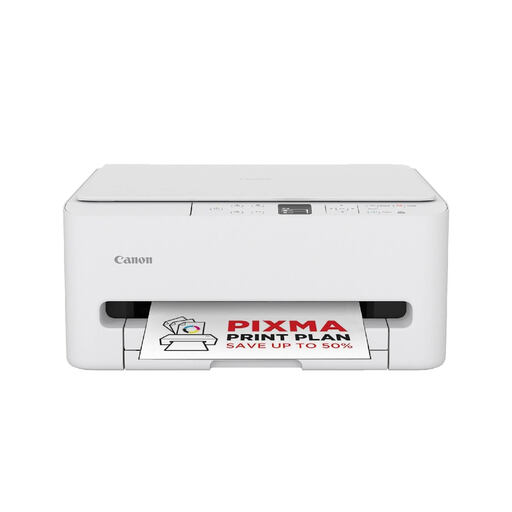
Consider this model for a group with a lighter printing workload and limited desk space. Check that its paper handling suits the expected batches, and confirm the intended card stock, feed route and ink requirements before purchase.
No: check the planned card’s type, weight or thickness against the exact printer and feed path. Brother UK specifies 64–220 g/m² for the DCP-T780DW standard tray; Epson says the ET-8500 straight feed accepts media up to 1.3 mm thick. Neither specification applies to every printer.
Only if the printer’s instructions support automatic duplex for your particular card and feed path. A printer’s general two-sided printing feature does not establish that it works with heavier stock.
Not automatically. The Health and Safety Executive says it is a myth that every portable electrical appliance in a low-risk environment such as an office needs annual portable appliance testing. Follow the studio operator’s equipment-maintenance procedure, taking account of its setting and use.
Use an appropriate electrical-equipment collection or recycling route rather than treating the printer as ordinary rubbish. GOV.UK describes the UK Waste Electrical and Electronic Equipment Regulations 2013, as amended, as underpinning measures to encourage recovery, reuse and recycling.