Choose the scanning setup around the catalogue’s physical format. An automatic document feeder (ADF) suits prepared loose sheets, while thick or bound catalogues call for a platen-glass workflow; if full-size A3 or automatic scanning of both sides matters, check those scanning capabilities on the exact model rather than relying on its printing specifications.
Who needs which scanning setup?
People scanning bound catalogues
If your exhibition catalogues are stapled, glued, thick or fragile, keeping each page in place matters more than feeding a stack quickly. Canon advises using the platen glass for thick or bound documents; check that the scanner bed and lid let you position your catalogue without forcing its spine.
People scanning loose pages in batches
If most originals are removable sheets, an ADF can save you from placing every page on the glass. Check the feeder’s capacity, accepted paper sizes and document-condition rules against the batches you actually handle.
People scanning large or two-sided pages
If you need full-size A3 scans or regularly handle two-sided loose sheets, look for those scanning capabilities explicitly. Epson specifies double-sided scanning up to A3 for the WorkForce WF-7840DTWF; that does not make bound pages suitable for its feeder.
What to check before buying
Start with whether each catalogue is bound or made up of loose sheets, then measure its largest page. Feeder capacity and printing features matter only after the scanning method fits the originals.
| Concern | What to check | Who this matters to |
|---|
| Bound or delicate originals |
Platen size and whether the lid allows gentle page placement. |
If my catalogue is bound or fragile, I need to position each page without forcing it through a feeder. Around 33% of consumers put protecting the original first. |
| Loose-page batches |
ADF capacity and the feeder’s rules for paper condition. |
With removable pages to digitise, I want to scan a prepared stack rather than lift the lid for every sheet. For around 27% of consumers, batch handling is the primary concern. |
| Large or two-sided pages |
Maximum scan size on both platen and feeder; automatic duplex scanning, not just duplex printing. |
If a page is A3 or printed on both sides, I need to capture the required area and sides without unnecessary repositioning. Full-size or two-sided capture comes first for around 20% of consumers. |
| Printing after scanning |
Ink system and its stated yield conditions; paper capacity for regular printing. |
Once the catalogues are digitised, I still need the machine for routine colour documents. Around 20% of consumers primarily balance scanning with ongoing printing. |
Mistakes that can slow or damage a scan
-
Putting every catalogue through the ADF
A feeder moves loose sheets through rollers. A bound, thick or unsuitable original can jam or be damaged.
Separate prepared loose pages from bound material before choosing a workflow. Canon advises placing thick or bound documents on the platen glass.
-
Mistaking duplex printing for duplex scanning
Automatic printing on both sides does not establish that the machine can scan both sides of a sheet automatically.
Check the exact scanning specification. Epson lists double-sided scanning up to A3 for the WF-7840DTWF, but single scanning for the A4 WF-3820DWF.
-
Choosing an A4 scanner for full-size A3 pages
An A4 platen cannot capture an entire A3 page in one scan; repositioning or stitching adds manual work.
Measure pages and fold-outs, then check the scanner’s supported size separately from its print size.
-
Treating rated ink yield as your own result
Manufacturer-rated yields depend on stated test conditions and may differ from printing graphics-heavy catalogue material.
Compare ink systems using their stated yield conditions and your expected mix of documents, without letting printing features override the required scan format.
Relevant printer ranges to consider
Epson
Epson WorkForce models provide distinct A4 and A3 scanning routes for a home office.
- Epson specifies double-sided scanning up to A3 for the WF-7840DTWF, a consideration for suitable loose, two-sided originals.
- Epson describes the smaller WF-3820DWF as an A4 model with single scanning; do not choose it on the assumption that duplex printing means duplex scanning.
Canon
The MAXIFY GX6050 combines a flatbed and ADF scanner with a refillable ink system for users who also print regularly.
- Canon specifies a 50-sheet ADF for the GX6050 and advises platen-glass use for thick or bound documents.
- The GX6050’s platen maximum is A4; its ADF is not an A3 scanning route.
Brother
Brother’s MFC-J4540DW is an A4-focused home-office example for combining routine printing with moderate loose-sheet scanning.
- Brother specifies a 20-sheet ADF and 400-sheet paper capacity for this model.
- Its stated feeder capacity is smaller than the 50-sheet Canon GX6050 example; check your usual batch size rather than treating capacity as a measure of scan quality.
Joybuy multifunction printers to consider
These multifunction printers are choices to examine if you want to scan catalogues and retain a home-office printer. Before choosing one for bound, A3 or two-sided originals, check its exact scanner-bed, feeder and duplex-scanning specifications.
 No image available
Brother MFC-J6760DW multifunction inkjet printer
Consider this model if you want one inkjet machine for printing and catalogue scanning. Check the feeder’s accepted originals and maximum scan size, particularly if your pages are A3; print size alone does not answer that question.
View on Joybuy
 No image available
Canon MAXIFY GX6150
For a home office that will use the printer as well as scan loose catalogue pages, compare the GX6150’s feeder and scanner-bed limits with your originals. Confirm how it scans two-sided pages before planning a large batch.
View on Joybuy
 No image available
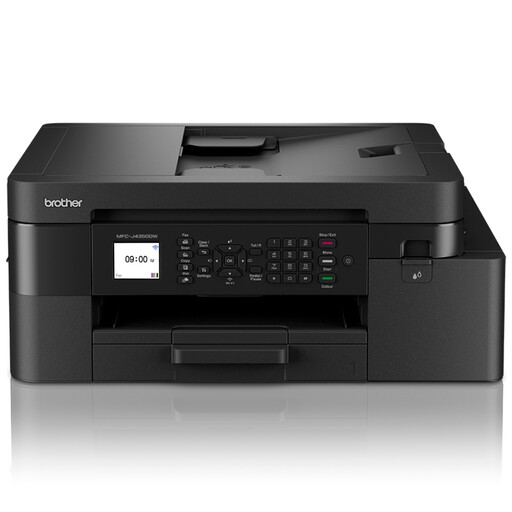
Brother MFC-J4350DW multifunction inkjet printer
This inkjet model is worth considering for loose-page scanning alongside ordinary office printing. Match its feeder and platen specifications to your page sizes, and check duplex scanning separately if the originals have content on both sides.
View on Joybuy
 No image available
Epson EcoTank ET-5150 A4 multifunction printer
Its stated A4 format makes the ET-5150 a model to examine when larger originals are not essential. The product name specifies Wi-Fi, scanning and copying; confirm the actual scan area and duplex-scanning method before using it for catalogues.
View on Joybuy
Common questions
Can I put a bound exhibition catalogue through an ADF?
Use the platen glass instead for a thick or bound catalogue. Canon’s guidance directs users to place thick or bound documents on the platen; check how the lid accommodates the particular volume without forcing its spine.
What should I do before feeding loose catalogue pages?
Prepare only sheets that meet the feeder’s document-condition rules. Remove staples and clips, and check the model’s guidance on curled, coated or damaged pages before loading a batch within its stated limit.
When do I need A3 scanning?
Choose A3 scan capability when you must capture a full A3 original in one scan rather than crop or reposition it. Epson specifies double-sided scanning up to A3 for the WF-7840DTWF, but a bound A3 catalogue still needs a suitable platen workflow, not merely an A3 feeder.
Will an ink-yield figure tell me how long supplies will last?
Not on its own: a manufacturer’s rated yield applies to its stated test conditions. If you also print colour documents, compare those conditions with your likely print mix instead of using a yield figure to decide whether the scanner suits your catalogues.


