Repeated-event programme organisers
If you print for several assemblies or performances, paper loading and ink replenishment can interrupt a run. Check both the tray capacity and the ink system against the number of sheets you expect to print.


For folded or double-sided A4 programmes, start with a colour printer whose automatic duplex mode supports the paper you intend to use. Then match paper capacity and ink replenishment to the size and frequency of your event runs; print a complete proof before producing the full batch.
If you print for several assemblies or performances, paper loading and ink replenishment can interrupt a run. Check both the tray capacity and the ink system against the number of sheets you expect to print.
If you fold or staple double-sided A4 pages, check the supported duplex paper and binding orientation before committing to a printer or programme layout.
If the printer will share a small room with staff and pupils, allow space to load paper and collect output as well as space for the machine itself. Confirm that it works with the devices and network staff will use.
Plan the programme format and paper first, then work out how many sheets an event run needs and where the printer can operate.
| Concern | Buying checks | Who this matters to |
|---|---|---|
| Batch interruptions | Compare tray capacity with the sheets needed per run, and check the ink system for repeated printing. Manufacturer page yields are not finished-programme counts. | If I print programmes for several events, I need to finish each batch without repeatedly stopping for paper or ink; around 46% of consumers put uninterrupted batch printing first. |
| Double-sided programmes | Check automatic A4 duplex support for the intended paper, then proof the page order and binding edge. | When my programme will be folded or stapled, I need both sides to read in the right order and print cleanly; for around 36% of consumers, that is the primary concern. |
| Classroom fit | Measure the operating space, including access for paper and output, and confirm compatibility with staff devices and the school network. | With little room for a shared printer, I need a workable position and a straightforward way for staff to send documents; roughly 18% of consumers prioritise classroom fit and setup. |
Automatic two-sided printing has paper and layout limits. Epson's duplex guidance specifies plain paper in supported sizes and warns that unsuitable paper can cause smearing or bleed-through.
Print one complete programme on the intended stock. Check the cover, reverse side, page order, fold and staple position before starting the full run.
A failed proof is less disruptive than discovering smeared or misordered pages across an event batch.
A stated page yield does not tell you how many finished programmes a layout with photographs or colour backgrounds will produce.
Use a representative programme proof to plan ink needs, rather than converting a page-yield figure directly into an event quantity.
Paper capacity affects how often someone must reload during a batch. Canon lists a 250-sheet cassette for the MAXIFY GX2050, while Brother lists a 150-sheet tray for the DCP-T780DW; those capacities apply to those models, not every printer from either brand.
Count the sheets needed for an event, including proofs and reprints, and measure the proposed location with room to load and retrieve paper.
Canon's MAXIFY MegaTank range is relevant to recurring document batches where paper handling matters.
Brother's ink-tank range is relevant when organisers want a refillable system alongside A4 document printing.
Epson's EcoTank ET-2950 is an A4 print, scan and copy option with double-sided printing, according to Epson.
These printers are options to examine for classroom programme printing, from repeated batches to more occasional runs. Match the exact model's paper handling, ink format and duplex settings to your programme before ordering.
 Image unavailable
For repeated programme batches, check whether its paper capacity and ink arrangement fit the number of sheets you print per event.
Confirm automatic duplex support for your chosen stock and proof the finished layout before a full run.
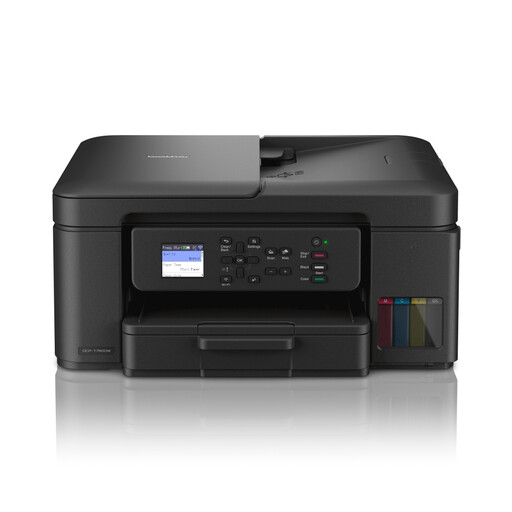 Image unavailable
For recurring A4 programme runs, its refillable-ink format and automatic two-sided printing are worth considering.
Brother lists a 150-sheet tray and a rated monochrome speed of 16 images per minute for this model. Check the duplex settings and paper compatibility for your programme.
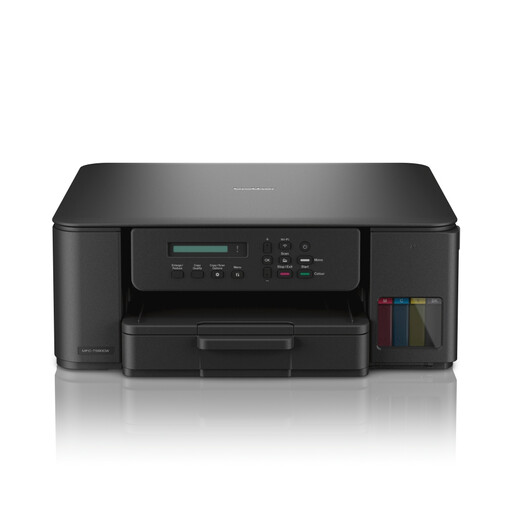 Image unavailable
For repeated classroom programme runs, assess how its ink format and paper handling fit your usual batch size.
Check the exact model's automatic duplex settings and supported paper before printing a folded programme.
 Image unavailable
If you are considering this model for classroom programmes, check the supported sheet sizes and whether its paper handling suits an event batch.
Measure the intended location and confirm duplex compatibility with the programme stock.
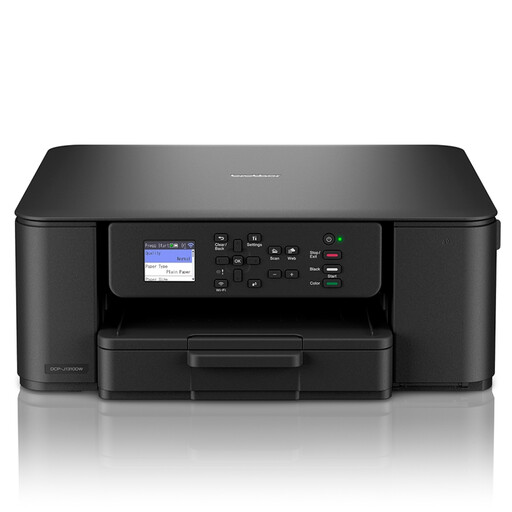 Image unavailable
For occasional classroom programme runs, compare its ink format and paper handling with the quantity you need to print.
Confirm the duplex-paper requirements and print a complete proof if the programme will be double-sided.
Yes, if the exact printer supports automatic duplexing with your chosen paper and size. Set the binding edge for the fold, then print and assemble one complete copy to check page order; Epson's duplex guidance specifies plain paper in supported sizes.
Do not assume that borderless printing and automatic duplexing can be used together. Epson's duplex guidance excludes borderless printing, so check the exact printer manual and consider a separately printed cover if the design requires it.
Test the exact programme paper on both sides and assemble a finished copy. Check for smearing or bleed-through as well as page order, the binding edge and the position of any fold or staples.
Use the school or academy trust's approved route for electrical equipment rather than putting the printer in general waste. GOV.UK's guidance on waste electrical and electronic equipment describes the rules intended to support recovery, reuse and recycling.