
24/7 Customer Support

Free returns

Same-day & Next-day Delivery

Quality Guaranteed

Unlock Your Welcome Offers: FREE Delivery | Up to 80% OFF | Free 30-day JoyPlus trial
Download the APP
Buying a pro stunt scooter for a child, teenager or adult can look straightforward, but product listings often make similar scooters sound interchangeable. The important differences are usually found in the construction, wheel setup, compression system and rider suitability.
Whether you are looking for a freestyle scooter for a birthday gift or a trick scooter for regular skatepark use, watch for these common buying pitfalls.
A lightweight stunt scooter is easier to lift and rotate during tricks, but low weight should not mean a thin, poorly supported deck or loose handlebar assembly. Check the materials and construction rather than relying on phrases such as “pro level” or “extreme performance”.
Aluminium alloy decks are commonly used to reduce weight, while steel handlebars can add strength. Some complete scooters combine a 6061 aluminium alloy deck with a 4130 chromoly steel handlebar, creating a practical balance for beginners learning jumps, barspins and other basic movements.
ABEC-9 bearings are frequently highlighted in listings, but bearing rating is only one part of the riding experience. Wheel material, wheel hardness, alignment and maintenance also affect how smoothly a scooter rolls.
A scooter with ABEC-9 bearings and high-rebound polyurethane wheels can provide a smooth glide on suitable, dry surfaces. However, no bearing rating makes a scooter suitable for wet paths, rough roads or neglected maintenance.
A “stunt scooter for kids” still needs to match the rider’s height, weight and intended use. A model designed for a younger beginner may feel restrictive as a teenager develops more advanced skills. Conversely, a larger scooter for adults may be heavier or less manageable for a seven-year-old.
Always compare the stated age range, handlebar height, deck dimensions and maximum rider weight before ordering. Age guidance is not a substitute for checking the complete specification.
The deck is the platform that receives most landing impact. A reinforced or heat-treated deck can offer a more substantial structure for learning tricks, while a non-slip surface helps maintain foot placement.
For younger beginners, a deck around 20 inches long and 4 inches wide can provide useful standing room without making the scooter unnecessarily cumbersome. Riders who are progressing towards more demanding skatepark movements may prefer a stronger one-piece or reinforced aluminium design.
Most complete freestyle scooters use solid polyurethane wheels, which avoid punctures and require less upkeep than pneumatic tyres. 100mm scooter wheels are commonly found on entry-level models and can feel responsive for beginners. 110mm scooter wheels offer a slightly larger rolling diameter and are frequently selected by intermediate riders.
Wheel hardness is also relevant. For example, an 88A polyurethane wheel is a stated specification on several K1 models. Do not interpret this number as a guarantee of comfort or speed; actual feel depends on the surface, bearings and rider technique.
A secure handlebar connection is essential for controlled trick riding. Look for a fixed or one-piece fork, a suitable compression system and a clamp with enough bolts to hold the bar firmly.
A three-bolt clamp is used on several of the scooters below and can be straightforward to tighten during initial assembly. The VOKUL Pro Trick Scooter also lists a permanent HIC compression system, while K1 models use a one-piece T4T6 fork. These are useful construction details, but the scooter should still be inspected before every ride.
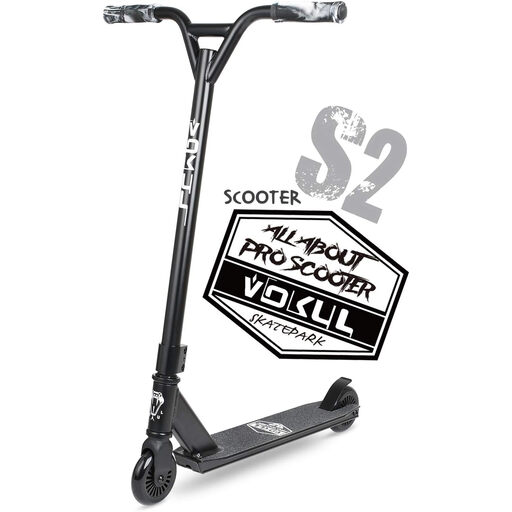
Why This Fits Their Persona: A practical entry-level option for children aged 7–14 learning basic tricks at a local skatepark or on smooth private surfaces.
It lists a reinforced deck, 6061 aluminium frame and three-bolt clamp rather than relying only on promotional wording.
100mm polyurethane wheels, rear brake, 8lb stated item weight and mostly pre-assembled setup.
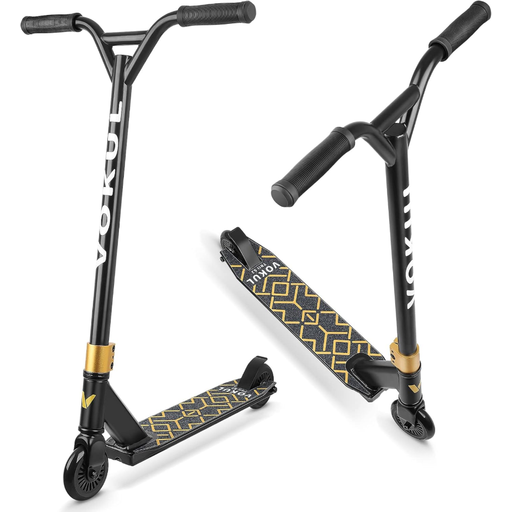
Why This Fits Their Persona: Suitable for a young rider who wants a more considered beginner freestyle scooter for regular practice and skill development.
Its specification identifies deck dimensions, wheel composition and bearing rating, making comparison easier than a vague “smooth ride” claim.
20 x 4-inch matt non-slip deck, 100mm PU+PC wheels and ABEC-9 bearings.

Why This Fits Their Persona: A suitable direction for riders aged 8 and over, including teenagers and adults, who want to progress from basic riding towards repeated trick practice.
The one-piece T4T6 fork, non-slip deck and solid wheels address the weak connection points buyers should check for frequent use.
110mm solid wheels, ABEC-9 bearings, adjustable 32-inch handlebar and stated 220lb weight limit.
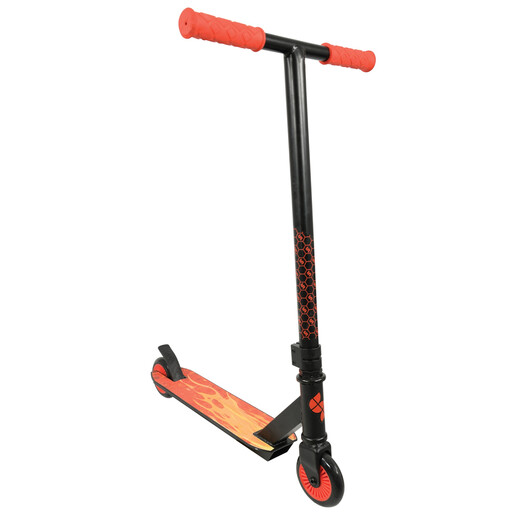
Why This Fits Their Persona: A visual, skatepark-oriented choice for riders aged 8 and over who want a fixed bar and a design suited to learning rotational tricks.
It provides stated wheel, bearing, brake and compliance details instead of only focusing on glow effects and graphics.
100mm 85A PU cast wheels, ABEC-7 bearings, 360-degree handlebar rotation and rear flex brake.
We have compiled a complete, real-time list of products that fully satisfy these strict selection criteria and UK safety regulations.
Most of these complete scooters arrive largely assembled, but the clamp still needs tightening before use. Check the manual and confirm that the handlebars are straight and secure. Before every ride:
For upkeep, wipe the scooter with a damp cloth and keep bearings away from high-pressure water. Store it indoors in a dry place. A scooter used frequently for tricks may need more regular bolt and wheel inspections than one used occasionally on a smooth path.
Yes, provided the model is labelled for beginners and matches the rider’s size. Entry-level scooters with 100mm wheels, a fixed handlebar and a rear brake can help a new rider learn balance, stopping and basic tricks. Supervision is advisable for younger children.
There is no fixed lifespan. Frequency of use, landing technique, surface quality and maintenance all make a difference. Regularly tightening bolts and replacing worn grips, wheels or bearings can help maintain safe operation. Stop using the scooter if the deck, fork or handlebar becomes cracked or noticeably loose.
They can be, but wheel size should be considered alongside scooter weight, handlebar height and the child’s ability. A lightweight stunt scooter with 110mm wheels may suit an older child or teenager progressing in freestyle riding, while a younger beginner may find 100mm wheels easier to control.