For a beef roast you plan to portion for batch cooking, choose an oven-safe leave-in probe to monitor the centre during roasting, an instant-read probe for checks near the end, or a wireless probe if remote monitoring matters to you. Confirm oven-use approval for any probe left in the roast, and take readings at the centre or thickest part with a clean probe.
Who needs which type of probe?
Batch cooks monitoring a whole joint
If you want to follow the centre temperature while a beef joint roasts, consider a leave-in probe explicitly rated for oven use. Lakeland describes its Digital In-Oven Kitchen Thermometer as a model whose probe can remain in the meat during cooking.
Home cooks making a final doneness check
If you mainly test the roast near the end of cooking or while it rests, an instant-read probe lets you check the thickest part without setting up continuous monitoring. It must be removed after the check unless its manufacturer expressly permits oven use.
Cooks who want remote monitoring
If you want to follow a longer roast from elsewhere in your kitchen, a wireless probe may suit you. Check the model’s temperature limits, app compatibility, charging needs and connection in your cooking setup.
What matters when choosing a probe?
Decide whether your main need is continuous monitoring, a quick final check or remote alerts; those lead to different thermometer formats.
| Concern |
What to check |
Who this matters to |
| Continuous monitoring |
Confirm that the probe and cable are rated for oven use and can be positioned with the display outside. |
If I’m roasting a joint for several portions, I want to follow its centre temperature without repeatedly opening the oven; around 45% of consumers put continuous monitoring first. |
| Fast final checks |
Check the stated response time, readable units and whether the probe can reach the joint’s thickest part. |
For a roast I only need to test near the end, I want a prompt reading at its thickest point; roughly 33% of consumers prioritise final spot checks. |
| Remote monitoring |
Check internal and ambient temperature limits, app compatibility and charging requirements. |
While I prepare other food, I’d rather follow the roast remotely and receive alerts; about 22% of consumers place remote monitoring first. |
Mistakes to avoid
-
Assuming any digital probe can stay in the oven
Food Standards Agency guidance for caterers distinguishes ordinary digital thermometers from equipment suitable for oven use. Leaving an unsuitable thermometer in place could damage it.
For continuous monitoring, follow the exact model’s instructions for the probe, cable or wireless unit and its temperature limits.
-
Measuring at the edge of the joint
A reading near the surface may not represent the temperature at the roast’s centre.
Place the probe tip in the centre or thickest part, avoiding the roasting tin and any bone.
-
Using the probe across raw and cooked food without cleaning it
An unclean probe can transfer contamination between checks.
Clean the probe after each use, as GOV.UK advises, and use a clean or disinfected probe for the next centre-temperature check.
-
Choosing wireless features without checking their limits
Charging, connection and temperature limits can affect whether a wireless probe fits your intended roast.
Check the exact model’s internal and ambient temperature ratings, app requirements and stated range against your cooking setup.
Thermometer brands to consider
Lakeland
A reference point if you want a wired probe that stays in a roasting joint during cooking.
- Lakeland describes its Digital In-Oven Kitchen Thermometer as having an oven-safe probe, a -20°C to 250°C range, preset meat temperatures and a timer.
- Check how that model’s probe and cable should pass through your oven door; its oven-use description does not mean the display belongs inside the oven.
Thermapen
A reference point for quick, manual checks near the end of roasting.
- Thermapen UK states that the Thermapen ONE gives one-second readings and specifies accuracy of ±0.3°C within its stated range.
- The Thermapen ONE is an instant-read option, not a substitute for a leave-in oven probe.
OXO
A reference point if display position matters when you make a spot check.
- OXO UK states that its Chef’s Precision Digital Instant Read Thermometer has a pivoting head, displays °C and °F, and reads from -40°C to 150°C.
- Check the model’s instructions before considering any continuous oven use.
MEATER
A reference point for cooks interested in app-based monitoring of a roast.
- MEATER states that MEATER Plus has internal and ambient temperature sensors, with stated maximums of 100°C and 275°C respectively.
- Its stated wireless range of up to 165 ft depends on the cooking environment; check connectivity, charging and app suitability for your setup.
Joybuy thermometer for final roast checks
This instant-read option is for checking a beef roast rather than monitoring it continuously in the oven. Confirm its probe instructions before choosing it for your joint.
 No image available
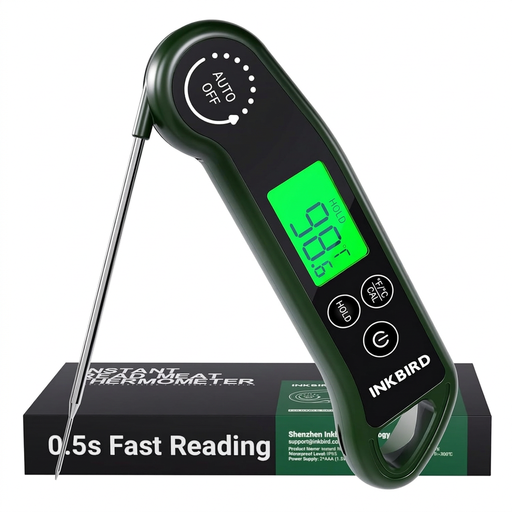
INKBIRD RHT-11K K-Sensor Digital Meat Thermometer, Green
For a final check of a beef roast, confirm how this model’s probe should be inserted to reach the centre or thickest part. Its product title advertises a 0.5-second instant reading and an LCD screen; check its temperature range and oven-use instructions before buying, rather than assuming it can remain in the oven.
Joybuy
Questions about checking a beef roast
Where should I insert a probe in a beef roast?
Put the tip in the centre or thickest part of the joint, as Food Standards Agency guidance describes for a core-temperature check. Avoid relying on a surface reading or letting the tip touch the tin or a bone.
Can I leave an instant-read thermometer in the oven?
Only if its manufacturer explicitly approves that use for the exact model. Food Standards Agency guidance for caterers warns that ordinary digital thermometers are not suitable for oven use; a leave-in probe must be used within its own stated conditions.
How should I clean the probe between checks?
Clean it after each use to reduce cross-contamination, as GOV.UK advises. Use a clean or disinfected probe when you next check the roast’s centre, particularly after contact with raw meat.
Should I treat a whole beef joint like a burger or rolled joint?
Do not assume the same cooking advice applies to all three. GOV.UK food-hygiene guidance distinguishes whole beef roasting joints from rolled joints and minced-meat products; check the guidance and cooking instructions appropriate to your particular cut rather than applying a burger rule to a whole joint.


