
24/7 Customer Support

Free returns

Same-day & Next-day Delivery

Quality Guaranteed

Unlock Your Welcome Offers: FREE Delivery | Up to 80% OFF | Free 30-day JoyPlus trial
Download the APP
Choosing probiotic supplements can feel more complicated than it should be. Labels may highlight impressive CFU numbers, multiple bacterial strains or phrases such as “advanced delivery”, yet these details do not automatically make a product suitable for your routine.
For UK shoppers, the practical choice usually comes down to format, storage, declared potency, dietary requirements and how consistently you can take the supplement. This guide explains the main buying pitfalls and matches several options to different everyday needs.
CFU means colony-forming units, a measure used to indicate live microorganisms. However, one product may state its count at the time of manufacture, while another guarantees a count until its best-before date.
These figures are not directly comparable. A high-CFU probiotics product is not necessarily the right choice if you dislike its format or cannot store it correctly. Check:
Probiotic strains are not interchangeable. Products can contain different combinations of Lactobacillus, Bifidobacterium, spore-forming organisms or fermented cultures. A daily probiotic supplement should be selected around your preferences and intended use, rather than a generic promise of “gut health”.
Someone who travels frequently may value shelf-stable probiotics, while a capsule-averse user may prefer liquid probiotics or dissolvable powder sticks. Those following plant-based diets should check for vegan probiotics, and people avoiding gluten or dairy should read the complete allergen statement.
A product that looks affordable per pack may have a short supply period, multiple daily doses or refrigeration requirements after opening. Liquid products may also need measuring and fridge space, while capsules are usually simpler to carry.
Before buying, calculate the cost per daily serving and confirm whether the routine fits your lifestyle. Consistency is more realistic when the product is easy to use.
Look for the specific bacterial strains, not only a broad species name. A transparent label should identify the organisms included and explain the serving size. Some products combine probiotics with prebiotics such as inulin, fructooligosaccharides or psyllium husk. These ingredients may not suit everyone, particularly those who are sensitive to additional fibre.
A live bacteria supplement may be supplied as a capsule, liquid, powder or chewable-style serving. Choose the format you can take reliably.
There is no single CFU number that suits every adult. Products in this selection range from 500 million CFU per capsule to 50 billion CFU per serving. A larger number should not be treated as an automatic indicator of quality.
Check whether the label recommends one or two servings daily, whether the count is guaranteed until expiry and whether a product is intended for adults only. If you take antibiotics, follow the individual label instructions and ask a pharmacist or healthcare professional about timing. Do not change prescribed medicine based on supplement marketing.
Some probiotic capsules are designed to remain at room temperature, while others may require cool storage or refrigeration. Liquid products commonly need refrigeration after opening and may have a limited period for consumption.
Read the label for:
“Gluten-free” wording should always be checked against the current packaging. For example, Symprove product information describes a gluten-free water-based formula, while also listing germinated barley in its ingredients and allergen information. Anyone with coeliac disease or a barley allergy should verify the supplied label and seek appropriate advice before use.

Why This Fits Their Persona: A straightforward one-capsule daily format suits adults starting a regular routine, including vegans and vegetarians. It can be stored without refrigeration, which is useful for work bags and UK travel.
The label states a minimum of 1 billion live bacteria per capsule at manufacture, making the potency reference clear. It avoids a refrigeration-dependent routine.
Eight listed strains; vegan capsule; no refrigeration required according to the product information.

Why This Fits Their Persona: This option combines a four-strain probiotic blend with 20 mg of fructooligosaccharides, appealing to adults who want probiotics and prebiotics in one daily capsule.
The product lists its four strains, 12 billion CFU total and prebiotic quantity instead of relying only on a general gut-health statement.
12 billion CFU per serving; vegan and dairy-free formulation; 60-capsule pack.
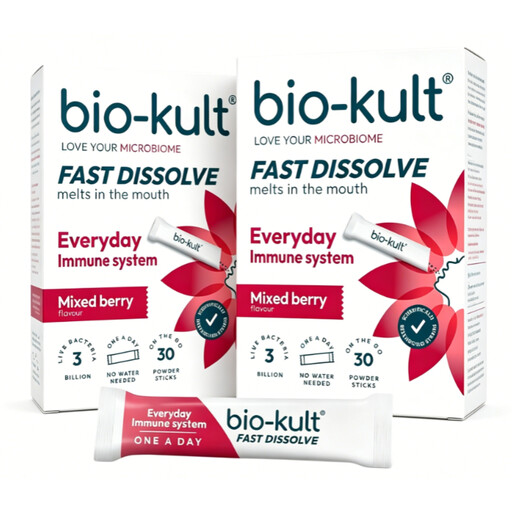
Why This Fits Their Persona: The powder dissolves directly on the tongue, so it needs no water, spoon or refrigeration. Individual sticks are convenient for commuting, holidays and hotel stays.
It avoids the common assumption that probiotic supplements must be swallowed as capsules or mixed with a drink.
3 billion CFU per stick; vitamin C and vitamin D contribute to normal immune-system function; suitable for adults and children over three, subject to label guidance.

Why This Fits Their Persona: This is aimed at adults specifically comparing high-CFU probiotics and synbiotic formulas. It combines six listed cultures with inulin and psyllium husk.
The label separates the individual culture quantities and states that the CFU values apply at the time of manufacture, giving useful context for comparison.
50 billion CFU per listed serving; vegan and free from wheat, gluten, lactose, dairy and soya according to the product information.
We have compiled a complete, real-time list of products that fully satisfy these strict selection criteria and UK safety regulations.
Follow the current product label rather than assuming every capsule needs refrigeration. Shelf-stable probiotics are generally stored in a cool, dry place away from sunlight. Liquid probiotics may need refrigeration once opened, while heat and freezing can affect live cultures. Keep all supplements out of sight and reach of children.
Some products provide label guidance for use alongside antibiotics, but timing and suitability vary. Certain capsule labels recommend separating doses by two to three hours. Ask a pharmacist or healthcare professional for advice, particularly if you take other medicines, have a medical condition, are pregnant or breastfeeding or have a compromised immune system.
Check the best-before date and the storage instructions. The usable period after opening may be shorter than the unopened shelf life, especially for liquids. Rather than buying a large pack automatically, choose a quantity you can use within the stated period and take it only as directed. Food supplements should complement a varied, balanced diet and healthy lifestyle.