
24/7 Customer Support

Free returns

Same-day & Next-day Delivery

Quality Guaranteed

Unlock Your Welcome Offers: FREE Delivery | Up to 80% OFF | Free 30-day JoyPlus trial
Download the APP
As a professional technician or workshop owner, your diagnostic tool is the cornerstone of your efficiency and profitability. The right device can pinpoint complex faults in minutes, while the wrong one can become a costly paperweight. With the market flooded with options making bold claims, it's easy to fall into common traps that waste both time and money. This guide cuts through the marketing jargon to focus on what truly matters when selecting a professional car diagnostic tool for your UK-based work.
Before looking at features, it's crucial to recognise the pitfalls that catch out even experienced buyers.
To ensure your investment pays off, focus on these three non-negotiable technical capabilities.
Bi-Directional Control (Active Tests): This is the defining feature of a professional tool. Unlike basic code readers that only receive data, a bi-directional OBD2 scanner can send commands to a vehicle's modules to test individual components. For example, you can command the ABS pump to cycle during a brake bleed, activate the cooling fan to test its operation, or switch an injector on and off to diagnose a misfire. This active test diagnostic tool capability is essential for accurately locating faults without having to swap parts.
Comprehensive Service Functions & ECU Coding: A professional workshop needs more than just an oil light reset. Look for a tool that offers a wide range of maintenance functions, often marketed as a 31+ reset service tool. This should include Electronic Parking Brake (EPB) release, Steering Angle Sensor (SAS) calibration, DPF regeneration and injector coding. Furthermore, a proper ECU coding tool is vital. It allows you to reprogram adaptive data for components after a replacement, update vehicle software and in some cases, enable or disable factory-fitted options.
Modern Protocol Support (CAN FD & DoIP): Vehicle technology is constantly evolving. Controller Area Network with Flexible Data-Rate (CAN FD) and Diagnostics over Internet Protocol (DoIP) are the new standards for high-speed communication in modern vehicles. A CAN FD DoIP scanner is essential for working on post-2020 vehicles from manufacturers like General Motors, Volvo, Land Rover and BMW. Purchasing a tool without this support in 2026 means it is already obsolete for a growing portion of the cars you'll see.
We've matched some devices to the distinct needs of UK automotive professionals.
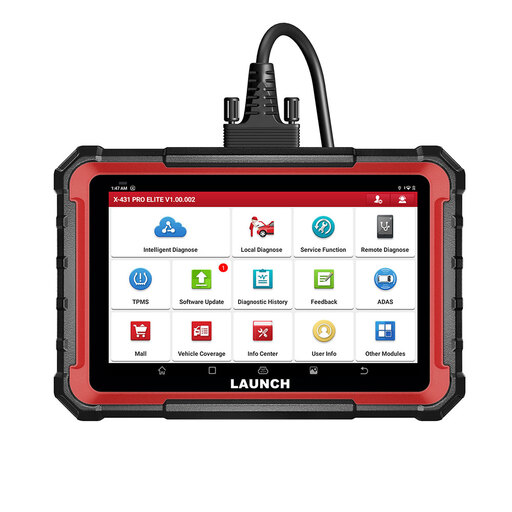
Why This Fits Their Persona: This user needs a single, powerful device to handle the wide variety of makes and models that come into their garage. The LAUNCH X431 PRO ELITE is built for this, offering OE-level diagnostics that cover everything from routine servicing to complex module programming.
It directly addresses the pitfalls with full CAN FD/DoIP support, deep bi-directional controls beyond just reading codes and advanced ECU coding. The update structure is transparent, with two years of updates included.
Its main advantage is the sheer breadth and depth of its vehicle coverage and diagnostic functions, including VAG guided functions and compatibility with expansion modules for tasks like ADAS calibration.
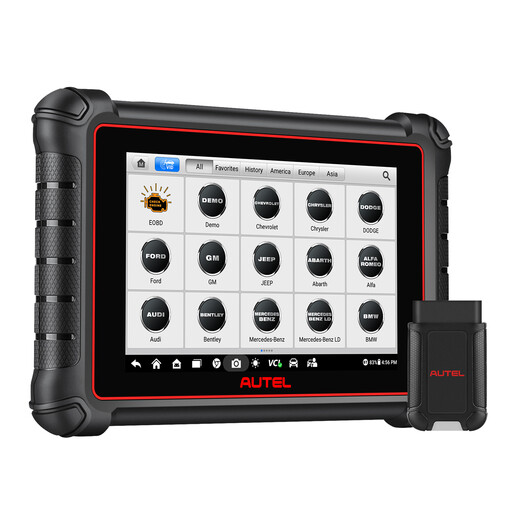
Why This Fits Their Persona: Portability and power are key. This user needs a robust tool that isn't tethered to a bay. The wireless Bluetooth VCI allows them to work freely around the vehicle, whether in a client's driveway or their own garage, without sacrificing professional-level functions.
It offers a comprehensive suite of over 40 service functions and full bi-directional control. Crucially, it supports CAN FD/DoIP protocols and includes FCA AutoAuth access, avoiding the hidden access cost trap for modern Fiat, Chrysler and Jeep vehicles.
The combination of wireless freedom via the MaxiVCI V150 and a strong feature set makes it an excellent all-rounder. The Android 11 OS and responsive touchscreen provide a modern, efficient user experience.
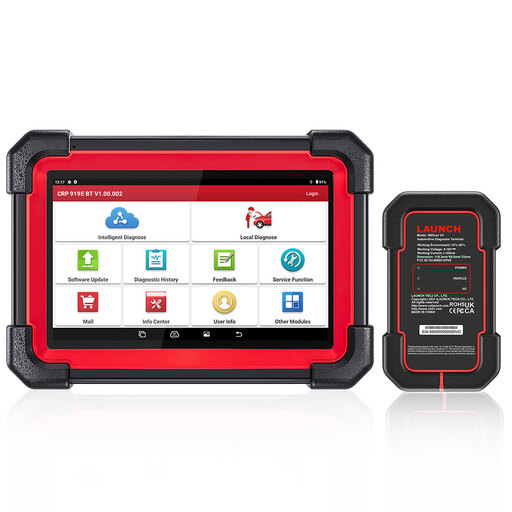
Why This Fits Their Persona: This user needs access to professional-grade features to build their business but must be mindful of initial investment. They require a tool that delivers a strong return without the premium price tag of a top-tier device.
It provides the essential professional features—Active Test, ECU Coding and 31+ reset services—at a more accessible price point. It also includes CAN FD/DoIP support, ensuring it's not obsolete straight out of the box.
Its value proposition is excellent. You get a wireless, future-proofed diagnostic tool with a comprehensive range of functions that cover the vast majority of tasks a growing workshop will face, all without over-investing.
We have compiled a complete, real-time list of products that fully satisfy these strict selection criteria and UK safety regulations.
1. How long does a professional car diagnostic tool typically last before it becomes obsolete? The physical lifespan of a quality tool can be many years, but its professional relevance is determined by its ability to communicate with new vehicles. A tool's hardware is the limiting factor. A device that supports modern protocols like CAN FD and DoIP today should remain relevant for at least 3-5 years. Tools without this support are already functionally obsolete for many newer cars, regardless of software updates.
2. Are there ongoing costs with these tools after the initial purchase? This depends on the manufacturer's policy. Most professional-grade tools, including those recommended here, come with one or two years of included software updates. After this period, you can typically purchase an annual subscription to continue receiving updates for the latest vehicle models and diagnostic functions. The tool will usually continue to work on the cars it already covers even if you don't renew, but you won't get new coverage. Always verify the update policy before purchasing.
3. Can I use a single professional scanner for both petrol and 12V diesel vehicles in the UK? Yes, absolutely. A key function of an automotive scanner for mechanics is its versatility. Professional tools are designed to cover both petrol and 12V diesel passenger cars, SUVs and light commercial vehicles. They include diesel-specific functions such as DPF regeneration, AdBlue resets and injector coding. However, they are not designed for 24V systems found in heavy-duty lorries, which require different, specialised equipment.